Taipei commuters criticize lack of seats, handrails in streamlined MRT redesign
Taipei commuters criticize lack of seats, handrails in streamlined MRT redesign
2026-08-26
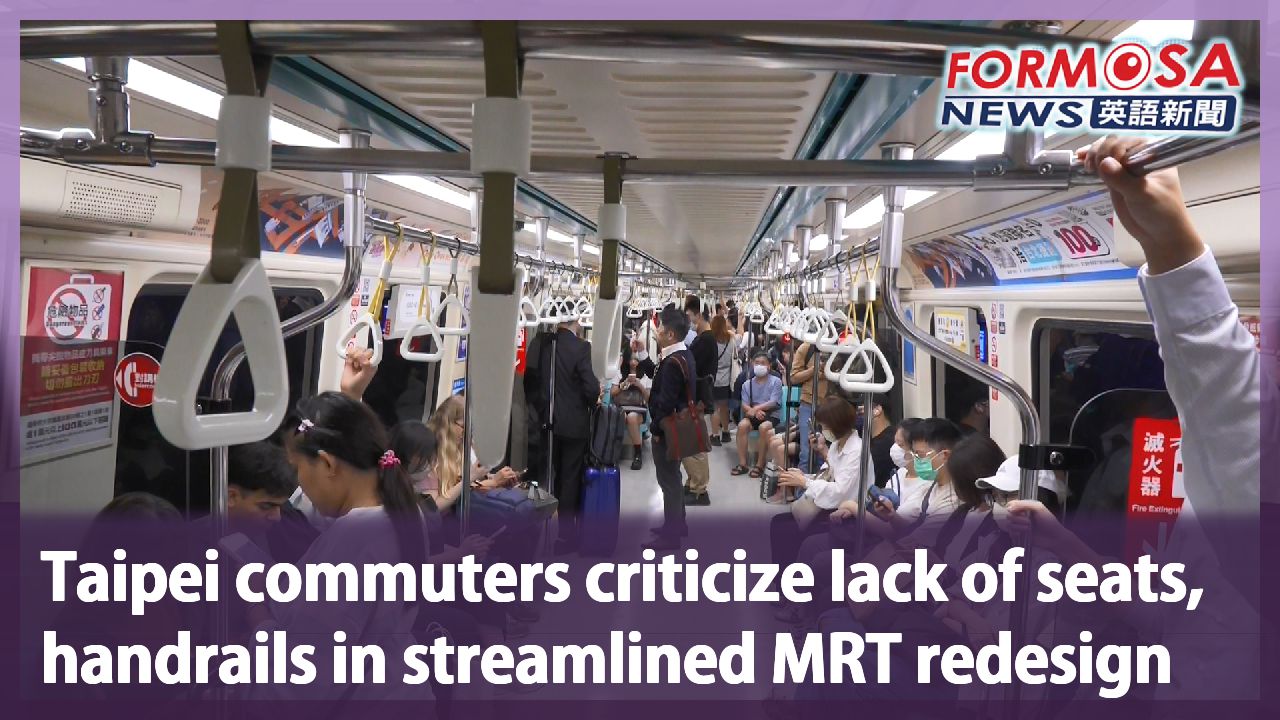
To ease congestion during rush hour, the Taipei MRT has redesigned some of its cars to optimize interior space. The new layout has done away with some seats and the central poles, and added a family zone to give people with strollers, wheelchairs, and luggage more room. But after these cars were rolled out, passengers began to complain. Some say the hanging straps are hard to use. Parents also say that while there may be more space for strollers, there’s now nowhere for them to sit.
The MRT is crammed with commuters every morning, crushed against each other during rush hour as more people hunt for gaps to board. To give more space, the Taipei Metro introduced a more spacious redesign that does away with some seating and the center poles. But after it was rolled out, many riders found it didn’t make things any easier.
MRT rider
Prefers having center pole
I want it to stay like it was. I don’t think it’s a good idea to remove the center pole.
MRT rider
Doesn’t mind the change
I don’t think it makes much of a difference if a few more people stand. I actually don’t like the hanging straps and prefer to hold onto the side rail.
Riders said the original center pole could be held by many people at once. But the new hanging straps are more difficult to use for shorter passengers who have to keep their arm raised, posing a danger if they lose their balance and fall.
Lin Yi-yun
FTV reporter
Some of the carriages now have these family zones. But riders have complained that this area that used to fit three standing and three sitting passengers now only fits three standing riders. It may better accommodate strollers, but there’s nowhere for the parents to sit.
MRT rider
Doesn’t like the change
I don’t think it’s good. When your child gets fussy, it’s harder to handle them. And kids don’t have a way to keep themselves stable, so they end up swaying around.
The space-optimized carriages were introduced last October with their fewer central posts, adjusted seating, new stroller area, and more horizontal handrails. In response to the criticism, the Taipei Metro said that through train scheduling, station management, and space optimization, it aims to keep expanding capacity and enhancing service quality during peak hours. Some people prefer more standing room, while others need more handrails and seats. Finding common ground will remain a challenge as the metro seeks to keep improving for everyone.
#TaipeiMRT #publictransit #metro #trains #metrodesign #traindesign #MRT #spaceoptimization #rushhour #commute
For more Taiwan news, tune in:
Mon to Fri at 9:30 pm on Channel 152
Tue to Sat at 1 am on Channel 53
不買單! 北捷推空間優化車廂 民眾:扶手難抓.沒比較好
2026-08-26
為了紓解尖峰時段擁擠,北捷推出「空間優化列車」,拆除部分座椅和中央立柱,還增加親子友善空間,希望讓嬰兒車、輪椅和大型行李有更多活動空間。只是上路後,不少通勤族卻認為「扶手反而不好抓」,也有家長說,嬰兒車有地方放了,陪同的大人卻沒位置坐,引發討論。
上班時間一到,捷運車廂塞得滿滿滿,通勤族每天人貼著人,想擠上車都得先找空隙。為了讓車廂多一點活動空間,北捷推出空間優化列車,拆除部分座椅及中央立柱,但實際上路一段時間,部分通勤族卻發現沒有比較方便。
[[民眾]]
“我們希望維持原來的,中間桿子拆掉是我覺得是不方便。”
[[民眾]]
“我覺得多站幾個沒有差吧,我反而不喜歡拉環,我喜歡旁邊(中央立柱)這樣。”
有民眾認為原本的中央立柱可以讓多人一起抓,如今改成手拉環,對個子比較嬌小或是長時間得把手舉高的乘客來說,列車一旦加速煞車沒抓穩,相當危險。
[[民視記者 林意芸]]
“台北捷運在部分車廂內打造親子友善區,就有民眾在網上控訴,原本能坐3個人站3個人,現在只能站3個人,甚至親子友善區是為了要放嬰兒車,但媽媽卻沒地方坐。”
[[民眾]]
“我覺得不好,因為有時候小孩如果有吵鬧什麼的,我覺得比較照顧比較不方便。像是小孩子根本沒辦法支撐,會搖搖晃晃。”
北捷從2025年10月推出車廂空間優化,包含移除部分車門中央立柱、增設嬰兒車停放區、調整座位配置,以及新增橫向扶桿。對此,北捷表示,希望透過行車調度,車站管理,及車廂空間優化,持續擴充捷運運輸能量、提升尖峰時段服務品質。有人希望多一點站立空間,也有人需要更多扶手和座位,如何找到最大公約數,恐怕也是北捷後續優化一大難題。
更多新聞內容,請鎖定:
民視台灣台(152頻道)週一至週五晚上9:30
民視新聞台(53頻道)週二至週六凌晨1:00
Related News