Taiwan space industry ready for takeoff
A new space race has gripped the world, with many nations pursuing advanced satellite networks. In May of last year, Taiwan passed a first-of-its-kind bill to drive growth in the space industry. What’’s Taiwan doing in space and does it have a future in the industry? We find out in our Sunday special report.
In 1957, the Soviet Union kicked off the Space Age with the launch of the world’s first artificial satellite. Since then, more than 3,000 satellites have been launched into orbit. Here on Earth, we have become dependent on satellites for many services, including GPS navigation, phone tracking, meteorological observation and television broadcasting.
In the past, it cost billions of dollars to manufacture a single satellite. Launching the satellite on a carrier rocket would further rack up the bill. The cost of launching a 300-kilogram satellite started at NT$900 million.
Dr. Chang Guey-shin
Former National Space Organization head
Space technology used to be a very expensive industry, and most firms were supported by the government. Satellites seemed like a nearly unreachable goal. But that’s been changing in recent years. The first factor behind this change is the miniaturization of technology. There’s been progress in the miniaturization of satellite technology. The second is the reutilization of launch vehicles. As we all know, SpaceX is developing reusable launch systems.
SpaceX is the largest commercial satellite operator in the world. The firm is developing a reusable orbital launch vehicle to cut the manufacturing cost for single-use carrier rockets. With satellite manufacturing and launching getting cheaper each year, new possibilities are springing up in the space tech sector. Companies and countries around the world all want a piece of the pie, particularly when it comes to low Earth orbit satellites.
There are many types of satellites, which perform different functions at varying orbit altitudes. Generally speaking, there are three types of orbits: low Earth orbits, medium Earth orbits, and geosynchronous orbits. Low Earth orbits are those at an altitude below 2,000 kilometers, and they’re mainly used for telecommunications.
Dr. Chang Guey-shin
Former National Space Organization head
There are several advantages to positioning a satellite at a low altitude to communicate with Earth. Firstly, it doesn’t require as much power to launch them. Secondly, they are very close to Earth, so the delay in transmission is very low. The downside of low Earth satellites is that they are not like geosynchronous satellites, which stay on top of you all the time. Instead, you need to have thousands of them in orbit to have a connection at all times.
In 2015, SpaceX announced Starlink, an ambitious plan to build and operate a constellation of about 12,000 low Earth orbit satellites by 2024. The company says the dense network of satellites can offer satellite connectivity to every part of Earth, making it a key step toward 6G networks.
In Taiwan, transmission towers are used to deliver data domestically across 4G and 5G networks. But if a Taiwan user connects to the internet outside Taiwan, all the data has to be transmitted via submarine communications cables. Currently, the whole world’s internet is connected by underwater fiber optic cables. But low Earth orbit satellites could soon be a viable option for global telecommunications.
Tsai Tung-hung
National Space Organization
With this technology, transmission would not be restricted to one plane. You’d be able to connect upward as well, with satellites that link up to each other. The satellites move very fast, at about 500 or 600 kilometers per hour, or about 7 kilometers per second. That’s like traveling from Hsinchu to Taipei in just 10 seconds. So data can be delivered very fast.
Switching from transmission towers on Earth to satellites in space. It’s an exciting proposition that could turn our two-dimensional telecommunications network into a three-dimensional network, covering all gaps in coverage.
Dr. Wu Jong-shinn
National Space Organization head
Before, if you were up in the mountains, you may not have had a connection. Maybe there wasn’t a transmission tower nearby. The network may have had gaps. But if you had tens of thousands of satellites above you, you could be here at the National Space Organization or on the Himalayas and still have a direct connection.
In a future powered by the internet of things, we might rely on self-driving cars and airplanes, which will need a low Earth satellite connection at all times. According to U.S. financial services company Morgan Stanley, the global space industry could surpass NT$28 trillion in revenue by 2040. In 2021, President Tsai Ing-wen said that Taiwan should secure a strategic position in the sector.
Tsai Ing-wen (Sept. 14, 2021)
President
At present, countries around the world are proactively making efforts to establish themselves in space. And in the coming 10 years, we expect to see the launch of tens of thousands of low Earth orbit satellites. It is time that we start proactively working on our space program.
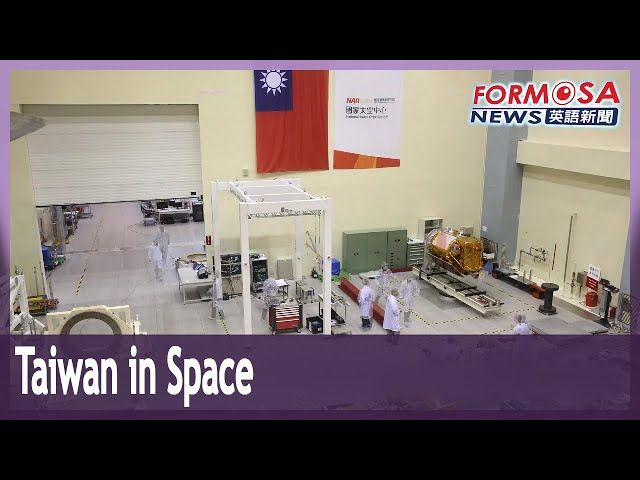
Located in Hsinchu Science Park, Taiwan’s National Space Organization has been in operation for 30 years. It’s the only agency in Taiwan specializing in space tech.
Taiwan launched its first satellite in 1999. In 2017, the National Space Organization launched its first domestically developed satellite, the Formosat-5, from a site in the U.S.
Dr. Chang Guey-shin
Former National Space Organization head
The Formosat-5 is an optical remote sensing satellite. It produces satellite images. These images can be used for land development or during natural disasters. Of course, they can also be used for national security purposes.
In 2019, Taiwan’s Formosat-7 satellite was launched into space, in a collaborative venture with the U.S.
Dr. Wu Jong-shinn
National Space Organization head
This satellite has made huge contributions to Taiwan. It’s improved our typhoon and meteorological predictions by 6% to 8%. That’s considerable accuracy in the meteorology sector.
Formosat-5 and Formosat-7 are testament to the prowess of Taiwan’s space capabilities. Since 2021, the National Space Organization has made a big push in low Earth orbit satellites. In collaboration with the Industrial Technology Research Institute, it’s developing a low Earth orbit telecommunications network called Beyond 5G. The first satellites could be launched as early as 2025.
Dr. Wu Jong-shinn
National Space Organization head
Taiwan may develop a few dozen or a few hundred satellites to create a public network that the government and private firms can use. It would be especially useful for the Internet of Things and fishing vessels, among other applications.
The National Space Organization hopes to develop a public telecommunications network of its own using low Earth orbit satellites. Such a network would help Taiwan avoid what happened to Ukraine, which lost its internet when Russia attacked.
Dr. Wu Jong-shinn
National Space Organization head
Currently our internet runs through submarine cables, which can be damaged easily. If they broke, how else could we communicate with other countries? We need satellites. And not just one satellite, but a bunch of them. With a bunch of them, there is nothing to be afraid of. Using an intercontinental missile to take down one satellite would cost NT$1 billion. At such a cost per satellite, it’s just not worth it for the attacker.
In May 2021, the Legislative Yuan passed Taiwan’s first law for the space industry, called the Space Development Act.
Chung Chia-pin
Lawmaker
The Space Development Act opens by saying that peace is the goal of our activities in space. Taiwan is developing this sector so that we can provide services to the whole world and do business together.
The act states that the relevant agencies will establish a national launch center – that is, a base for launching rockets.
In April 2015, National Yang Ming Chiao Tung University’s Advanced Rocket Research Center launched a small rocket from Hsinchu’s Xiangshan Wetlands. Although Taiwan doesn’t yet have a rocket that can push satellites in orbit, several research agencies have launched sounding rockets with success.
Wei Shih-sin
NYCU Advanced Rocket Research Center
Rockets that can carry satellites are very distinct. They tend to be quite large, because they have to fly high and go into orbit. The controls are not quite the same. Sounding rockets have fins for stability during the flight, and the technology-related costs are lower. They’re kind of like fireworks.
The Ministry of Science and Technology has established a small launch site in Macaran, a village in Pingtung’s Mudan Township. The ministry hopes to one day expand the venue into a world-class launch site.
With so many contenders in the modern-day space race, experts say Taiwan should move off the beaten path.
Bill Chang
Taiwan Space Industry Development Association
Regarding the issue of low Earth orbit satellites, there is already a lot of buzz surrounding Starlink, which is operated by a dominant company. So I don’t think that Taiwan should take the route of launching low Earth orbit satellites of its own. Manufacturing our own telecommunications satellites network is something that requires industry competitiveness. So I think we should turn our sights to areas where infrastructure is still lacking.
Tsai Tung-hung
National Space Organization
We don’t have to think of it as competing against Starlink. It’s more about running a program that creates momentum in Taiwan’s space industry, helping it to enter new fields.
But already, SpaceX’s satellite project wouldn’t be possible without Taiwan. Peek inside their satellites, and you’ll find plenty of parts made by Taiwanese firms. Today, Taiwan is a key supplier for SpaceX, and it has the potential to make systems of its own, to cement its position in the global supply chain.
The nation’s tech talent is ready for takeoff, to make sure Taiwan doesn’t miss out as mankind expands into space.
2022-05-01