Researchers and an entrepreneur talk about their efforts to keep fire fishing alive
Researchers and an entrepreneur talk about their efforts to keep fire fishing alive
2022-09-18
Last week, we heard from fire fishermen who use torches to attract fish at night. Their unique fishing method relies on a property of calcium carbide that causes it to ignite in water, producing a small amount of light. With this traditional fishing technique near extinction, a handful of local fishermen and researchers are working together to preserve what they see as an important cultural asset. Tonight in part two of Fishing with Fire, we hear from these researchers, and learn what they are doing to keep fire fishing alive.
Chien Shih-kai, 28, is a fire master. Five years ago he decided to come back to Jinshan to work on a fire-fishing boat. Unfortunately, his timing couldn’t have been worse.
Chien Shih-kai
Fire master
In the past, when there were more fish in the water, we could pull in about 400 to 500 baskets with our nighttime and morning hauls combined. That year I came back we were lucky to bring in about 80 baskets. The situation is really bad. Before, 80 baskets in one day would already be considered a very small amount. Nowadays, we might pull in just over 80 baskets over the course of five or six days.
Chang Cheng-liang
Professor
According to research by Professor Lee Ming-an at National Taiwan Ocean University, water temperatures along the northern coast of Taiwan have gone up quite a bit. When the water warms up, there are some fish that aren’t able to deal with the higher temperatures, and they simply won’t come near the shore.
After the 1970s the temperature in waters near Taiwan rose continuously, going up be as much as 2 degrees in waters near the northern coast. Researchers believe this may have influenced the behavior of fish. To make matters worse, 80% of commercially fished species worldwide have been overfished over the past half century. For the past decade, Taiwan’s near-water fisheries have seen catches drop to half previous numbers. Then, in 2016, stocks of Japanese sardinella near New Taipei City’s Shihmen District were further impacted by an oil spill.
Kuo Ching-lin
Cultural historian
On March 10, 2016 there was an oil spill from a TS Lines cargo ship that ran aground. Before that accident there was a previous one in the same place – near the Temple of the Eighteen Lords. Eight years before the TS Lines accident there was a Panama-registered cargo ship that sank in that area and leaked oil. From that experience, we learned that it takes at least five years for the affected area of the ocean from such an accident to be restored, to recover.
Facing the challenges of climate change, overfishing and pollution, fire fishers once again find their livelihood imperiled.
Chien Kun
Chien Shih-kai’s father
I told him that things are not good. It’s not good to get into the fisheries now. It’s not just our own livelihoods, you have a crew of six, seven or eight fishers on the boat. You have to take care of those people. If you can’t afford your livelihood, you will be under great stress. If you really can’t make it work, don’t drag others down with you.
On the shoulders of this young person is the weight of six or seven families. Whether to give up or keep fighting is a tremendously difficult decision.
Luckily, there are others like him who want to fight on.
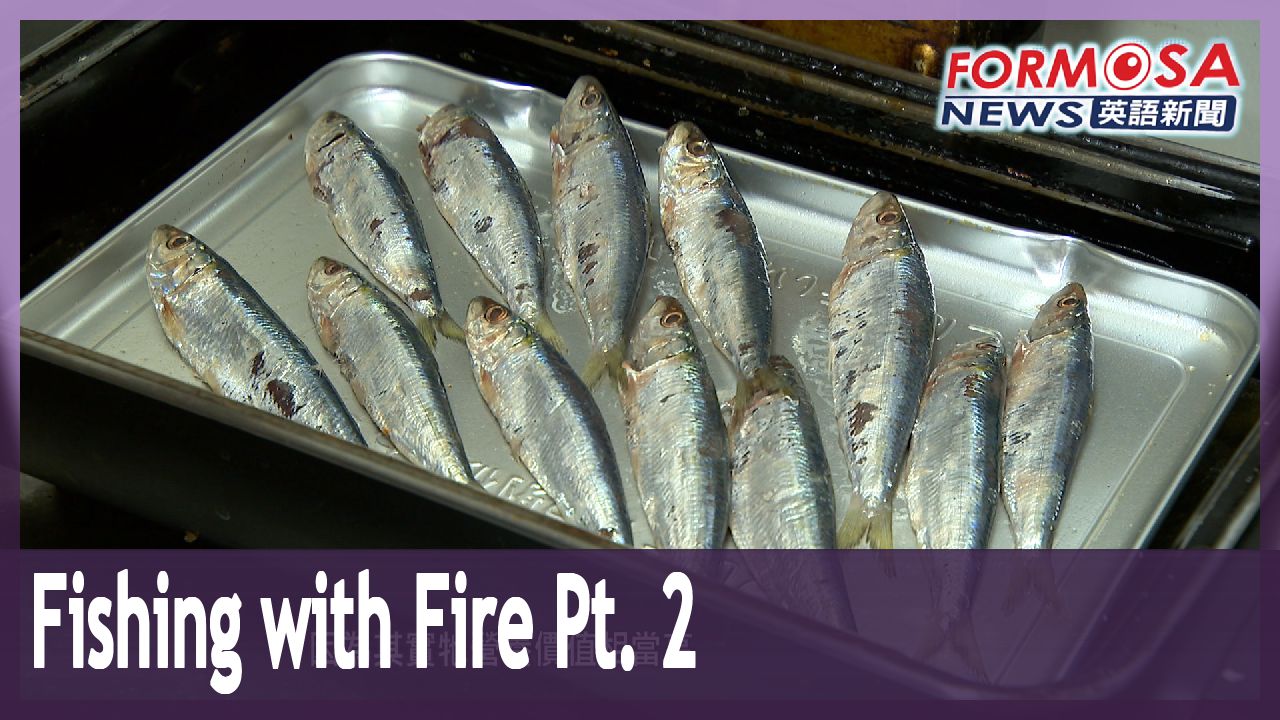
In this container is a small catch of Japanese sardinella. A small group of local fire fishers hope to create a new market for the fish by working with a Japanese restaurant.
Lai Chia-hao
Entrepreneur
By working with a local Japanese restaurant we are developing dishes with the fish. We hope that one day it can gain a following just like Wanli Crab. When people visit New Taipei’s Wanli District they eat Wanli Crab, and we hope they will come to Jinshan to eat Japanese sardinella dishes, when the fish is in season.
Currently, Japanese sardinella are sold to fish farmers as feed for groupers, fetching between NT$4 and NT$5 per catty–about 600 grams. Some feel this to be a wasteful use of the nutritious Japanese sardinella.
Chang Yu-wei
National Taiwan Ocean University
The fatty acids of this fish contain omega-3 in the form of EPA and DHA. These things are beneficial to the brain and nervous system. The Japanese sardinella has roughly 4.7 grams of EPA per serving and 6.5 grams of DHA. This is higher than the standard amount found in other fish, including deep-sea fish.
Aside from its benefits when used in cuisine, Japanese sardinella can also be used in nutritional supplements.
Lai Chia-hao
Entrepreneur
There was a period of a few years when chicken essence was a hot product. Later on this was followed by sea-bass essence, milkfish essence and beef essence. If we could apply the same high-temperature, high-pressure process to Japanese sardinella to extract its essence, its value would instantly go up.
Chang Yu-wei
National Taiwan Ocean University
We can extract the essence from the fish, and the solids that are left behind are rich in protein, as well as containing some calcium. Protein and calcium are nutrients that the body needs very much. We could go in the direction of a healthy seasoning–a local seasoning from Jinshan, made from Japanese sardinella.
If the value of Japanese sardinella goes up, fishers will no longer have to rely on large catches. In fact, there is value not only in the products that come from fire fishing, but also tourism value in the fishing experience itself.
Nighttime fishing for squid and beltfish, as well as barbecues at sea are all really popular. During the fire-fishing season, people can get close up to enjoy this centuries-old fishing method – that’s a big selling point.
Lai Chia-hao
Entrepreneur
We arrange for tourism boats and fishing boats to have some close interaction. Fishing boats can even provide their catches to the tourist boats. Before we set an itinerary, we negotiate the distribution of profits, so that a portion of profits goes to the fishing boats.
Through some innovative thinking, tourism revenue gets shared with fishers, so that everyone in the local community can prosper together. Since 2017, regional tourism officials have been arranging a fire-fishing festival at the start of every summer. They hope to call more attention to this traditional fishing method.
On shore, tourists gather, waiting eagerly to snap photos of fire fishers at work.
Captured within this majestic scene is a love and respect for the ocean that was shared by Jinshan’s earlier inhabitants.
Chang Cheng-liang
Professor
The torches they use are not that bright. So that’s why we say that only the fish that are willing to be caught are caught. When the school of fish is disturbed, only those that jump out of the water are caught, while the others remain under the water to continue on. That’s why we say this is a friendly method of fishing.
The government promotes environmentally friendly agriculture, and offers incentives and assistance toward this aim. Fire fishing is both environmentally friendly, and a part of cultural heritage. However, the government’s support toward protecting this practice has not kept pace with its gradual extinction.
Kuo Ching-lin
Cultural historian
So far nothing substantial has been done to protect the four remaining fire-fishing boats. In accordance with regulations, the city’s Cultural Affairs Department has done three things: they’ve made video recordings of fire fishing, and made written records of it. They’ve also started the third step, which is to preserve the practice, or to transform it into something more sustainable. They are still in the process of researching this last step.
Protecting this important cultural asset should not be left to fishers to do themselves. If the government doesn’t invest in protecting fire fishing, it may one day be nothing more than a spectacle for tourists.
Chang Cheng-liang
Professor
In the early days, this method of fishing with a torch was used all over the world. At present, the only place that still has fishers who use this method for income-generating fishing is Taiwan. If fire fishing is used only for performances, and if you don’t pass on this tradition or rely on it for your livelihood, it will be no different from what happens to language: left unused, it slowly disappears. If used only for performative purposes, it will be hard to preserve this tradition, because it will be too far removed from everyday life.
Chien Shih-kai
Fire master
I feel there is still hope. I feel like, if we gave up on it, that would be quite a pity.
Kuo Ching-lin
Cultural historian
We hope this fishing method won’t disappear in our generation. The desire to continue the hard work of preserving it is what makes these locals so special. Whatever we do, we just don’t want to be wasteful, we don’t want to see so many things disappear in our lifetime.
Will the next generation know about fire fishing, and about their ancestors’ special knowledge of the sea? The passion of fishers in Jinshan today gives hope. Researchers and entrepreneurs are also searching for new opportunities for this industry. Whether their combined efforts can keep the tradition of fire fishing alive remains to be seen.
被青鱗魚放鳥的漁民(下)
2022-09-18
上個禮拜,我們帶您看到百年魚法「蹦火仔」令人讚嘆的美、還有它所歷經的興衰,然而,因為海洋環境改變,漁獲量一年比一年低,是要放棄,還是堅守,對許多漁民來說,真是個兩難的課題。這個單元,我們要帶您認識一位漁民簡士凱,他和幾位返鄉青年,決心要復興蹦火仔。他們將捕獲的少量青鱗魚送到當地日本料理店,開發成特色料理,或研發成高單價的滴魚精,要改變青鱗魚過去經常被賤賣、或充當魚飼料的窘境。繼續帶您看,他們是怎麼做的。
28歲的簡士凱,是蹦火船火長,5年前,他決定返回金山接手家裡的蹦火船,然而這卻是個最糟糕的時間點。
[[簡士凱 火長 新北市金山蹦火船]]
“之前正常來講,魚多的話,一天晚上跟早上,加起來都有四、五百簍,那年抓下來只有八十幾簍而已,這個是算很差了,以前一天八十幾簍已經算很少了,現在是五、六天,八十幾簍”
[[張政亮教授 歷史地理學家]]
“根據海洋大學李明安教授他所做的研究,在台灣整個北海岸的地方,其實水溫都升高蠻高的,因為水溫一高,其實有些魚,牠的耐熱度不夠 ,自然而然就不會靠近”
1970年代之後,台灣附近海域持續升溫,而北海岸一帶溫度升高將近兩度,這可能影響了魚群習性,此外,過去半個世紀,全球80%的經濟魚種過度捕撈,過去十年台灣的沿岸漁業總體漁獲量已減少將近一半,雪上加霜的是,2016年每年青鱗魚靠岸的起點,石門十八王公海岸,又發生了油輪的污染事件。
[[郭慶霖 新北市金山文史工作者]]
“2016年3月10日,德翔台北輪的油污事件,在這事件前,其實在同位置,十八王公這個地方,8年前曾發生巴拿馬籍油污事件,依那事件的經驗,至少要5年,它(海洋)才能慢慢地修復,復育”
暖化,過漁,污染種種因素,讓蹦火仔再次陷入困境。
[[簡坤 簡士凱父親新北市金山蹦火船船東]]
“我跟他說不好,現在漁業不好經營,不是只有我們自己生活,有六、七、八個船員,你還要照顧這些船員,如果不能生活,自己心裡也難過,如果真過不下去 ,就別拖累別人”
這年輕人肩上,有著六、七個家庭的重擔,要放棄,還是堅守,怎麼都是困難的決定。
所幸,也還有人也跟他一樣不想放棄。
盒子中裝的,是捕獲的少量青鱗魚,幾位想復興蹦火仔的當地人,把牠送到日本料理店,想替牠尋找新活路。
[[賴家華 創辦人 北海創生論壇]]
“跟在地的日本料理店合作,去開發青鱗魚的料理,我們也希望有一天,牠可以像萬里蟹一樣,我來到萬里就是吃螃蟹,我青鱗魚季來到金山,就吃青鱗魚的料理”
目前青鱗魚當石斑魚飼料,一台斤只賣4到5元,十分可惜,因為其實牠營養價值相當高。
[[張佑維 所長 海洋大學食品管理所]]
“牠脂肪的脂肪酸裡面,富含了EPA跟DHA這兩個東西,我們知道對腦神經是有幫助的,尤其是青鱗魚的EPA大概有4.7 ,DHA大概是6.5左右,這個都是在標準以上 ,跟深海魚來比的話,牠也不輸”
而除了餐桌上的料理,青鱗魚也適合化身營養品。
[[賴家華 創辦人 北海創生論壇]]
“過去幾年熱銷的滴雞精,後來衍生有鱸魚精 虱目魚精,也有牛肉精這類的東西,如果青鱗魚可以透過高溫高壓的設備去滴出魚精之後,牠的身價瞬間就往上提了”
[[張佑維 所長 海洋大學食品管理所]]
“我們去萃取魚精,牠剩下的固形物,富含蛋白質還有一些鈣,蛋白質跟鈣其實也都是人非常需要的營養素,我們可以朝健康機能性的調味粉方向走,我們就是打出金山本地產的青鱗魚調味粉”
一旦青鱗魚價值提升,漁獲就不需要再衝量,而除了產業加工之外,其實蹦火仔本身也很具觀光財。
夜釣小卷,白帶魚,海上BBQ都很受歡迎,在蹦火魚季的時候 ,能近距離欣賞百年漁法,更是一大賣點。
[[賴家華 創辦人 北海創生論壇]]
“讓這些觀光船跟漁船可以近距離接觸,甚至是直接由漁船提供漁獲到觀光船上,在我們形塑這個遊程之前 ,裡面已經談好一定的比例分配,把這樣的利潤分配到蹦火漁船身上”
將觀光收益部分挹注到蹦火船上,讓地方可以共生共榮, 2017年起,每逢初夏時分,北海岸風景觀管理處都會舉辦「金山蹦火節」,持續推廣蹦火仔的知名度。
岸上黑壓壓的一大片觀眾,與一個個等著捕捉畫面的鏡頭。
其實蹦火的美之中,還藏著一份先民對大海的友善與尊重。
[[張政亮 教授 歷史地理學家]]
“他用的火把,其實它的燈光瓦數是很低的,那它怎麼補呢我們叫「願者上鉤」,他驚擾這些魚群之後,跳上來的,他才抓,不跳的,潛到裡面的就不抓,這是為什麼友善,原因就在這裡”
在作物生產上,政府大力推廣環境友善的農法,也給予小農種種獎勵與輔導,反觀蹦火仔是友善漁法,又是新北市的文化資產,但政府對這文化資產的維護 ,似乎趕不上它的消逝。
[[郭慶霖 新北市金山文史工作者]]
“到目前為止,文化資產保存對於四艘蹦火船是沒有實質幫助,依照規定,文化局做了三件事情,第一個影像紀錄,第二個文字記錄,第三個目前正在進行的,就是如何保存維護或甚至轉型,這個還在研究當中”
文化資產的保護,不能只靠漁民餓肚子苦撐,若政府未即時挹注資源,蹦火仔未來可能只淪為觀光秀。
[[張政亮教授 歷史地理學家]]
“早期這種所謂的火把漁業,其實全世界都有,目前真正有在實施,真正在從事漁撈作業的大概只剩下台灣,純粹做觀光表演的話,如果沒有去傳承它,或生計不再靠它,其實就跟語言一樣,你沒有在用,慢慢地,這種純觀光很難去做完善的保存,因為它跟生活脫節了”
[[簡士凱 火長 新北市金山蹦火船]]
“就是覺得還有希望,就覺得(放棄)好像也蠻可惜的”
[[郭慶霖 新北市金山文史工作者]]
“希望這樣的漁法,不要在我們這一代消失,想繼續傳承的苦心,也就是地方的人很特別,我們怎麼做,也不想做敗家子,就是很多事情,在我們這一代敗光了”
後代子孫還會知道蹦火仔嗎,還會知道先民面對大海淬煉出的生存智慧嗎,現在漁人的血還熱著,地方還在找生機,學界也還在研討新方向,只是他們能不能撐到,青鱗魚再度靠岸呢。
Related News