Researchers and an entrepreneur talk about their efforts to keep fire fishing alive
Last week, we heard from fire fishermen who use torches to attract fish at night. Their unique fishing method relies on a property of calcium carbide that causes it to ignite in water, producing a small amount of light. With this traditional fishing technique near extinction, a handful of local fishermen and researchers are working together to preserve what they see as an important cultural asset. Tonight in part two of Fishing with Fire, we hear from these researchers, and learn what they are doing to keep fire fishing alive.
Chien Shih-kai, 28, is a fire master. Five years ago he decided to come back to Jinshan to work on a fire-fishing boat. Unfortunately, his timing couldn’t have been worse.
Chien Shih-kai
Fire master
In the past, when there were more fish in the water, we could pull in about 400 to 500 baskets with our nighttime and morning hauls combined. That year I came back we were lucky to bring in about 80 baskets. The situation is really bad. Before, 80 baskets in one day would already be considered a very small amount. Nowadays, we might pull in just over 80 baskets over the course of five or six days.
Chang Cheng-liang
Professor
According to research by Professor Lee Ming-an at National Taiwan Ocean University, water temperatures along the northern coast of Taiwan have gone up quite a bit. When the water warms up, there are some fish that aren’t able to deal with the higher temperatures, and they simply won’t come near the shore.
After the 1970s the temperature in waters near Taiwan rose continuously, going up be as much as 2 degrees in waters near the northern coast. Researchers believe this may have influenced the behavior of fish. To make matters worse, 80% of commercially fished species worldwide have been overfished over the past half century. For the past decade, Taiwan’s near-water fisheries have seen catches drop to half previous numbers. Then, in 2016, stocks of Japanese sardinella near New Taipei City’s Shihmen District were further impacted by an oil spill.
Kuo Ching-lin
Cultural historian
On March 10, 2016 there was an oil spill from a TS Lines cargo ship that ran aground. Before that accident there was a previous one in the same place – near the Temple of the Eighteen Lords. Eight years before the TS Lines accident there was a Panama-registered cargo ship that sank in that area and leaked oil. From that experience, we learned that it takes at least five years for the affected area of the ocean from such an accident to be restored, to recover.
Facing the challenges of climate change, overfishing and pollution, fire fishers once again find their livelihood imperiled.
Chien Kun
Chien Shih-kai’s father
I told him that things are not good. It’s not good to get into the fisheries now. It’s not just our own livelihoods, you have a crew of six, seven or eight fishers on the boat. You have to take care of those people. If you can’t afford your livelihood, you will be under great stress. If you really can’t make it work, don’t drag others down with you.
On the shoulders of this young person is the weight of six or seven families. Whether to give up or keep fighting is a tremendously difficult decision.
Luckily, there are others like him who want to fight on.
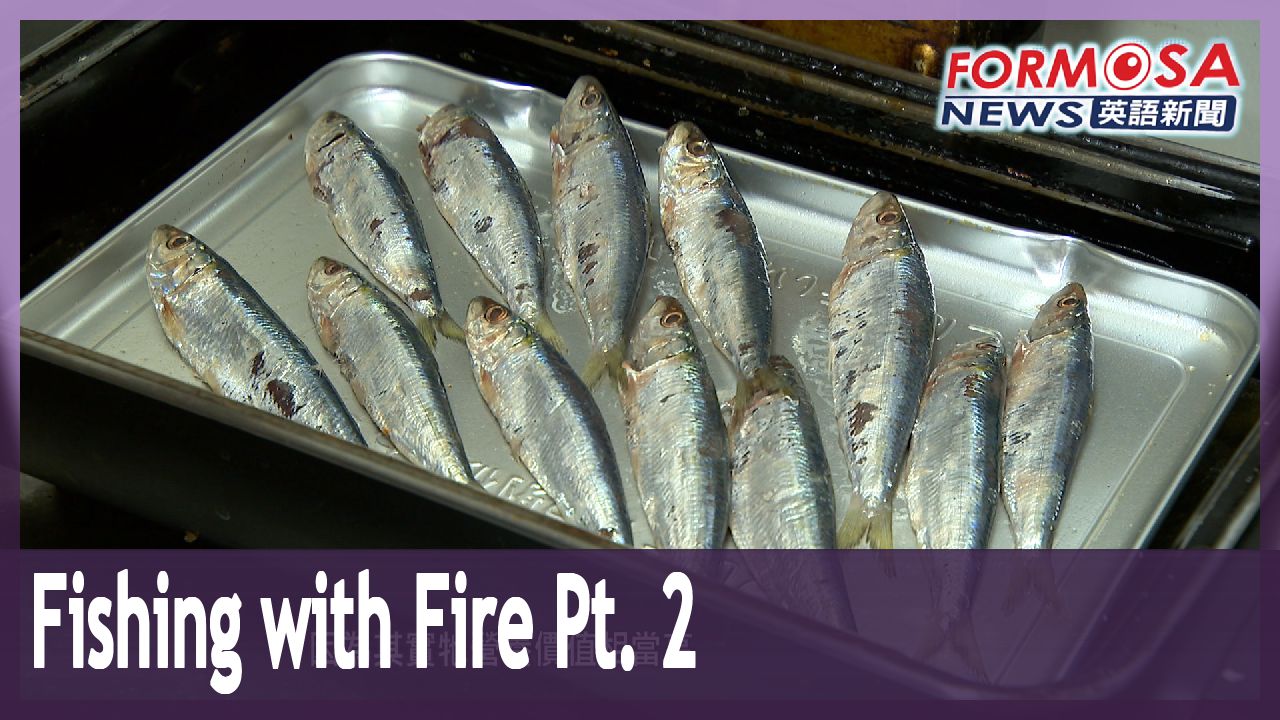
In this container is a small catch of Japanese sardinella. A small group of local fire fishers hope to create a new market for the fish by working with a Japanese restaurant.
Lai Chia-hao
Entrepreneur
By working with a local Japanese restaurant we are developing dishes with the fish. We hope that one day it can gain a following just like Wanli Crab. When people visit New Taipei’s Wanli District they eat Wanli Crab, and we hope they will come to Jinshan to eat Japanese sardinella dishes, when the fish is in season.
Currently, Japanese sardinella are sold to fish farmers as feed for groupers, fetching between NT$4 and NT$5 per catty–about 600 grams. Some feel this to be a wasteful use of the nutritious Japanese sardinella.
Chang Yu-wei
National Taiwan Ocean University
The fatty acids of this fish contain omega-3 in the form of EPA and DHA. These things are beneficial to the brain and nervous system. The Japanese sardinella has roughly 4.7 grams of EPA per serving and 6.5 grams of DHA. This is higher than the standard amount found in other fish, including deep-sea fish.
Aside from its benefits when used in cuisine, Japanese sardinella can also be used in nutritional supplements.
Lai Chia-hao
Entrepreneur
There was a period of a few years when chicken essence was a hot product. Later on this was followed by sea-bass essence, milkfish essence and beef essence. If we could apply the same high-temperature, high-pressure process to Japanese sardinella to extract its essence, its value would instantly go up.
Chang Yu-wei
National Taiwan Ocean University
We can extract the essence from the fish, and the solids that are left behind are rich in protein, as well as containing some calcium. Protein and calcium are nutrients that the body needs very much. We could go in the direction of a healthy seasoning–a local seasoning from Jinshan, made from Japanese sardinella.
If the value of Japanese sardinella goes up, fishers will no longer have to rely on large catches. In fact, there is value not only in the products that come from fire fishing, but also tourism value in the fishing experience itself.
Nighttime fishing for squid and beltfish, as well as barbecues at sea are all really popular. During the fire-fishing season, people can get close up to enjoy this centuries-old fishing method – that’s a big selling point.
Lai Chia-hao
Entrepreneur
We arrange for tourism boats and fishing boats to have some close interaction. Fishing boats can even provide their catches to the tourist boats. Before we set an itinerary, we negotiate the distribution of profits, so that a portion of profits goes to the fishing boats.
Through some innovative thinking, tourism revenue gets shared with fishers, so that everyone in the local community can prosper together. Since 2017, regional tourism officials have been arranging a fire-fishing festival at the start of every summer. They hope to call more attention to this traditional fishing method.
On shore, tourists gather, waiting eagerly to snap photos of fire fishers at work.
Captured within this majestic scene is a love and respect for the ocean that was shared by Jinshan’s earlier inhabitants.
Chang Cheng-liang
Professor
The torches they use are not that bright. So that’s why we say that only the fish that are willing to be caught are caught. When the school of fish is disturbed, only those that jump out of the water are caught, while the others remain under the water to continue on. That’s why we say this is a friendly method of fishing.
The government promotes environmentally friendly agriculture, and offers incentives and assistance toward this aim. Fire fishing is both environmentally friendly, and a part of cultural heritage. However, the government’s support toward protecting this practice has not kept pace with its gradual extinction.
Kuo Ching-lin
Cultural historian
So far nothing substantial has been done to protect the four remaining fire-fishing boats. In accordance with regulations, the city’s Cultural Affairs Department has done three things: they’ve made video recordings of fire fishing, and made written records of it. They’ve also started the third step, which is to preserve the practice, or to transform it into something more sustainable. They are still in the process of researching this last step.
Protecting this important cultural asset should not be left to fishers to do themselves. If the government doesn’t invest in protecting fire fishing, it may one day be nothing more than a spectacle for tourists.
Chang Cheng-liang
Professor
In the early days, this method of fishing with a torch was used all over the world. At present, the only place that still has fishers who use this method for income-generating fishing is Taiwan. If fire fishing is used only for performances, and if you don’t pass on this tradition or rely on it for your livelihood, it will be no different from what happens to language: left unused, it slowly disappears. If used only for performative purposes, it will be hard to preserve this tradition, because it will be too far removed from everyday life.
Chien Shih-kai
Fire master
I feel there is still hope. I feel like, if we gave up on it, that would be quite a pity.
Kuo Ching-lin
Cultural historian
We hope this fishing method won’t disappear in our generation. The desire to continue the hard work of preserving it is what makes these locals so special. Whatever we do, we just don’t want to be wasteful, we don’t want to see so many things disappear in our lifetime.
Will the next generation know about fire fishing, and about their ancestors’ special knowledge of the sea? The passion of fishers in Jinshan today gives hope. Researchers and entrepreneurs are also searching for new opportunities for this industry. Whether their combined efforts can keep the tradition of fire fishing alive remains to be seen.
2022-09-18