Twins born from Taiwan’s first successful round spermatid injection
Twins born from Taiwan’s first successful round spermatid injection
2022-09-30
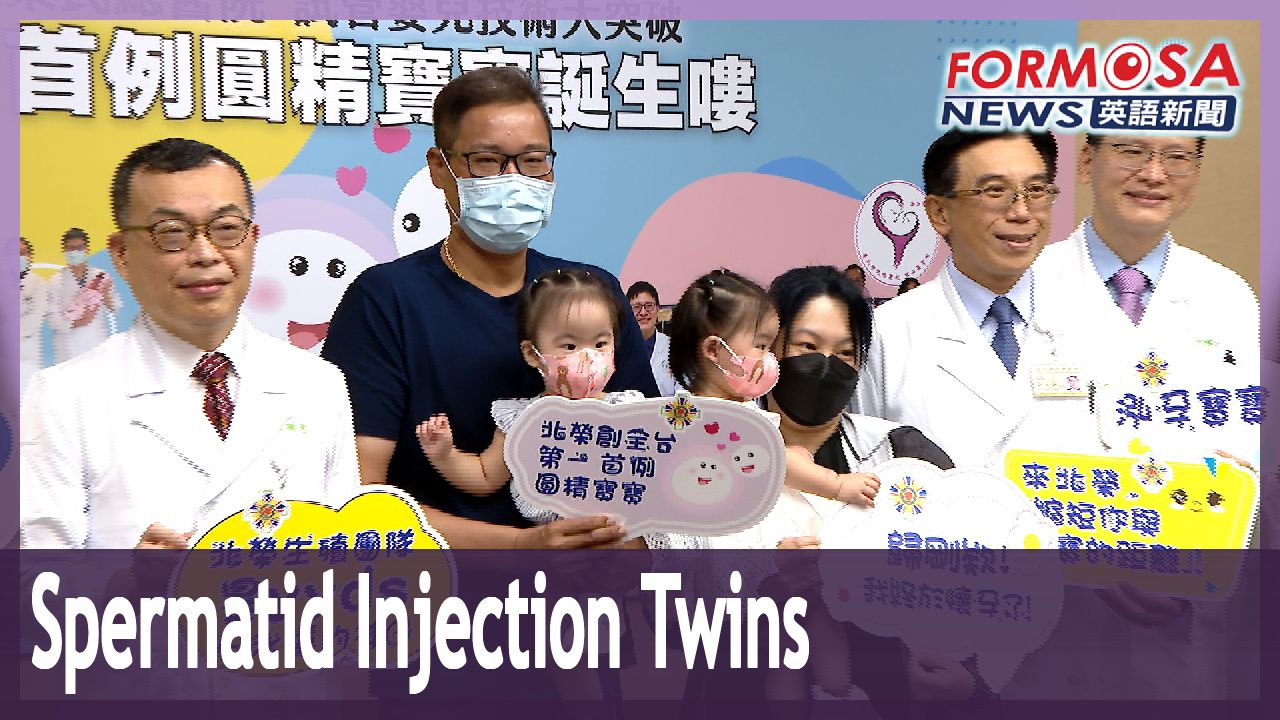
Taipei Veterans General Hospital held a press conference Friday to announce the birth of Taiwan’s first babies born from round spermatid injections. Round spermatids are immature sperm cells, which typically lack the necessary apparatus to move and fertilize egg cells. Thanks to the advanced fertilization procedure, a couple now has a pair of healthy twin girls.
They hold up their twin daughters. It’s a picture of pure joy.
Father
There is nothing but gratitude in my heart. I really had lost all hope of having children, as I was already in my 40s.
Married for two years, the couple had been trying to conceive with no success. The now-father had been even diagnosed with azoospermia. A team of medical experts from Taipei Veterans General Hospital later discovered that his sperm cells were not developing past the round spermatid stage. As such, they lacked tails, which made fertilization a difficult task.
Huang Chih-hsien
Taipei Veterans General Hospital
In the third stage of spermatogenesis, the round spermatids change shape. The head becomes smaller and they grow a tail. That’s how they grow into mature sperm cells that are able to move. Before this stage, spermatids are not able to move or fertilize egg cells.
Previous studies conducted abroad found a fertilization rate of just 38.7% after round spermatid injections. Live birth rates were as low as 2.4% due to chromosomal abnormalities. In the case of the Taiwan couple, doctors collected the father’s sperm three times and egg cells from the mother twice. Through microinjections of round spermatids, they were able to obtain eight embryos, finally resulting in pregnancy.
Huang Chih-hsien
Taipei Veterans General Hospital
Round spermatid cells look very similar to other cells. It’s very hard to tell them apart. A very difficult part is getting the ovum and the sperm to bond, as this process requires movement. Normal, mature sperm cells are able to move. But round spermatids do not have this ability.
Thanks to advancements in medical technology, the couple was able to conceive, Taiwan’s first pair of twins born from round spermatid cells.
北榮試管嬰技術大突破 國內首對"圓精寶寶"
2022-09-30
台北榮總生殖團隊,最近幫助一對求子多年的夫妻,透過圓精細胞顯微注射,讓發育不完全、沒有長出尾巴的精子,也能成功與卵子結合,順利生下一對雙胞胎,這也成為國內誕下的第一對"圓精寶寶"。
抱著雙胞胎女兒,40多歲的A先生滿臉笑容。
[[A先生]]
“心裡感謝再感謝,我真的認為說,我可能沒有希望有小孩,因為活到快40幾歲”
和太太結婚兩年,雖然求子心切,卻一直無法成功,還一度被其他醫院診斷是無精症,榮總發現,他的精子是發展不完全的圓精細胞,沒有長出尾巴,難以和卵子結合。
[[台北榮總泌尿部主任 黃志賢]]
“造精過程的第三階段,圓精細胞會再形變,頭會縮小,尾巴會長出來,變成成熟的精子,獲得活動能力,在這之前圓精細胞,基本上沒辦法主動跟卵子結合”
根據國外文獻,圓精細胞受精率只有38.7%,因為容易出現染色體異常,活產率只有2.4%,夫妻倆取精3次、取卵2次,透過圓精細胞顯微注射,培養出8顆胚胎,終於順利生產。
[[台北榮總泌尿部主任 黃志賢]]
“圓精細胞跟周遭細胞型態上非常類似,不容易判斷,很困難地方是,卵子獲得和精子結合能力,需要激活的動作,這個動作在正常成熟的精子,具備這個能力,但圓精細胞本身缺乏這個能力”
克服技術困難,讓無尾巴的圓精細胞,也能生女,成功生下台灣第一對圓精寶寶。
Related News