ATVs bringing noise, pollution and destruction to Taiwan’s beaches and forests
ATVs bringing noise, pollution and destruction to Taiwan’s beaches and forests
2022-10-09
Beaches on Taiwan’s east coast have become travel hotspots for domestic tourists, and beachgoers have turned to all-terrain vehicles, or ATVs and other activities to add to the excitement. Now, environmentalists are expressing concern that ATVs are damaging the ecosystem and driving out wildlife. Fines have had little impact in places where they are used. One expert says authorities must find a way to manage the activity and protect nature. Join us as we hear from people on all sides on what can be done to tackle the problem.
Manbo Beach in Hualien’s Xincheng Township has become a hot spot for domestic tourists.
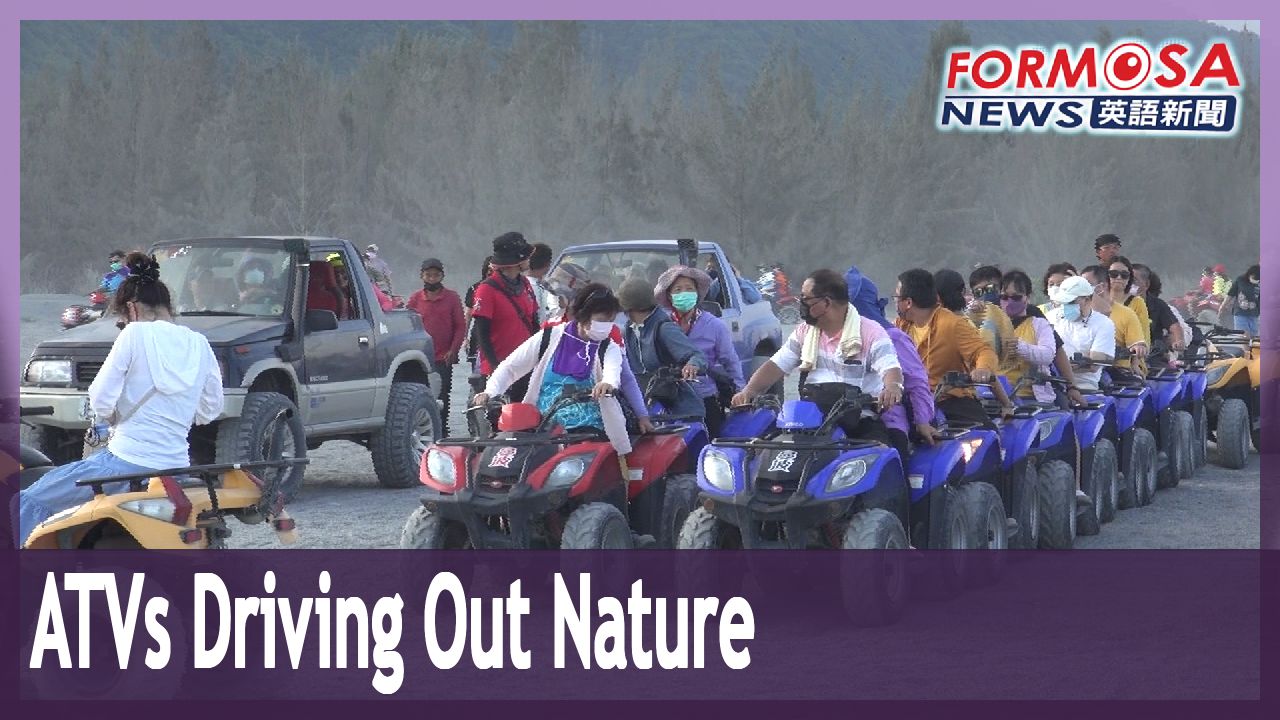
In recent years, the beach has been taken over by shops renting out all-terrain vehicles. In the tiny village of Shun’an, which encompasses Manbo Beach, there are now 13 ATV rental shops, which together operate several hundred ATVs. Visitors renting the small recreational vehicles race across the beach and along nearby streams.
Yang Hua-mei
Hualien County councilor
A large number of ATVs can be seen whipping around the area, taking turns at high speed, and so on. They’ve created this racetrack-type atmosphere, to make it more exciting.
Led by rental shop owners, one ATV after another flies by amid screams of excitement, kicking dust and sand up into the air. This once green-and-yellow patch of coastal she-oak trees is now a swathe of white. Distraught by the scene, an environmentalist grabs hold of a tree branch and shakes off the dust.
These coastal trees have an important function as a windbreak, which protects the soil and prevents environmental degradation. Now, this forest area has become a racetrack for tourists. Through aerial footage, the destruction of the coastal trees is apparent. In recent months the situation has only worsened, as bus loads of tourists funnel into the area to experience the thrill of racing on ATVs.
ATVs are able to traverse all manner of terrain. In the past, they were used by Taiwanese farmers in farmlands. Now, they are used for recreational purposes.
Sung Ping-ming
Professor
There are many things living on the beach. This type of activity not only destroys this life or interferes with its daily activities, the more serious impact is the destruction of the overall ecosystem there. You’ve got dozens or even hundreds of these ATVs driving around, and they engage in this activity on a daily basis. When they drive over the beach and surrounding area, even if they don’t destroy living creatures, they will at least cause them to leave the area.
The Society of Wilderness said that Manbo Beach was once home to Class 2 protected species of birds. The frequent activity of ATVs has driven them out and seriously interfered with the lives of other small creatures.
Lee Chih-fen
The Society of Wilderness
A lot of living things go unseen to the casual observer. For example, there are land crabs, and over here there are hermit crabs. There are also ring-necked plovers and little terns, and of course there are other living things. They can’t live in these types of conditions, and nobody speaks on their behalf.
The ATVs also drive through Sanzhan River, and this has The Society of Wilderness worried. The ATVs present a threat to the ecosystem there too, and the river is legally off limits to vehicles.
Lee Chih-fen
The Society of Wilderness
This is a waterway, and under the Water Act, vehicles are prohibited from traversing it. We have looked into the issue of fines, which we brought up with the Hualien County Economic Affairs Department. We asked about it in our meeting with them, and pointed out that driving vehicles through a waterway is illegal, but they were indecisive, and wouldn’t offer any suggestions about how they’d deal with it. There is a law, but nobody wants to enforce it.
The beach and coastal forest are public resources, so can businesses operate there and earn money?
Lee Chih-fen
The Society of Wilderness
The Hualien County Government has insisted that since the beach is public, businesses can also use the space. However, the problem is that these businesses are excludable in nature. Their activities also kick up dust and make a lot of noise, as well as create danger, which naturally drives others away.
Currently there are ATV rental operators in Hualien, Pingtung, Yilan and New Taipei City. However, the central government has no laws in place regarding ATV use, which makes it difficult for local governments to manage the issue.
Yang Hua-mei
Hualien County councilor
Currently we have the Act for the Development of Tourism and the Regulations Governing Water Recreation Activities. However, neither of these includes provisions on the use of ATVs. Local governments also have no legal basis to say, for example, where ATV use is prohibited, or when to issue fines, or to protect the interests of local residents by delineating when tourists can engage in such activities. There are no such options.
Currently, the Hualien County Government requires ATV operators to have company or business registration, and insurance for the use of ATVs by tourists. However, there are no penalties or regulations to protect against the ecological impact of ATV use.
Wang Chih-yi
Tourism Bureau
I don’t think this is an unmanageable problem, it just comes down to whether you want to do something about it. Although you can’t impose fines for the issues of concern, land-management authorities have their own laws. For example, there’s the Forestry Bureau – if the land under their management is getting completely messed up, they would have laws related to the protection of forests. They could invoke the Forestry Act to impose penalties.
In the face of various concerns, operators said they were prepared to comply with county government rules, but they hoped a way could be found for them to continue earning money.
Huang Hung-ta
ATV operators’ association
As I’m sure you’re aware, work opportunities in Hualien are fairly limited. We were fortunate to hit upon something popular. For the local economy, tourism, local residents and instructors it’s been quite helpful, financially speaking.
Yang Hua-mei
Hualien County councilor
We aren’t trying to have ATVs banned, we’re just thinking about how to manage them. Otherwise, there will be losses on many fronts, including ecological damage and dangers to tourists. The industry will also be stigmatized.
One academic feels that as new types of recreational activities emerge, the government should hire experts to assess the environmental impact of those activities. They suggest that the government delineate less-environmentally sensitive areas for outdoor activities, and limit the amount of such activity, rather than letting business operators act without restraint.
Sung Ping-ming
Professor
After we make an assessment, we can specify what is a suitable amount of ATV activity for the area. Even if the activity is permitted, we want to have a set of specifications to regulate it. Only by managing it in this way can we use resources in a friendly manner, in a sustainable manner.
Hualien’s problems with ATVs have just begun, but in Southern Taiwan’s Kenting National Park, ATVs have been a threat for more than 30 years already. Kenting is home to an abundance of species, which the park sought to protect early on with strict regulations. ATV use is not permitted in the park, but rental operators have ignored the rules for years now, and continue to operate despite repeated fines.
Seeing water on the ground, park officials determine there are ATVs in the vicinity.
The park official stops a group of more than half a dozen ATV riders, and police arrive to issue fines to the rental operator in the amount of NT$3,000 per ATV.
ATV rental businesses have been operating illegally in the national park for years now, which has caused serious erosion of the soil. For example, Longpan Park – which is within Kenting National Park – has world-class coastal scenery, but it’s been scarred in several areas by ATV tracks, which turn into barren troughs.
It’s difficult for areas of erosion to recover, and when there is heavy rain, these eroded areas become sources of silt that contributes to coral bleaching.
Hsu Shu-kuo
Kenting National Park office
The main cause for concern is that when ATVs operate in the area for a long time, the tires cause the grassland to become barren. When there is rainfall, the surface soil in these areas of erosion gets washed out to sea where it gathers on the seabed. When the soil washes out to sea like that, it could end up covering coral, and when that happens the coral suffocates.
One of the major selling points for these ATV businesses was night trips within Longpan Park, where visitors could have the opportunity to see wild deer. Their activities have become a major source of disturbance for this and other wildlife.
Hsu Shu-kuo
Kenting National Park office
The sound of the engines and the action of chasing the deer causes them serious anxiety. Mammals like these deer are inherently frightened more easily, and when they are put under pressure like that – especially when it comes to the younger deer – it can cause heart problems, which could even lead to death.
In 2021, the Kenting National Park office began collecting evidence that soil damage was being caused by ATVs. After evidence against four rental operators was sent to the local prosecutors’ office for investigation, the four stopped hosting ATV tours in Longpan Park. Evidence against other operators is also mounting.
Tourists pay NT$1,200 to ride an ATV in the national park for one hour, netting roughly NT$10,000 per hour of revenue for the average rental operator. Even if they get stopped occasionally and are forced to pay fines, they can still earn a hefty profit.
Hsu Shu-kuo
Kenting National Park office
The highest fine that we can issue in a national park in Taiwan is NT$3,000. When you look at the profits that these operators make, obviously the fines aren’t going to deter them. That’s why we’re looking into whether we can increase the amounts of these fines.
Sung Ping-ming
Professor
I can understand it. These tourists want excitement, speed, and a sense of danger. What I really want to say to these people is, “Don’t look for your excitement in the mountains and forests, because after you get your excitement, the ecosystem is dead.”
Profit and personal entertainment should not come at the cost of sacrificing the environment. Activists hope they can strike the right balance, so that the nation’s beaches, forests and parks can be enjoyed by everyone for generations to come.
沙灘車‧殺灘車
2022-10-09
台灣有些旅遊景點,業者標榜「越野冒險」,讓民眾騎乘沙灘車,體驗海灘競速、大漠飆沙的刺激感。國外的沙灘車,大多是官方在海灘執行任務時的交通工具;但台灣,卻被當成休閒娛樂。當民眾馳騁沙灘時,事實上,也成了可怕的生態殺手。採訪團隊特地前往目前最熱門的沙灘車景點,帶您深入瞭解沙灘車 如何殺了沙灘。
位於花蓮縣新城鄉的曼波海灘,是最近相當夯的旅遊景點。
曼波海灘最近幾年,被沙灘車業者包圍,一個小小的順安村就有13家業者,數百台沙灘車,他們帶著遊客在海邊、溪口奔馳。
[[花蓮縣議員 楊華美]]
“大量的沙灘車行駛之後,急速行駛、過彎等等,產生出賽道,這樣子比較刺激。”
由業者帶頭,一台又一台的沙灘車,呼嘯而過,帶起漫天的揚塵,原本黃綠色的木麻黃,全成了慘白一片,一旁荒野保護協會的成員,看了於心不忍,上前搖了一下樹。
防風保安林的用途,是水土保育以及防止天然災害,如今卻成了遊客狂飆的賽車場。透過空拍畫面,更能清楚看到保安林被破壞的情形。近兩三年,曼波海灘的沙灘車活動變得越來越有名,遊覽車載著一車又一車的遊客,就是要來體驗沙灘車飆速的樂趣。
沙灘車能克服各種特殊地形,過去在台灣,沙灘車主要做為農業用途,如今卻被當成休閒娛樂。
[[東華大學自然資源與環境學系教授 宋秉明]]
“沙灘上有很多的生物,你破壞的不只是生物的生命,跟干擾牠的生活習性,你一個很嚴重的事情是,破壞牠實質的生態環境。幾十輛、幾百輛成群結隊,或者例行每天都有這樣的活動,車子過去的話,那個地方一定是所有生物,可能不是被你弄死了,就是牠跑掉了。”
荒野保護協會指出,曼波海灘原本有二級保育鳥類小燕鷗活動,沙灘車的橫行,對許多小動物都造成了嚴重干擾。
[[荒野保護協會花蓮分會副會長 李志芬]]
“其實有很多生態是我們沒有看到的,譬如說陸蟹,前面這邊有一些寄居蟹。然後有環頸鴴、小燕鷗,當然還有其他的生物其實都有。像這樣的狀況下,根本不可能(存活),沒有人替這些生物說話。”
業者推出的行程,還包括三棧溪,荒野保護協會也擔憂,沙灘車對這裡的生態造成威脅,而且法律本來就規定這裡禁止車輛通行。
[[荒野保護協會花蓮分會副會長 李志芬]]
“這個行水區,其實在水利法上面,是禁止車輛行駛的。那要不要罰,我們跟花蓮縣政府的建設局水利科主管單位,跟他們一起開會的時候,其實也有提到,水利法是禁止通行,但他們就不置可否,沒有提出他們要怎麼管理。其實這個都是有法卻不執行。”
沙灘、防風林、溪流都是公共財,究竟業者能不能在這裡營利賺錢?
[[荒野保護協會花蓮分會副會長 李志芬]]
“因為花蓮縣政府一直強調說,沙灘是共有財,業者也可以使用,可是問題是這個行業有強大的排他性,揚塵,還有它造成的噪音,還有危險,自然而然就會把我們驅趕走。”
目前沙灘車活動在花蓮、屏東、宜蘭、新北都有業者經營,然而政府對於沙灘車的法律規定相當缺乏,使得地方政府在管理上出現困難。
[[花蓮縣議員 楊華美]]
“現行的《發展觀光條例》,還有《水域遊憩活動管理辦法》,都沒有對沙灘車進行相關的規範。地方政府相關單位也沒有法源依據,很難公告說,你哪裡可以禁止,或者要怎麼處罰,或者跟居民、一般遊客錯開時間的規範,其實都沒有。”
目前花蓮縣府對於縣內的沙灘車活動,明文要求業者必須有公司或商業登記以及保險等等,不過沒有任何的罰則,對於生態影響也沒有任何規範。
[[交通部觀光局技術組副組長 王智益]]
“其實應該不是無法可管,是看要不要管而已。雖然注意事項沒有辦法去罰,但是土地管理單位它有自己的法律。像林務單位,他的土地被搞得亂七八糟,他一定自己有,例如說保安林的相關管理條例,或者是森林法,他們就可以去做裁罰。”
而面對種種的質疑,業者回應表示,願意配合縣府的管理,希望謀求一條生路。
[[花蓮天空之鏡沙灘車協會會長 黃鴻達]]
“你也知道說我們花蓮,講實在話工作機會比較少,我們剛好運氣很好,造就了一波的熱潮,其實對地方上的經濟、觀光,對這些居民、教練他們的生計都有很大的幫助。”
[[花蓮縣議員 楊華美]]
“我們不是要禁止,而是要怎麼樣來管理,否則是多方面的共輸,生態土地也輸,遊客也有風險,這個產業它也被貼了標籤。”
學者認為,面對各種新興的遊憩活動,縣府應該尋找專家學者,進行生態調查評估,劃定出允許發展的生態低敏感區,訂定遊憩承載量,而非放任業者隨意使用。
[[東華大學自然資源與環境學系教授 宋秉明]]
“調查之後我們再經過規劃,這個地方可以適於做,就算是你可以做了,我們也是要發展出一個叫做沙灘車的活動規範,反正我們一定要經過這樣子,我們才有可能跟我們的資源和平相處、永續相處。”
在花蓮,沙灘車的問題才剛剛開始,但是在南端的墾丁國家公園,卻是三十多年來一直飽受危害。墾丁國家公園物種豐富,墾管處早在三十多年前就已經嚴令,國家公園內不得騎乘沙灘車,但是業者多年來屢勸不聽、屢罰不怕。
墾管處人員看到地面潮濕,立刻判斷沙灘車業者就在附近。
七、八台沙灘車被逮個正著,每台沙灘車要吃上三千元的罰單。
沙灘車業者長年在國家公園內非法經營,導致國家公園出現嚴重水土流失,像是國家公園內的龍磐大草原,擁有世界級海岸風景,但是草原上出現一道道光禿裸露的黃土溝槽。
土壤流失的地表不僅難以復原,甚至大雨沖刷夾帶大量泥沙,還導致珊瑚白化。
[[墾丁國家公園管理處副處長 許書國]]
“最主要是沙灘車它在這個區域活動的時候,會造成長期的輪胎滾動,就造成地表的裸露,這些地表裸露一旦下雨的話,這些泥沙就會沖到海底,這些泥沙一旦入海之後,它有可能就直接覆蓋在珊瑚上面,一旦被覆蓋了,可能珊瑚就會窒息死亡。”
過去沙灘車業者在墾丁國家公園的一大賣點,就是帶遊客在龍磐草原上,「夜探梅花鹿」,卻嚴重干擾野生動物的生活。
[[墾丁國家公園管理處副處長 許書國]]
“包括引擎的聲音,甚至直接去追逐梅花鹿,其實就造成梅花鹿很大的緊迫,尤其像我們鹿科的動物,其實牠本身都是生性比較膽小的哺乳動物,一旦受到一些緊迫,尤其小鹿牠可能一緊張,會造成牠的心肌阻礙,有可能就會面臨到死亡的威脅。”
2021年,墾管處搜集沙灘車業者,破壞水土的證據,將業者函送地檢署偵辦後,才讓在龍磐草原經營的四家業者停業,然而其他業者違法的情況卻仍層出不窮。
一台沙灘車在墾丁體驗一小時約一千兩百元,業者每次出團就有近萬元的收入,偶爾被警方抓到一次,甚至全盤吸收遊客的罰單,對業者來說還是很有賺頭。
[[墾丁國家公園管理處副處長 許書國]]
“其實我們國家公園法最高就是罰三千元,相對業者可以獲利的狀況,當然這個罰則就比較沒有嚇阻作用,所以有關國家公園的罰則,我們這邊也在研議,希望能夠提高罰鍰的額度。”
[[東華大學自然資源與環境學系教授 宋秉明]]
我可以理解,他要的是刺激、速度,他就是要風險。我實在是很想講,你不要在山林尋求你的刺激,你一旦刺激了之後,很多山林的生態隨著你陪葬。
人們的娛樂不該以犧牲山林、出賣海洋作為代價,消費者的選擇,可能是對環境的保護,也可能是傷害。
Related News