Environmental group designs innovative trash bin with features to encourage recycling
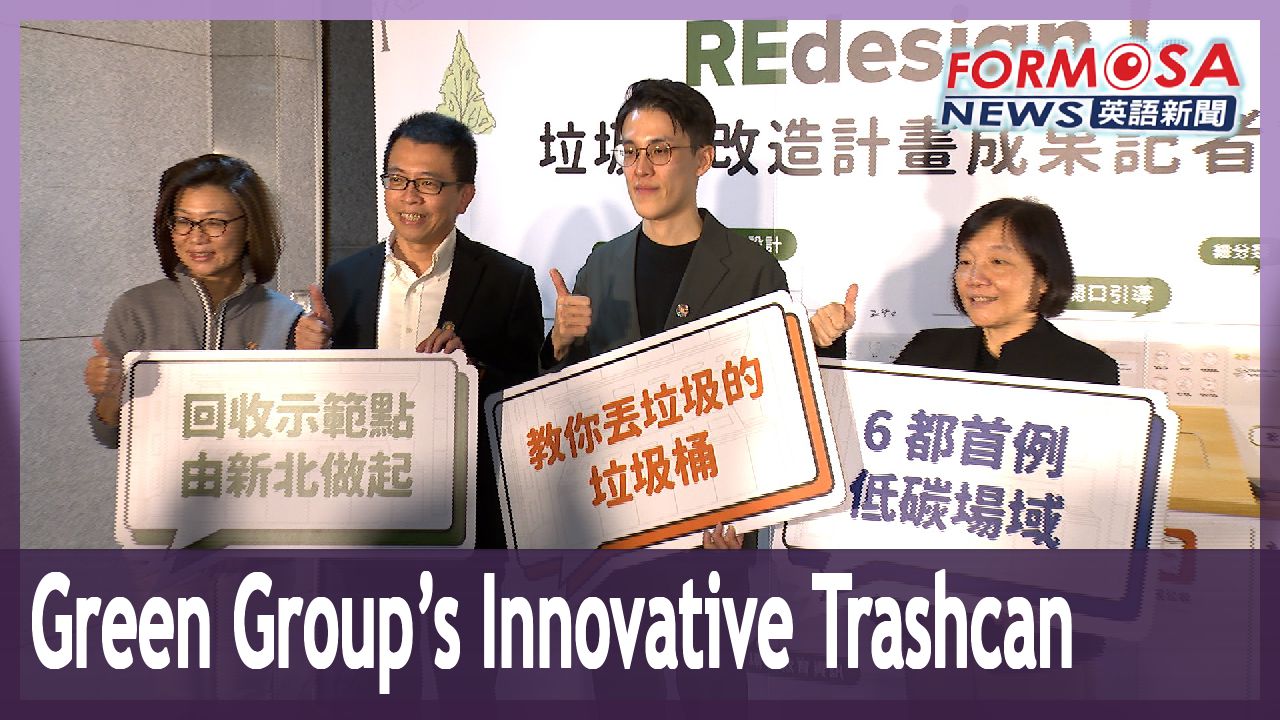
A poll from the environmental group RE-THINK recently found the majority of Taiwanese think the biggest obstacle to sorting their waste effectively are trash bins that are not user-friendly. So the group decided to take matters into its own hands and design an innovative trash bin that helps people sort their rubbish more effectively in public spaces. Its disposal holes are limited to certain shapes so that people are forced to separate the different kinds of recyclables. It also features infographics in both English and Mandarin. FTV reporter Stephany Yang spoke to Jason Huang, the co-founder of RE-THINK, to learn more about their work.
Stephany Yang
FTV reporter
This new trash bin designed by RE-THINK includes labels such as “paper containers”, “general waste,” and “food waste.”
There are color-coded labels indicating where paper containers, general waste, and food waste can go, as well as tin cans, glass, plastic, and paper. There are also infographics and pictures in both English and Mandarin indicating the kind of trash that should be thrown into each section.
In contrast to traditional metal trash cans, this new bin is made out of wood. The group found that traditional trash cans often accumulate mountains of unsorted trash around them. In contrast, the new trashcan is slanted to prevent people throwing in their trash from a long distance. The organization hopes to enhance the public’s knowledge of recycling and reduce the workloads of cleaners.
Jason Huang
RE-THINK co-founder
First, there are some data and infographic designs. It is displayed by the trash bin. Second is that we have re-designed the trash bin into a problem-solving system, including the holes of the trash bin have been limited to certain shapes so that people cannot throw the whole package of trash into it. They have to stand right in front of the trash bin to recycle. The third is that we made the classification into a more detailed version so that people can find the specific item and specific category for the trash.
RE-THINK has installed these trash bins in different areas, including campuses and companies. The newest location is New Taipei City government.
Member of public
The new trash bin has different sections marked by colors, so it is easier for us to identify the section we need to throw our trash in. Compared with previous trash cans, which were made of metal, this one looks more colorful.
Member of public
I saw this new type of trash can and felt that its classification guidelines are clearer and more detailed. For example, for plastic objects, there’s both a clean plastic bag and plastic container section. It’s the same with paper. There is an ordinary paper section and a section for paper containers, so the classification process is clearer.
Member of public
The big difference is that a traditional trashcan does not have a plastic container section and the new trash bin does. Then there is the food waste section. Earlier, I threw away trash that still had a bit of sauce on it, so I was able to dispose thanks to the food waste section. That’s not possible with a regular trash can. Traditional bins are a bit confusing, and I’m never sure whether I should throw my rubbish in there directly. It also often feels like I’m making work harder for the cleaning staff.
RE-THINK’s 2020 and 2022 Taiwan Recycling Awareness Survey found that more than 60% of respondents said that the design of recycling bins was the main factor preventing them from sorting their trash correctly. Obstacles included unclear recycling labels, different sorting rules in different places, or overly complicated sorting directions that confuse people.
Jason Huang
RE-THINK co-founder
The biggest inspiration is that we did a huge survey. Tens of thousands of people were surveyed and found out that the very moment people confront the recycling problem is when they do recycling in front of the trash bin. The trashbin itself, becomes a very important moment and facility for people to do communication and education. By implementing the newly redesigned trash bin, we have enhanced the accuracy of recycling from 26% to 53%.
Cheng Ta-wei
Environmental Protection Administration
In the past, when people were recycling and wanted to know how to classify trash, they would rely on their intuition. For example, they would separate metal cans from bottles and plastic bottles. But that could still be confusing. We think that environmental protection policies should be easy for the public to understand and take action on.
RE-THINK hopes to partner with the EPA to implement this new style of trash bin in more areas around Taiwan and educate more people on recycling.
2023-01-05