Residents on edge as sinkholes strike near construction zones
Residents on edge as sinkholes strike near construction zones
2023-07-16
In April of this year, a startling sight unfolded near a construction area in Hsinchu. A section of a road suddenly caved in, creating a sinkhole that swallowed up a nearby Tesla. Just half a month earlier, a similar incident occurred in Taipei a giant sinkhole appeared near a construction site, causing nearby homes to lean precariously and prompting the residents’ evacuation. These incidents are not isolated. Sinkholes are showing up all across urban Taiwan, damaging roads and threatening the safety and property of locals. But what’s causing this alarming rise in sinkholes? And is there a way to predict when and where the next one will occur?
Even in a casual conversation with neighbors, anxiety is visible on the face of Zhubei community leader Mao Zhenfu.
Mao Zhen-fu
Zhubei community leader
The businesspeople here are either tenants or property owners who live on the property themselves. The tenants suffer the most. Why? Because when the road is sealed, they can’t do business. Any one of these shop fronts cost NT$30,000 or NT$40,000 in rent each month.
Over the past nine months, the roads surrounding this Zhubei construction site have collapsed five times. One of those roads, Shengli 2nd Road, has been closed for more than half a year, leaving a long row of desolate shops.
This year in April, another sinkhole at the worksite devoured a Tesla.
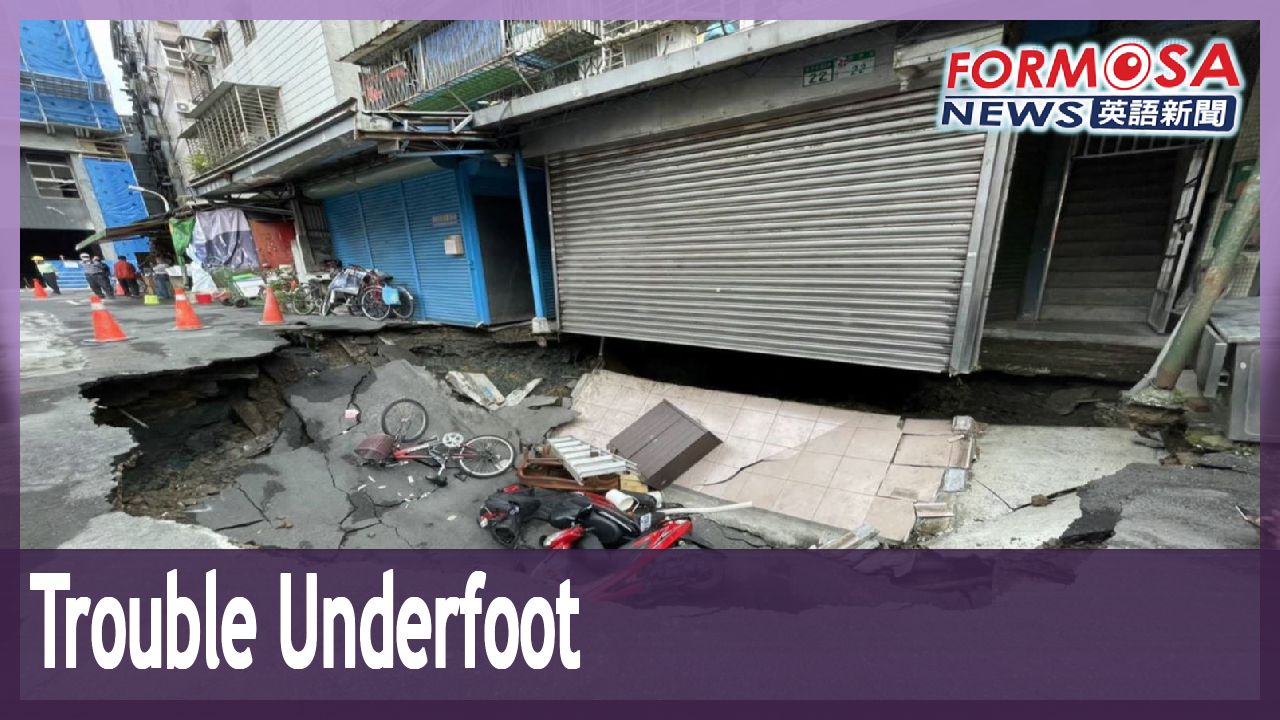
Residents in Zhubei live in fear, and less than half a month later, another sinkhole appeared in Taipei’s Xinyi District, swallowing up scooters and bicycles.
Sinkholes have become an increasingly common phenomenon. One struck in Yonghe, New Taipei in 2020, in Changhua City in 2021, in Cianjin, Kaohsiung in 2022, and in Longjing, Taichung in 2023. What’s driving this unsettling phenomenon?
Ni Chun-fa
National Central University Graduate Institute of Applied Geology
Many of the sinkholes that we see are the result of human interference. It has to do with the mechanical balance between water and soil. Anything that causes an imbalance of water in the soil can lead to the rearrangement of soil particles, resulting in a collapse.
To get a sense of this water-soil imbalance, consider this scenario: A water pipe bursts under a road. Water comes rushing out, washing away the nearby soil and leading to the formation of voids in the soil layer. Once the road begins to cave, a sinkhole is created.
Ni Chun-fa
National Central University Graduate Institute of Applied Geology
Typically, building a high-rise involves deep excavation, which lowers the level of the groundwater. Particularly at the construction site itself, the groundwater level is very low. If the groundwater level is significantly lower than the level outside of the construction site, fine particles of soil can be washed away.
When a high-rise basement is excavated to a depth that’s lower than the groundwater level, water infiltration can hinder construction. To keep this from happening, wells are often set up to pump groundwater and lower the water level. The discrepancy between the water levels inside and outside the worksite causes water to flow out, toward the area with the lower level. This becomes a problem if the ground composition is a mix of gravel and sand. Flowing water can sweep away the sand, depriving the gravel of its supportive structure. The gravel then repositions itself, leading to the creation of voids.
But before a high-rise is built, wouldn’t a construction firm conduct a geological survey?
Tseng Ho-teng
New Taipei geological technicians association
In the early years, we’d heard of cases where geological surveys were falsified or even skipped entirely. But nowadays, we don’t hear about such things happening. Each worksite will conduct a geological survey at the very start. I believe that the survey requirement is fulfilled at this stage, and that after the survey is completed, there’s an efficient review mechanism.
Next, the geological report is turned over to professional technicians. They use it to design supports for the sides of an excavated basement, to prevent soil or water from collapsing. Three types of supports are commonly used in the industry: sheet piles, earth-retaining piles, and continuous walls.
Tseng Ho-teng
New Taipei geological technicians association
The continuous wall is the most expensive and it takes the longest time to set up. However, it’s the best at retaining soil and water. The next best thing is the earth-retaining pile. But there are gaps between each one, so of course groundwater can seep in, reducing its effectiveness. Then there’s the sheet pile. The crevices in sheet piles make it easy for groundwater to seep in.
Technicians will recommend which support to use, based on the geological conditions. With modern engineering designs, safety isn’t an issue. But even the highest-performing continuous walls can’t prevent sinkholes from forming.
Chan Jung-feng (July 2020)
Former head of New Taipei Public Works Department
The preliminary assessment is that water leaked from the seams of the wall.
No matter what form of construction is used, the appearance of muddy water at a construction site is a warning sign. Here in the basement of this Zhubei construction project, you can see muddy water where the sandbags are piled up.
Ni Chun-fa
National Central University Graduate Institute of Applied Geology
The leaking water – if it carries materials such as sand, you’ll be able to see color. Seeing color means that the water has started to bring out fine particles. That’s a very important message. Disasters caused by groundwater actually occur very slowly. There are opportunities to resolve them, there’s time.
Sinkholes are problems with warning signs, and there’s time to prevent their formation. So when they occur anyway, over and over again, is man solely to blame? Over in Zhubei, Hsinchu, locals now find it hard to trust developers.
Eight years ago, Casey moved to Zhubei with her husband, an engineer. They live near the construction site where multiple sinkholes have occurred. On the day a Tesla fell into a crater, she was not far away.
Casey
Zhubei resident
It felt like a stunt from a movie. You could see a car stuck inside, and it felt so unreal. I took a picture on my way back. The soil erosion inside – by that time, the car had been already been removed, and I discovered that all the soil inside was gone, the hole was super empty. When I saw it, I was shocked at first glance, and then later I felt scared.
The looming threat of sinkholes has caused anger and distress among the people of this neighborhood.
Each day, cracks expand in their sidewalks and flower planters.
Mao Zhen-fu
Zhubei community leader
Everybody is worried about their house collapsing. They worked so hard to buy a house. You’re lying to them if you tell them not to worry. Through a friend’s referral, I personally invited a structural engineer from Taipei to provide an explanation to our residents. Last Friday, through a neighbor, we brought in another structural engineer from Kaohsiung.
Repeated sinkholes have forced residents to seek out experts on their own. They don’t believe the narrative of construction companies. They’re also suspicious of the local government.
Chiu Hsien-chih
Lawmaker
What Hsinchu County Commissioner Yang Wen-ke does is, he goes to the site, he performs his outrage – that’s his SOP. After his performance of rage, construction stops, it stops for a while, and then it resumes. The reality is, there’s a relationship between construction companies and local governments. These politicians are too close-knit with builders, who provide political donations or campaign headquarters and things like that. This leads to the inability to assert public power over people you need to manage.
But what can these locals do to help themselves?
Assistant professor Lin Chen-hua pushes a ground-penetrating radar, a machine that costs nearly a million New Taiwan dollars. It offers a window to the world below ground.
Lin Chen-hua
Chung Hua University Dept. of Civil Engineering
It’s just like doing an X-ray scan of the human body. The depth of its detection is determined by the high and low frequencies of the antenna. In good geological conditions, low frequencies can detect up to 30 meters, no problem.
Based on the waves reflected from the ground, this radar can distinguish between different materials such as metal, plastic, and air. It can help residents judge whether the ground of their neighborhood is safe.
Experts can use these ripples to decode information from underground. Even a hole measuring 15 centimeters in diameter can be detected. Such a radar, if incorporated in the standard protocol of building construction, could eliminate many hazards and disputes.
Lin Chen-hua
Chung Hua University Dept. of Civil Engineering
Prior to excavation, you could do a survey. For example, regardless of the construction site, you must survey the neighboring properties. Do a test first, to get some baseline information. So in the process of excavation, if anything happens to the neighboring properties, another test can be done, to see the problem was caused by the soil.
To reduce the frequency of sinkholes over the long run, the central government needs to strengthen its regulation of the construction industry.
Chiu Hsien-chih
Lawmaker
We asked the Construction and Planning Agency to help local governments set up a standard for resuming work. After all, what are the criteria for resuming work? Secondly, there needs to be an SOP for follow-up safety monitoring. The website should let citizens know which builders are extremely terrible, with a record of frequent construction accidents and multiple fines from the construction agency.
Mr. Huang
Resident affected by Xinyi District sinkhole
They sent cement mixer trucks to do the grouting. They used 58 trucks.
With the arrival of each new building, one question invariably arises, “Will it be a good neighbor or a bad neighbor?” The answer is largely up to the government and the construction industry, and whether they can restore the people’s right to live in peace and without fear.
天坑驚魂記
2023-07-16
不久前,在新竹竹北的一處工地旁,馬路突然塌陷,出現一個大洞,當場吞掉了一輛原本好端端停在停車格上的特斯拉轎車;而才相隔半個月,台北信義區另一處工地前,也突然坍陷出一個大天坑,甚至造成一旁的房屋傾斜,居民緊急撤離,有家歸不得。其實類似「天坑」事件近年來不斷在各地發生,不但損壞道路,甚至直接威脅居民的安全和財產。但為什麼會出現這些天坑?你我有沒有辦法預知,在我們住家附近有沒有這樣的風險呢?
看似悠閒地和里民談笑,新竹竹北里長毛振福心裡卻籠罩著烏雲。
[[毛振福 新竹竹北里長]]
“我們這裡不是租的就是自己住,尤其承租戶是受害最深的,為什麼,路封掉了,生意也不能做,我們店家隨便一間店面,一個月3、4萬元租金”
在這竹北建案基地周邊道路,過去九個月,共坍陷了五次,其中這條勝利二路,去年中秋節至今封了超過半年,留下一整排店家,無限寂寥。
今年四月底,工地另一側又掉進了一輛特斯拉。
竹北居民惶惶不安,不到半個月,北市信義區也出現天坑,掉進機車與自行車。
天坑事件頻傳,2020年新北永和,2021年彰化市,2022年高雄前金,2023年台中龍井,為何到處都出現天坑呢。
[[倪春發 教授 中央大學應用地質所]]
“很多我們看到所謂天坑,應該都是人為的行為介入 比較多,水跟土壤的力學平衡有關,舉凡是造成土壤裡面的水不平衡,就有機會造成土壤的顆粒重新排列,就會造成陷落”
所謂的水不平衡與土壤重新排列,舉例來說,就像道路下方自來水管破裂,水因壓力而噴出,沖蝕並帶走附近土壤,就會導致土層出現空洞,一旦塌陷,就變天坑。
[[倪春發 教授 中央大學應用地質所]]
“通常大樓都在做深開挖,會降地下水水位面,尤其是在施工的範圍裡面,地下水水位很低,跟原來在大樓外面的施工區域外,地下水水位落差一大,就有機會把細顆粒帶走”
大樓開挖地下室,若挖的深度比地下水位低,為了避免基地進水,無法施工,此時工程上就會鑿井,抽地下水來降低水位,如此基地內外的水位差,就會造成水往低處流,若地層是礫石夾砂,水就容易帶走砂土,導致礫石失去支撐而重新排列,進而出現空洞。
不過在蓋大樓前,建商不會先地質調查嗎。
[[曾何騰 理事長 新北應用地質技師公會]]
“早年,我們都還可以聽到地質調查會有造假的情形,甚至不見得去做,但現在已經漸漸沒有聽到這樣的情形,在每一個基地一開始都會做地質調查,我認為在地質調查這個階段就應該能夠落實,調查完了之後,也能夠落實審查機制”
接下來地質報告,會交由專業技師設計,開挖的地下室側邊,要用什麼樣的擋土支撐,才能避免水或土往中間坍塌,目前業界常用的支撐,有鋼板樁、擋土排樁及連續壁三類。
[[曾何騰 理事長 新北應用地質技師公會]]
“連續壁的造價最貴,花的時間最長,但是它擋土,擋水效果都是最好的,再來就是擋土排樁,這種在一支一支排樁的中間當中,當然容易會讓地下水有機會滲進來,所以它的效果相對差一些,更何況如果是鋼板樁,鋼板樁中間的縫隙,通常都會很容易讓地下水滲進來”
專業技師們建議用哪種支撐,是因地制宜,以現今工程設計,安全都不是問題,不過現實來看,即使是採高規格的連續壁工地,卻也一再傳出天坑。
[[詹榮峰 新北工務局長 (2020.07)]]
“初步研判,連續壁的接縫處是有滲漏水沒有錯”
總歸來說,不論採取哪種工法,泥沙水流入基地就是一記警鐘,看看竹北建案地下室,沙包堆積之處,就可以看到流入基地的泥水。
[[倪春發 教授 中央大學應用地質所]]
“滲漏出來的水,如果有帶出材料(砂土) ,你就可以看到顏色,看到顏色表示,這些水已經開始在帶細顆粒出來了,這是很重要的一個訊息,這種地下水引發的災害,其實速度都是緩慢的,應該是都有機會去解決,有時間解決”
既有跡可循,又有時間處理,那一再發生的天坑,是不是就是人禍呢,以竹北來說,附近居民如今難以再相信建商。
八年前隨工程師先生搬到竹北的凱西,就住在天坑建案附近,特斯拉掉下去當天,她正經過該處。
[[凱 西 新竹竹北居民]]
“感覺上很像那種拍電影特效,因為你就看一個車子陷在那裡面,感覺非常的不真實,我那時候回來就有拍一下,裡面的土質流失狀況,那時候車子已經被抓起來,我才發現裡面真的是,整個都流失掉,超空,現場看的時候,我第一眼是覺得震驚,後來再看就覺得害怕”
生活必經之處,不知何時會塌陷,這不確定性令他們擔憂又生氣。
尤其住家人行道,花台裂縫日益擴大。
[[毛振福 新竹竹北里長]]
大家都擔心自己的房子會倒,很辛苦才有這樣一棟房子,你說叫大家不要擔心那是騙人的,我個人就有透過朋友介紹,請台北的一個結構技師下來跟我們住戶做一個簡單的說明,上個禮拜五,我們社區也有透過鄰居,請高雄的一個結構技師”
一再地塌陷,逼得居民們紛紛找專家自立救濟,他們不相信建商,也對縣府存疑。
[[邱顯智 立法委員]]
“楊文科的做法就是,他都會到現場,然後表演震怒,表演震怒,SOP都這樣,表演震怒之後就停工,停工一陣子又再復工,事實上,建商跟地方政府之間,這些政治人物關係太密切,政治獻金或者是提供競選總部等等之類的,而導致你應該管的人,你沒有辦法伸張你的公權力”
這些孤立無援的居民,還能怎麼自救呢?
林鎮華手中推的機器叫透地雷達,要價近百萬,它能讓地底世界一覽無遺。
[[林鎮華 助理教授 中華大學土木系]]
“就是像我們人體在做X光掃描一樣,會依據我們天線頻率的高低去決定它探測的深度,以低頻來講,在地質條件良好的狀況下,到三十米左右都沒問題”
透地雷達能從地底反射的波,辨別金屬、塑膠、空氣等等不同材質,能夠幫居民判讀住家周邊的基地是否安全。
對專家來說,這些波紋是解讀地底資訊的密碼,即使是直徑15公分的小洞都能揪出來,這樣的透地雷達,若納入大樓工序的SOP,就能避免危害與爭議。
[[林鎮華 助理教授 中華大學土木系]]
“如果說是在開挖前,可以先去做一個事先的調查,比如說,不管任何工地,一定會做鄰房的調查,可以先做一個檢測,當作一個基本資料,當它在開挖的過程中,假設鄰房發生了一些問題,可以再複測,看是不是土壤所造成的影響”
要減少天坑發生頻率,長期來看,更需要中央強化對建築業的管理。
[[邱顯智 立法委員]]
“我們有去要求營建署應該要去協助地方政府,訂出一個叫做「復工標準」,因為到底什麼樣的標準能夠復工,第二個就是後續安全監測的SOP,網站上也應該告訴國人,有哪幾家建商是非常惡劣的,工安事故頻傳,被我營建署開罰非常多次”
[[黃先生 台北信義天坑受災戶]]
“他們叫混泥土車來灌漿,灌了58台灌漿車”
初來乍到的新大樓,會是好鄰居還是惡鄰,政府、建商,誰能替居民把關,還給人最基本,免於恐懼,安居的生活。
Related News