Activists push people-oriented changes for Taiwan’
Activists push people-oriented changes for Taiwan’
2023-08-06
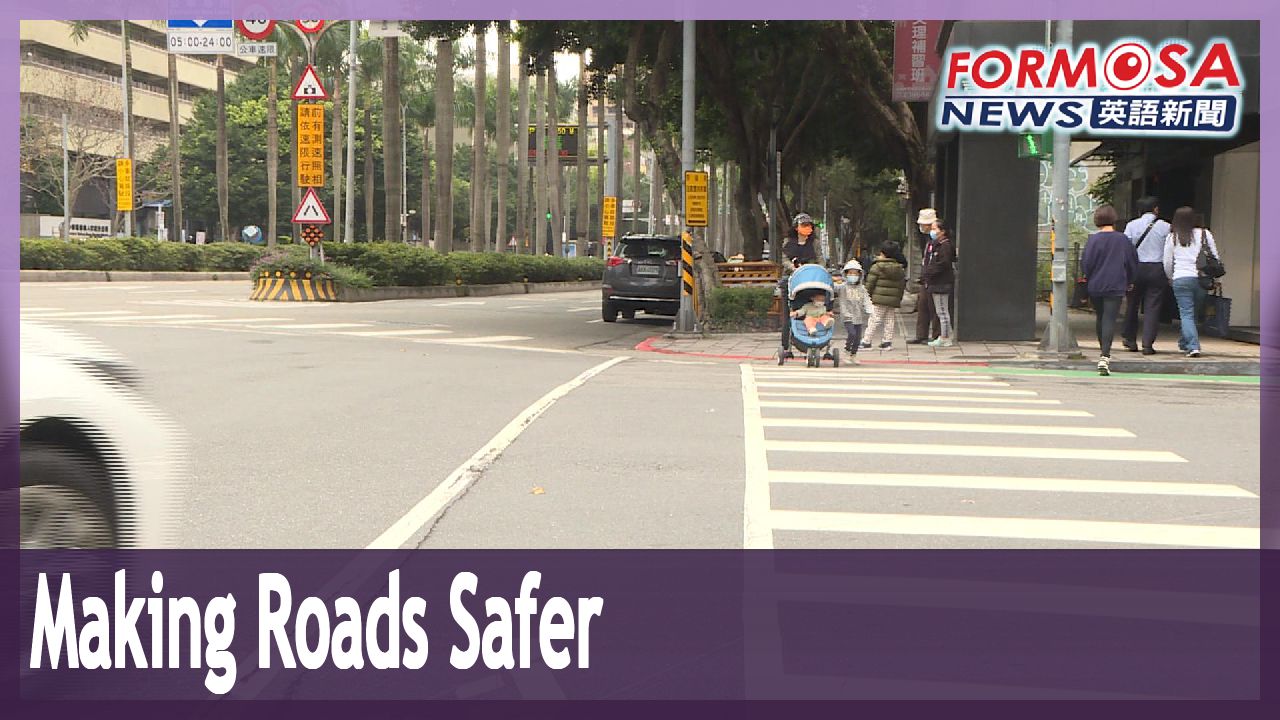
Taiwan is famous for its food, scenery and hospitality, but it’s also a "living hell for pedestrians." That’s according to a CNN report last year. Experts say that most of Taiwan’s road designs and policies are meant to get traffic moving as fast as possible, often at the cost of safety. But in recent years, the concept of "people-oriented transport" has gotten traction, and activists are pushing for the rights of pedestrians. What are the changes they say will improve road safety? We find out in our Sunday special report.
Cars not yielding to pedestrians is a daily sight in Taiwan. Some accidents cause only minor scrapes, while others sadly cost lives. Transport ministry statistics show more than 400 deaths annually from traffic accidents.
Liu Li-liang
Transport ministry
Everyone must adopt the concept of yielding to pedestrians, because pedestrians are the more vulnerable group of people using the road. If everyone yields, we may see a reduction in deaths at intersections.
Taiwanese drivers tend to be in a hurry, and this makes intersections a deathtrap. Pedestrians are urged to look both ways before crossing the road, but some argue the onus should be put on drivers.
Chao Chia-lin
Chung Yuan Christian University
It is the result of how we teach people that intersections have become deathtraps. We teach them to yield, fear and cower from cars. Drivers don’t need to cower away from pedestrians.
People are told to wear bright or reflective clothing outdoors at night. However, some say this suggestion also makes pedestrians responsible for safety, rather than drivers.
Lin Chih-hsueh
Taiwan Traffic Safety Association
You have to understand that telling people to wear reflective things is a driver-oriented mindset. People aren’t going to do that, so they must rely on public lighting fixtures to illuminate them.
Stepping out from Taimall Park in Taoyuan, traffic-safety advocate Lin Chih-hsueh spots a car parked illegally on the sidewalk. The lack of pedestrian-focused traffic design in Taiwan is frustrating, he says. Despite the introduction of pedestrian lanes painted in green on roads, the lanes are often missing or abruptly end.
Lin Chih-hsueh
Taiwan Traffic Safety Association
Turns at our intersections are designed based on the boundary between public and private land. They don’t take into account the path traversed by vehicles. So naturally it is difficult to account for the path of pedestrians.
Looking at the traffic design for Taiwan’s cities makes it clear there is no space allotted for pedestrians at corners. If a driver parks illegally at a corner, pedestrians are forced out into the street, putting them at risk of getting hit.
Lin Chih-hsueh
Taiwan Traffic Safety Association
If we designed the corners properly, it wouldn’t be possible for drivers to park illegally, and traversing corners would be made easier. The biggest impact would be felt by drivers of large commercial trucks. When those trucks make turns, if someone is parked illegally on the corner, it puts the truck driver in a real bind.
Designing sidewalks to follow the proper turning radius around corners would force drivers to make proper turns. It would also help prevent illegal parking at corners, and would make intersections safer for pedestrians.
Sidewalks in Taiwan are also often obstructed by power transformers, trees and illegally parked scooters. The issue is caused by poor lateral communication, with contractors simply following plans, and not communicating problems to designers. The issue results in unusable sidewalks.
Chang Sheng-hsiung
Tamkang University
In 10 meters there’s a power transformer. How will you get around it?
Chung Yuan Christian University School of Design Dean Chao Chia-lin draws a diagram of a typical intersection in Taiwan. He explains that when lights turn green, both vehicles and pedestrians proceed through the intersection. In many cases, pedestrians are in the driver’s blind spot behind their A pillar.
By moving sidewalks further outward, cars will be straightened out before they reach the intersection, and they will be able to see pedestrians clearly.
Taiwan’s driver-oriented traffic model is undoubtedly the reason Taiwan is called a hell for pedestrians.
Lin Chao-hsien
New Taipei Transportation Department
In fact, the design concept early on, including for intersections, was to prevent traffic jams. We aimed to get traffic moving along as fast as possible. The idea was to improve efficiency.
Chang Sheng-hsiung
Tamkang University
What I worry about in regard to society is the way we chase efficiency. Likely there are a lot of places now where we pursue efficiency at the expense of safety.
Taiwan’s driver-oriented traffic design can be traced back to 1978, and was based on the design in the U.S. However, differences in population and geographical factors between the countries mean the U.S. model is not fully suitable for Taiwan.
Chao Chia-lin
Chung Yuan Christian University
The U.S. is a driver-oriented society. Cars are cheap in the U.S., and there is plenty of land there. In many parts of the U.S. if you don’t have a vehicle, you can’t get around.
European countries adopt people-oriented transportation models. In some European countries, pedestrians have exclusive use of an area covering roughly 45% of the road. Although this reduces road width and causes traffic jams, it also changes the way locals think about transportation.
Chao Chia-lin
Chung Yuan Christian University
It’s common for people in Europe to ride a bicycle 10 to 15 kilometers one way for their daily commute. Therefore, they have comprehensive networks of bike lanes there. Their cities are already developed in that respect. If people there choose to drive, they choose to be stuck in traffic.
Here at the intersection of Xianmin Blvd. and Xinzhan 新站Rd. in New Taipei’s Banqiao District, the MRT and Taiwan Railways Administration rail networks converge. The intersection is often crowded, and the traffic is heavy and fast-moving. For the safety of pedestrians, the intersection uses a diagonal crossing and pedestrian signal lights.
Lin Chao-hsien
New Taipei Transportation Department
At certain times, only pedestrians can traverse the intersection. This can reduce the number of scenarios where cars are weaving through pedestrians, which significantly improves safety for people crossing the road.
The intersection’s crosswalks were also widened from 4 to 6 meters, and directional areas were added to both ends of the crosswalks. Additionally, pedestrian signals were enlarged to make them more visible to older adults.
This is Dexiang Rd. in Kaohsiung’s Nanzih District. Pedestrian lanes were painted along the roadside, and scooters now park outside the lanes. In the past, scooters would park illegally along both sides of the road, reducing the four-lane road to two lanes. Pedestrians were also forced out into the street, putting them at risk.
Now pedestrians walk close to the storefronts on a roughly 2-meter-wide lane, with scooters off to the side.
Mr. Wu
Shop owner
Actually, it hasn’t made a big impact on business. However, when I’m walking along the road I personally feel a bit safer.
Liu Kuan-chieh
Road safety advocate
Traffic jams are a problem that cities face worldwide. However, people typically won’t use this as a reason to widen roads. Instead, people will simply avoid driving in the city.
Liu Kuan-chieh previously studied in Europe as an exchange student. When he returned home, he realized that Taiwan’s roads are not pedestrian friendly. He set out to improve the situation through new road-design plans.
Liu Kuan-chieh
Road safety advocate
I just hope that the area around my home can be safe. I drew some rough drafts, which I may give to a city councilor, or to a transportation official. After they adopt the ideas, maybe they can slowly be implemented on the roads.
City traffic engineer Chuang Che-wei also has some new ideas about road design. He and road-safety advocate Liu Kuan-chieh often meet to discuss road design together. They collect road-design templates, which they pass on to officials to consider.
Liu Chien-pang
Kaohsiung Transportation Bureau
To make these changes we can use a PPP, or public-private partnership, model. Public and private parties can cooperate, to take our ideas for road markings and road design, and continuously make improvements.
With much of the world adopting a people-oriented traffic model, Taiwan must implement changes to keep pace. Safe roads and intersections are in everyone’s interest. If Taiwan resolves to improve traffic safety, it will shed its image as a “pedestrian hell,” and the country will be a better place for generations to come.
劃掉行人地獄的惡名
2023-08-06
美國有線電視新聞網CNN曾有一篇關於台灣的報導,提到台灣以美食、自然景觀和好客聞名,但惡名昭彰的交通讓人卻步。台灣多數的交通政策、道路規劃以車輛為主,大多著眼於讓更多車子順暢通過,結果卻忽略了行人的權利。近年來,人本交通的觀念已經逐漸抬頭,有哪些觀念需要扭轉呢?一起來了解。
車輛未禮讓行人的景象,台灣各地每天都在上演,輕則擦傷,重則失去寶貴生命。依據交通部提供的道路事故數據,平均每年約有四百多位行人慘死輪下。
[[交通部道安委員會組長 劉俐良]]
“大家要有停讓的觀念,行人畢竟是弱勢的用路族群,大家多一點停讓的話,可能在路口的部分,可以減少行人的死亡。”
台灣車輛搶快,路口被比喻成虎口。提醒行人過馬路時要左顧右盼、注意安全,但這樣的宣導,其實是「以車為本」的觀念。
[[中原大學設計學院院長 趙家麟]]
“這個是我們教育出來的,馬路如虎口,都在教育民眾,要讓車、要怕車、要躲車,車不用躲你。”
還有夜晚過馬路,倡導行人穿亮色衣服,或佩帶反光飾品,也讓提倡人本交通的專家相當疑惑。
[[台灣交通安全協會副理事長 林志學]]
“我們一定要去理解,自己會發亮,這個是車子的思維。人不會自己發亮,他要仰賴的是公共設施去照亮人。”
一出桃園南崁台茂購物中心,馬上就遇到車輛違停在人行道的狀況,台灣交通安全協會的林志學很無奈,因為台灣的交通很少是為了人而設計。近年雖然用標線劃出綠底的人行道,勉強可用,很多時候卻不連續,尤其到轉角,走著走著,人行道就消失了。
[[台灣交通安全協會副理事長 林志學]]
“我們的轉角設計都是從公私地界的界線平移出去,沒有考慮車輛的動線,所以自然人行空間,在轉角的部分就很困難。”
點出台灣都市設計與道路設計的通病,也就是彎角處沒有設計人行空間,一旦有車輛違停,行人就得往外走上車道,容易與右轉車發生碰撞。
[[台灣交通安全協會副理事長 林志學]]
“如果我們把彎角設計完之後,車輛就不容易違停在彎角,應該轉彎的時候會更順暢。尤其影響最深的,就是大型車輛的駕駛,因為大型車要右轉的時候,右轉的違停,常常造成他們轉彎很大的困擾。”
若把人行道沿著街角劃出,確保車輛轉彎時有乾淨的右轉弧度,不只可以遏止違停,駕駛能貼邊線行駛,行人也少了威脅。
人行道還常被電箱、行道樹甚至機車占據,會演變成這樣,其實是相關單位的橫向聯繫出現問題,按圖施工者沒和設計單位溝通,才會讓做好的人行道變得無法使用。
[[淡江大學運輸管理學系教授 張勝雄]]
“十公尺就有一個變電箱,請問你怎麼走?”
中原大學設計學院院長趙家麟在紙上簡單畫出台灣路口的現狀,說明斑馬線與號誌,可能也是行人的隱形殺手。原因在於斑馬線大多劃在路口,綠燈亮時,人與車同時前進,當車要右轉,駕駛容易被車子的A柱擋住視線,產生視線死角。
讓斑馬線往路口外推,騰出來的空間可以讓右轉車輛打正,就能看清楚來往的行人。
而台灣「以車為本」的交通設計,無疑也開啟了行人地獄。
[[新北市交通局交通管制工程科科長 林昭賢]]
“其實早期在設計,的確包括在路口設計的部分,我第一考量的部分,就是不要塞車,車輛能夠讓它快速地穿越,效率提升,這個大概是以前的觀念。”
[[淡江大學運輸管理學系教授 張勝雄]]
“尤其整個社會,我比較擔心的是,我們對於效率的追求,可能現在很多狀況是效率的追求,遠高於安全了。”
台灣交通之所以採車本觀念設計,其實可以追溯至1978年,是參考美國。但美國與台灣的人文、地理條件相去甚遠,根本無法完全適用。
[[中原大學設計學院院長 趙家麟]]
“美國是車本的國家,美國的汽油便宜、汽車便宜、土地廣闊。美國有很多地方,沒有車,根本就是沒有腳。”
相較美國,歐洲國家則採行「人本交通」,街道約45%的面積提供給行人走,雖然會壓縮車道寬度,造成塞車,卻也改變當地人的交通觀念。
[[中原大學設計學院院長 趙家麟]]
“上班族,十到十五公里一趟是非常正常的,騎腳踏車,所以他的自行車道的布建完整,城市已經發展到那個地步。他有沒有開車的?有,你選擇開車 你就選擇塞車。”
來到板橋,新北市政府前的縣民大道與新站路口,這裡交會了火車站與捷運站,人潮絡繹不絕,車流量大、車速也快。為了讓行人穿越便利又安全,新北市政府交通局在路口處,劃出交叉式的行人穿越線,還有行人專用號誌,讓行人號誌先啟動,提高行人過馬路的安全性。
[[新北市交通局交通管制工程科科長 林昭賢]]
“在這個特定的時間之內,只有行人可以穿越這個路口。這樣可以減少車輛,以及行人的一個交織狀況,也是大幅提升行人穿越路口的安全。”
此外,斑馬線也從原本四米加寬到六米,並增加箭頭導引標誌。行人號誌放大,則讓高齡者可以看得更清楚。
來到高雄市楠梓區德祥路,店家門前劃設的標線型人行道,機車沿著人行道邊線停放,過去這裡在沒劃人行道前,兩旁機車違規並排,讓原本四個車道變成兩個車道,行人還被迫與車爭道,險象環生。
如今行人走在緊靠店家門前約兩米寬的人行道,汽機車也依序停放在人行道邊線。
[[飲料店業者 吳先生]]
“其實(生意)並沒有很大的影響,但我自己在走,確實是有感覺到比較安全一些。”
[[標線改造台灣路主編 劉冠頡]]
“塞車我覺得是世界各國市中心的問題,但他們不會因為這樣子要把道路拓寬,大家就乾脆不要開車進來。”
他是劉冠頡,大學時曾到歐洲當交換學生,回國後發現,台灣習以為常的交通環境,相當不友善行人。為了要讓家鄉環境變得更好,他畫起道路設計圖。
[[標線改造台灣路主編 劉冠頡]]
“我希望我家附近可以改變,我就開始自己亂畫圖,可能提給議員,提給交通單位,後來慢慢地他們會接受之後,可能開始在一些路執行了。”
擔任市府交通工程科技士的莊哲維,對道路設計也有一套新思維,他跟劉冠頡兩人時常針對道路設計進行討論,還收集國內外道路的範本,提供給交通單位參考。
[[高雄市政府交通局副局長 劉建邦]]
“這個部分大家可以透過PPP的方式,就是public、private、partnership,公私部門來一起合作,讓我們的標線,還有道路設計上都能夠越來越好。”
「人本交通」是國際趨勢,台灣也必須跟上,駕駛與行人彼此互相體諒,讓道路環境更友善。有朝一日,當我們不用擔心馬路如虎口,能安心穿越時,「行人地獄」也將離我們越來越遠。
Related News