Activists push people-oriented changes for Taiwan’
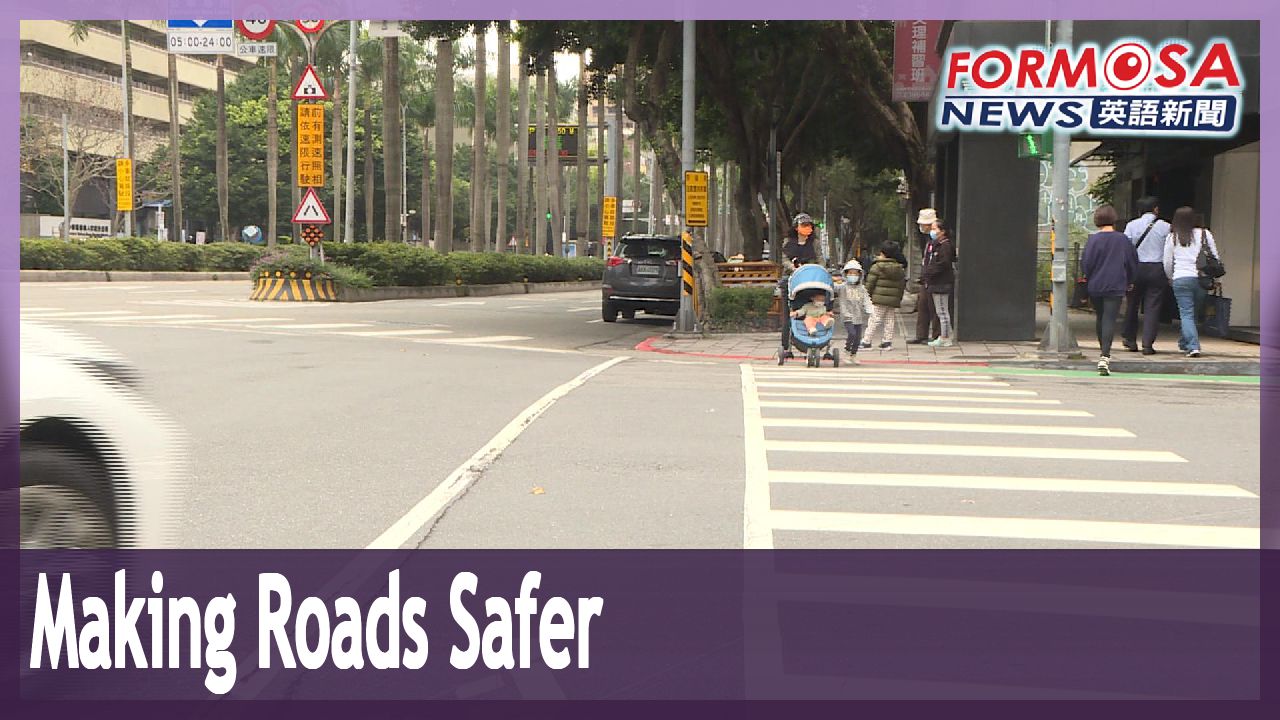
Taiwan is famous for its food, scenery and hospitality, but it’s also a "living hell for pedestrians." That’s according to a CNN report last year. Experts say that most of Taiwan’s road designs and policies are meant to get traffic moving as fast as possible, often at the cost of safety. But in recent years, the concept of "people-oriented transport" has gotten traction, and activists are pushing for the rights of pedestrians. What are the changes they say will improve road safety? We find out in our Sunday special report.
Cars not yielding to pedestrians is a daily sight in Taiwan. Some accidents cause only minor scrapes, while others sadly cost lives. Transport ministry statistics show more than 400 deaths annually from traffic accidents.
Liu Li-liang
Transport ministry
Everyone must adopt the concept of yielding to pedestrians, because pedestrians are the more vulnerable group of people using the road. If everyone yields, we may see a reduction in deaths at intersections.
Taiwanese drivers tend to be in a hurry, and this makes intersections a deathtrap. Pedestrians are urged to look both ways before crossing the road, but some argue the onus should be put on drivers.
Chao Chia-lin
Chung Yuan Christian University
It is the result of how we teach people that intersections have become deathtraps. We teach them to yield, fear and cower from cars. Drivers don’t need to cower away from pedestrians.
People are told to wear bright or reflective clothing outdoors at night. However, some say this suggestion also makes pedestrians responsible for safety, rather than drivers.
Lin Chih-hsueh
Taiwan Traffic Safety Association
You have to understand that telling people to wear reflective things is a driver-oriented mindset. People aren’t going to do that, so they must rely on public lighting fixtures to illuminate them.
Stepping out from Taimall Park in Taoyuan, traffic-safety advocate Lin Chih-hsueh spots a car parked illegally on the sidewalk. The lack of pedestrian-focused traffic design in Taiwan is frustrating, he says. Despite the introduction of pedestrian lanes painted in green on roads, the lanes are often missing or abruptly end.
Lin Chih-hsueh
Taiwan Traffic Safety Association
Turns at our intersections are designed based on the boundary between public and private land. They don’t take into account the path traversed by vehicles. So naturally it is difficult to account for the path of pedestrians.
Looking at the traffic design for Taiwan’s cities makes it clear there is no space allotted for pedestrians at corners. If a driver parks illegally at a corner, pedestrians are forced out into the street, putting them at risk of getting hit.
Lin Chih-hsueh
Taiwan Traffic Safety Association
If we designed the corners properly, it wouldn’t be possible for drivers to park illegally, and traversing corners would be made easier. The biggest impact would be felt by drivers of large commercial trucks. When those trucks make turns, if someone is parked illegally on the corner, it puts the truck driver in a real bind.
Designing sidewalks to follow the proper turning radius around corners would force drivers to make proper turns. It would also help prevent illegal parking at corners, and would make intersections safer for pedestrians.
Sidewalks in Taiwan are also often obstructed by power transformers, trees and illegally parked scooters. The issue is caused by poor lateral communication, with contractors simply following plans, and not communicating problems to designers. The issue results in unusable sidewalks.
Chang Sheng-hsiung
Tamkang University
In 10 meters there’s a power transformer. How will you get around it?
Chung Yuan Christian University School of Design Dean Chao Chia-lin draws a diagram of a typical intersection in Taiwan. He explains that when lights turn green, both vehicles and pedestrians proceed through the intersection. In many cases, pedestrians are in the driver’s blind spot behind their A pillar.
By moving sidewalks further outward, cars will be straightened out before they reach the intersection, and they will be able to see pedestrians clearly.
Taiwan’s driver-oriented traffic model is undoubtedly the reason Taiwan is called a hell for pedestrians.
Lin Chao-hsien
New Taipei Transportation Department
In fact, the design concept early on, including for intersections, was to prevent traffic jams. We aimed to get traffic moving along as fast as possible. The idea was to improve efficiency.
Chang Sheng-hsiung
Tamkang University
What I worry about in regard to society is the way we chase efficiency. Likely there are a lot of places now where we pursue efficiency at the expense of safety.
Taiwan’s driver-oriented traffic design can be traced back to 1978, and was based on the design in the U.S. However, differences in population and geographical factors between the countries mean the U.S. model is not fully suitable for Taiwan.
Chao Chia-lin
Chung Yuan Christian University
The U.S. is a driver-oriented society. Cars are cheap in the U.S., and there is plenty of land there. In many parts of the U.S. if you don’t have a vehicle, you can’t get around.
European countries adopt people-oriented transportation models. In some European countries, pedestrians have exclusive use of an area covering roughly 45% of the road. Although this reduces road width and causes traffic jams, it also changes the way locals think about transportation.
Chao Chia-lin
Chung Yuan Christian University
It’s common for people in Europe to ride a bicycle 10 to 15 kilometers one way for their daily commute. Therefore, they have comprehensive networks of bike lanes there. Their cities are already developed in that respect. If people there choose to drive, they choose to be stuck in traffic.
Here at the intersection of Xianmin Blvd. and Xinzhan 新站Rd. in New Taipei’s Banqiao District, the MRT and Taiwan Railways Administration rail networks converge. The intersection is often crowded, and the traffic is heavy and fast-moving. For the safety of pedestrians, the intersection uses a diagonal crossing and pedestrian signal lights.
Lin Chao-hsien
New Taipei Transportation Department
At certain times, only pedestrians can traverse the intersection. This can reduce the number of scenarios where cars are weaving through pedestrians, which significantly improves safety for people crossing the road.
The intersection’s crosswalks were also widened from 4 to 6 meters, and directional areas were added to both ends of the crosswalks. Additionally, pedestrian signals were enlarged to make them more visible to older adults.
This is Dexiang Rd. in Kaohsiung’s Nanzih District. Pedestrian lanes were painted along the roadside, and scooters now park outside the lanes. In the past, scooters would park illegally along both sides of the road, reducing the four-lane road to two lanes. Pedestrians were also forced out into the street, putting them at risk.
Now pedestrians walk close to the storefronts on a roughly 2-meter-wide lane, with scooters off to the side.
Mr. Wu
Shop owner
Actually, it hasn’t made a big impact on business. However, when I’m walking along the road I personally feel a bit safer.
Liu Kuan-chieh
Road safety advocate
Traffic jams are a problem that cities face worldwide. However, people typically won’t use this as a reason to widen roads. Instead, people will simply avoid driving in the city.
Liu Kuan-chieh previously studied in Europe as an exchange student. When he returned home, he realized that Taiwan’s roads are not pedestrian friendly. He set out to improve the situation through new road-design plans.
Liu Kuan-chieh
Road safety advocate
I just hope that the area around my home can be safe. I drew some rough drafts, which I may give to a city councilor, or to a transportation official. After they adopt the ideas, maybe they can slowly be implemented on the roads.
City traffic engineer Chuang Che-wei also has some new ideas about road design. He and road-safety advocate Liu Kuan-chieh often meet to discuss road design together. They collect road-design templates, which they pass on to officials to consider.
Liu Chien-pang
Kaohsiung Transportation Bureau
To make these changes we can use a PPP, or public-private partnership, model. Public and private parties can cooperate, to take our ideas for road markings and road design, and continuously make improvements.
With much of the world adopting a people-oriented traffic model, Taiwan must implement changes to keep pace. Safe roads and intersections are in everyone’s interest. If Taiwan resolves to improve traffic safety, it will shed its image as a “pedestrian hell,” and the country will be a better place for generations to come.
2023-08-06