Taichung mayor says fireworks snafu ‘all our fault’
Taichung mayor says fireworks snafu ‘all our fault’
2023-10-12
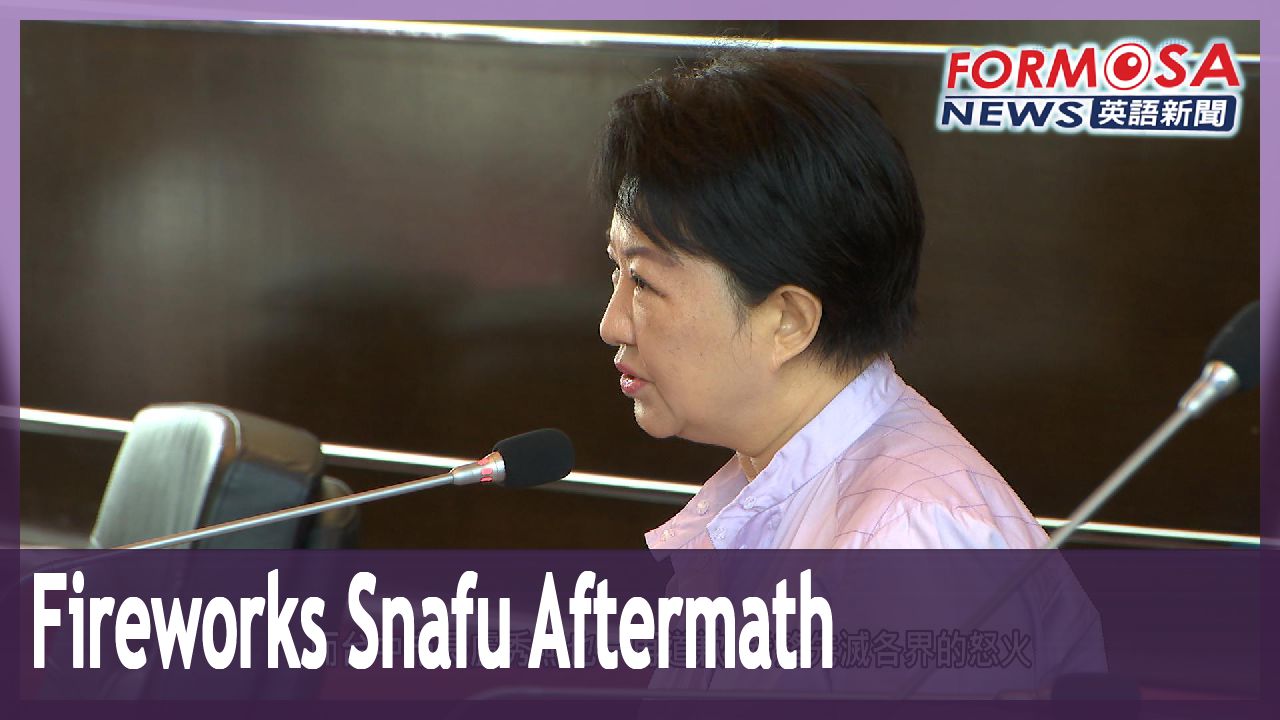
Taichung Mayor Lu Shiow-yen has accepted blame for the National Day fireworks’ premature launch. The display started 20 minutes ahead of schedule, after VIPs gave speeches that were shorter than expected. Speaking to a city councilor, the mayor said the scheduling lapse was, quote, all our fault. But another Taichung official claims that the defense ministry is also to blame.
After the premature launch of the National Day fireworks, the Taichung City government faced fiery criticism from city councilors. Taichung Mayor Lu Shiow-yen took full responsibility.
Lu Shiow-yen
Taichung mayor
The Taichung City Government accepts all the blame for this. It was all our fault.
Lu rushed to put out the fire. But the day before, her tourism director Chen Mei-hsiu had a different take on what happened.
Chen Mei-hsiu (Oct. 11)
Taichung Tourism and Travel Bureau
The National Security Bureau said the defense ministry’s fireworks unit, our chief director, and the emcee would each have a controller and they’d have to manage the launch together at the control station. So the fireworks launch was indeed handled by all three parties.
The tourism director said the defense ministry was partly to blame. But defense minister Chiu Kuo-cheng said the ministry only had a supervisory role and did not have a hand in making decisions.
Chiu Kuo-cheng
Defense minister
The Ministry of National Defense did not take part in the decision-making process, OK? The National Day celebrations are led by the organizing committee. We were involved in some of the work, but we did not make any decisions.
Tsai Chi-chang
Deputy legislative speaker
From the transport arrangements to the premature launch of the fireworks to the general chaos at the event, it was all such a pity. It showed a lack of meticulousness in the city government’s planning.
Amid the mishaps, the National Day organizing committee apologized Wednesday evening, saying it would learn from the mistakes and launch a review. Mayor Lu has repeatedly apologized, hoping to quell the outrage.
For more Taiwan news, tune in:
Sun to Fri at 9:30 pm on Channel 152
Tue to Sat at 1 am on Channel 53
國慶焰火變怒火 盧秀燕:都是台中市政府的錯
2023-10-12
國慶焰火在台中,流程被罵翻,立法院副院長蔡其昌直言「從驕傲變遺憾」;不過,到底為什麼會提早20分鐘放焰火?台中市觀旅局表示「是國防部焰火處、晚會總導演、主持人三方決定的」,對於爭議延燒,台中市長盧秀燕再度道歉,承認「都是我們的錯」。
一場令人期待的國慶焰火,轉眼間變成怒火,面對議員罵聲不斷,台中市長盧秀燕認了「一切的錯」。
[[台中市長 盧秀燕]]
“台中市政府概括承受,所有的錯,都是我們的錯。”
盧市長急滅火,但前一天下午,市府觀旅局長陳美秀,可不是這樣講的。
[[台中市觀旅局長 陳美秀(10.11)]]
“國安那邊也會說,焰火處,還有我們總導演,還有司儀,他們會有一個總控、主控三台會一起做,那個焰火確實是三方一起說開始放的。”
台中市觀旅局還點名國防部也有責任,但國防部長邱國正澄清,國防部是擔任督導的角色,並沒有插手實際的現場決策。
[[國防部長 邱國正]]
“我們國防部沒有參與到決策吧,好不好?因為國慶有個慶籌會嘛,那我們是有參與一部分工作,沒有去做決策的問題。”
[[立法院副院長 蔡其昌]]
“從交通動線、焰火的施放提早,然後到現場整個混亂的狀況,其實這是一個讓人感到遺憾,也展現出市府整個螺絲並沒有繃緊。”
對於國慶焰火多項缺失 ,國慶籌備會11日晚間向國人道歉,強調將會記取教訓,虛心檢討;而台中市長盧秀燕也一再道歉,希望先滅各界的怒火。
更多新聞內容,請鎖定:
民視台灣台(152頻道)週日至週五晚上9:30
民視新聞台(53頻道)週二至週六凌晨1:00
Related News