Music and art created by algorithms -- Wu Che-yu’s generative art exhibition
Music and art created by algorithms -- Wu Che-yu’s generative art exhibition
2023-10-12
With the rise of AI, generative art is becoming more prominent in artistic circles. Artworks are created with non-human technology that independently determines some or all of their artistic features without input from the artist involved. Taiwanese artist Wu Che-yu writes algorithms to create generative art pieces and musical compositions. FTV reporter Stephany Yang takes us to find out more.
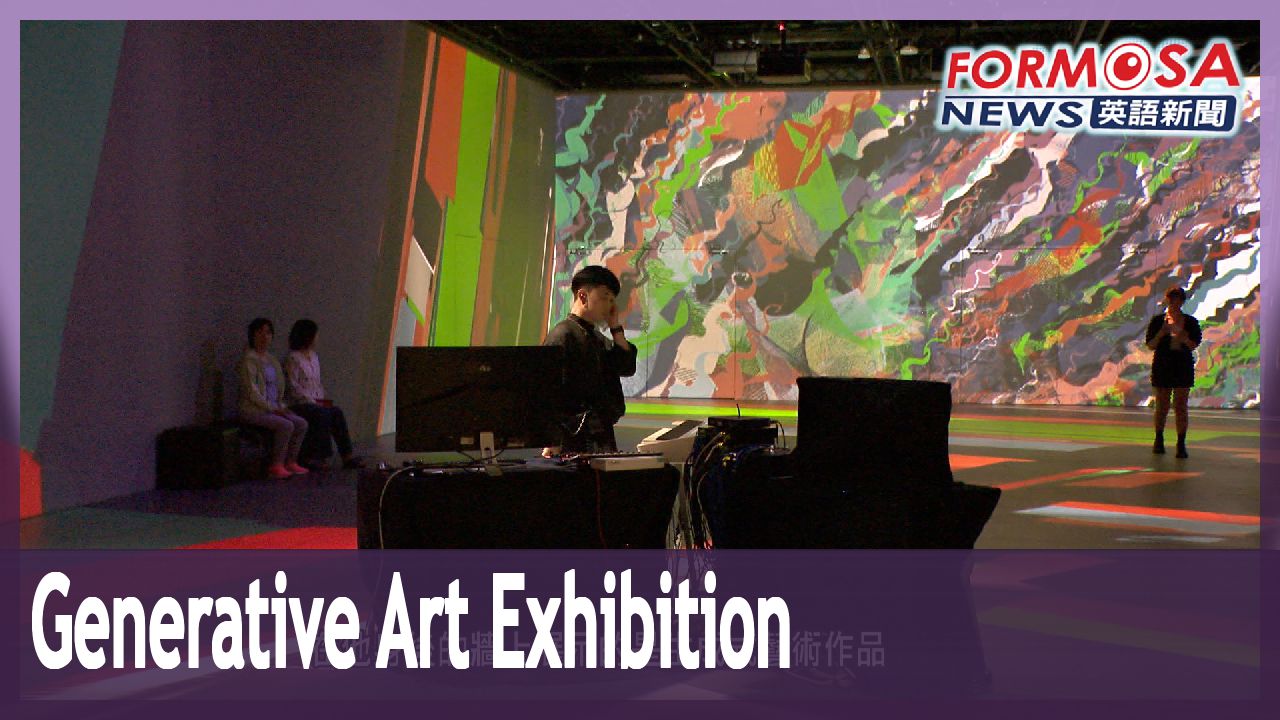
Taiwanese artist Wu Che-yu plays the electric piano. Behind him displayed on the walls are generative art pieces. As he plays, their backgrounds change. Wu wrote algorithms to create these works. The exhibition combines generative art with classical and modern electronic music.
Wu Che-yu
Generative artist
Generative art is more like an engineering process, not like taking a brush and do something on the canvas. It is actually when I am writing code, it is like I am writing poems. The artwork itself is the code. The code is an organic system living in the space. So, every time people come in, there have different music signals. You can see the generative art just change by all the behavior. So all the people will be involved in the artwork itself.
The exhibition presents 13 generative art pieces divided into three chapters. The series of works are inspired by nature, modern art, math, physics, and more.
Wu Che-yu
Generative artist
As an engineering student, I tried to find out how to describe all the things we see in the world. So like can we use math and algorithms to simulate fish swimming in the deep sea? Can we use those to describe the mountains in Taiwan? I think that is a very interesting way to present art.
Wu said it was a laborious process to write the codes and put everything together to present the exhibition.
Wu Che-yu
Generative artist
All the codes in the exhibition, it is the code from three years ago. I keep making different works. There are 300 to 400 pieces. Then, we made an organic system to combine them all together. So, this exhibition took six months to form it into its final visual. It is different from AI. So actually, we are more hand-crafted code. AI is like black box. We don’t know what to expect from that. For this, we are making a delicate machine like a clock.
Wu studied electrical engineering at National Yang Ming Chiao Tung University and integrative digital art at New York University for his master’s program. He began learning creative coding in 2017 and creating non-fungible tokens in 2020. He sees huge potential in combining generative art with fashion and hopes to collaborate with the fashion industry in the future.
Wu Che-yu
Generative artist
There was a time, I was confused about how to merge engineering, art, and also math. As a student in Taiwan, most of the time we are solving problems. But, I think engineering is also a medium to create. I am thinking of collaborating with the fashion industry. We made a clothing collaboration this time. It is clothes with different algorithms. It has 100 different styles but from the same algorithm. I think that is a very good point to get out of the box just to let this kind of creative algorithm art start to evolve and thrive into the society.
"The Great Equation - A Digital Life Journey" will be held till Oct. 16.
For more Taiwan news, tune in:
Sun to Fri at 9:30 pm on Channel 152
Tue to Sat at 1 am on Channel 53
台灣生成式藝術家吳哲宇個展 《萬物公式》展出中
2023-10-12
隨著人工智慧的興起,生成式藝術在藝術界變得越來越廣泛。藝術品是用非人類技術創作的,獨立決定部分或全部藝術特徵,無需藝術家的輸入。台灣生成式藝術家吳哲宇舉辦新展覽,透過編寫演算法來創作生成式藝術和音樂作品。一起來看看!
台灣生成式藝術家吳哲宇彈奏電子鋼琴。在他身後的牆上展示的是生成式藝術作品。背景會隨著他的演奏產生變化。吳哲宇利用演算法創作出這些作品,展覽將
生成式藝術與古典和現代電子音樂結合。
[[生成式藝術家 吳哲宇]]
"生成式藝術更像是一個工藝工程,而不是像拿起畫筆在畫布上。實際上,當我寫程式時,就像我在寫詩一樣。藝術品本身就是程式,是生存在空間中的一個有機系統。所以每次有人進來時,都會有不同的音樂訊號。你可以看到生成式藝術是透過各種行為而產生變化,所以每個人都會參與到藝術品本身。"
展覽分為三個章節展示13件生成式藝術作品。該系列作品的靈感來自大自然、現代藝術、數學、物理等。
[[生成式藝術家 吳哲宇]]
"作為一名工程學生,我試圖找出如何描述我們在世界上看到的一切。我們可以用數學和演算法來模擬深海的魚類游泳嗎?可以用這些來形容台灣的山嗎?我認為這是一種非常有趣的藝術呈現方式。"
吳哲宇表示,編寫程式以及結合所有內容,是一個相當費力的過程。
[[生成式藝術家 吳哲宇]]
"展覽中的所有程式碼,都是三年前的程式碼。我不斷創作不同的作品,有300到400件。然後,我們製作了一個有機系統將它們結合在一起。所以,這次展覽花了六個月的時間才形成最終的視覺效果。它與人工智慧不同。所以實際上,我們更多的是真人編寫的程式碼。人工智慧就像黑盒子,我們不知道會發生什麼事。但我們像是在製造一台跟時鐘一樣精密的機器。"
吳哲宇在國立陽明交通大學攻讀電機工程,並在紐約大學攻讀綜合數位藝術碩士學位。他於2017年開始學習創意程式設計,並於2020年投入創作NFT。他看到了生成式藝術與時尚相結合的巨大潛力,並希望未來與時尚產業合作。
[[生成式藝術家 吳哲宇]]
"曾經有一段時間,我很苦惱要怎麼結合工程、藝術和數學。身為在台灣讀書的學生,我們大部分時間都在解決問題。但是,我認為工程也是一種創作的媒介。我正在考慮與時尚界合作,這次我們進行了服裝合作,這是具有不同演算法的衣服,它有100種不同的風格,但來自相同的演算法。我認為這是一個很好的突破,讓這種創造性的演算法藝術開始在社會中發展。"
《萬物公式》展覽將展出至10月16日。
更多新聞內容,請鎖定:
民視台灣台(152頻道)週日至週五晚上9:30
民視新聞台(53頻道)週二至週六凌晨1:00
Related News