A refresher on earthquake safety: Forget the ‘Golden Triangle’ theory
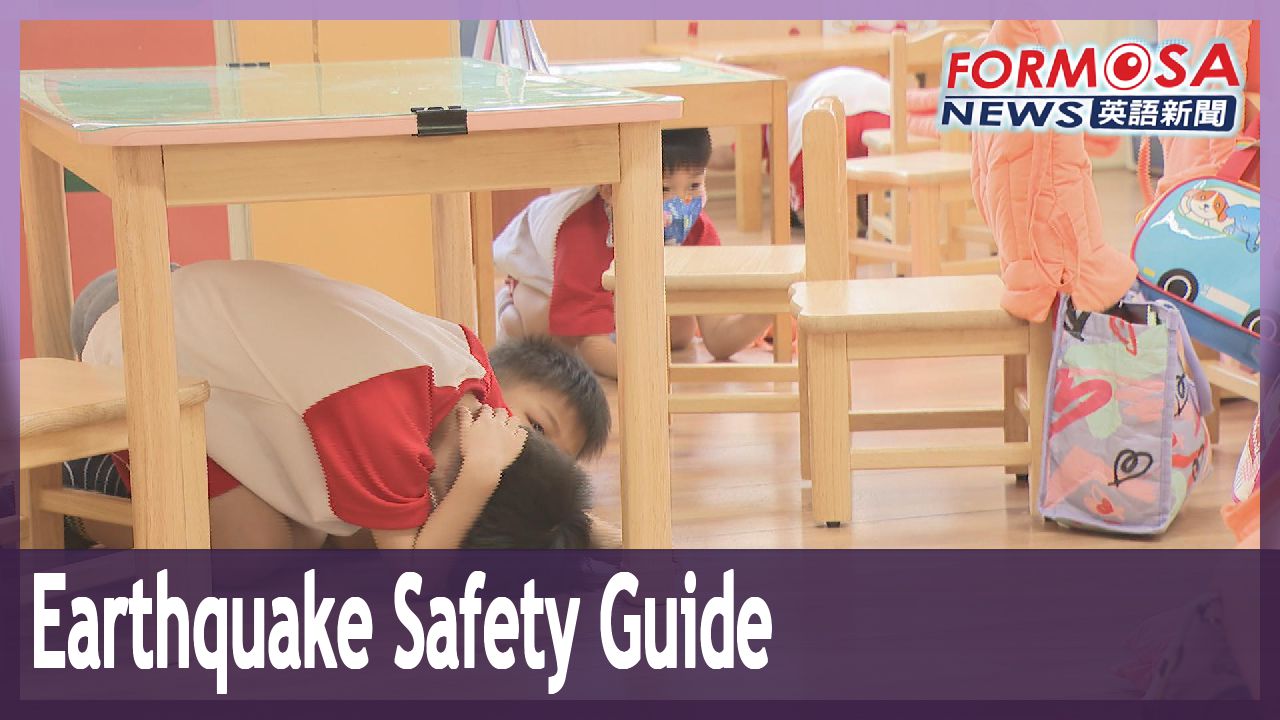
Now for a short refresher on earthquake safety. Do you know what to do if the Earth starts to tremble? Maybe you’ve been through loads of quake drills, maybe you have a procedure when you hear a tremor. And maybe you’ve heard of the popular “Golden Triangle” theory about where to hide. Today we go over the basic, uncontroversial advice, which is to “get down, cover, stabilize.” We also hear from quake experts to bust some myths. The keys to remember are lowering your center of gravity, protecting your head, and hiding under something stable.
When an earthquake siren sounds, and the ground starts to shake, there’s no time to waste. Many of us aren’t sure where to hide to protect ourselves, but these passersby are well-informed.
Member of public
I remember what we were taught in school. You need to hide under a solid table, and protect your head.
Member of public
Hide under the table or beside a cabinet.
There are 36,000 to 40,000 earthquakes in Taiwan every year. Only about 1,000 are strong enough to notice. Many of us have been going through emergency drills ever since we were children. The drill is always get close to the ground, cover yourself for protection, and when the quake calms down, leave the building while protecting your head. But where to hide is the million-dollar question. And best practice has changed over the years.
Chan Chien-yang
Fire Safety Museum of Taipei City Fire Department
In the 1999 Jiji Earthquake, when the Tunghsing Building collapsed in Taipei, the Sun brothers were trapped inside for many days. When they emerged, they said they had survived because of being next to a fridge, and having some fruit to eat. We can only say they were very lucky. But we can’t say, go and stand by a fridge next time there’s an earthquake, because in doing so you might be injured.
The “Golden Triangle” theory posits that when a quake begins, you should take cover next to a large piece of furniture, in a triangle between a wall and the furniture. Proponents say this space will increase your chances of survival. But earthquakes can cause furniture to move and walls to collapse, of course. It might not work out as you hope. In some cases, this space could become more dangerous.
Liao Cheh-wei
Central Weather Bureau Seismological Center
In general, we recommend that furniture like large cabinets should be fixed to the wall. For larger pieces of furniture, these days, we suggest buying an L-shaped bracket to fix it to the wall. Then if there’s an earthquake, they won’t move around.
Quake experts say the key is to get your center of gravity low to the ground and choose a sturdy piece of furniture to hide under. And do not go to turn off the gas or open the door – doing that could put you at risk of injury. The principles for best chances are “get down, cover, stabilize.”
For more Taiwan news, tune in:
Sun to Fri at 9:30 pm on Channel 152
Tue to Sat at 1 am on Channel 53
2023-10-24