Cheerleaders in stadiums: a home run or bad call?
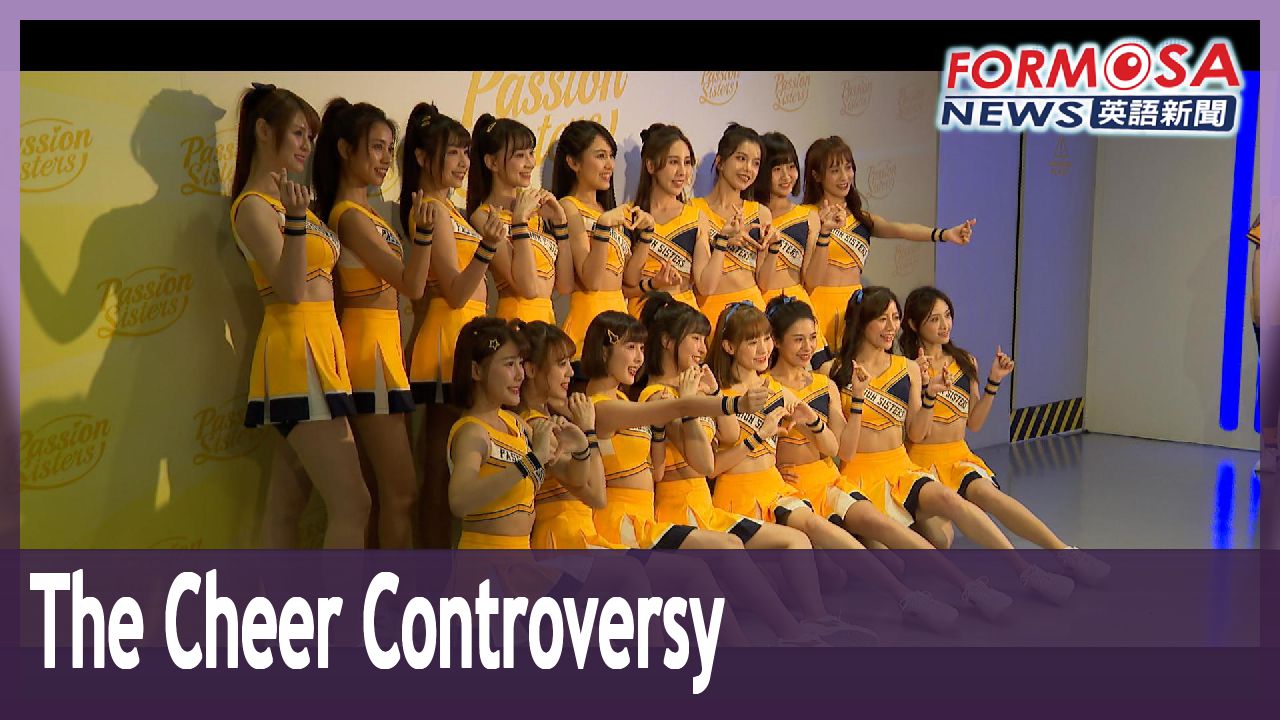
From basketball to baseball, nearly every professional sports team in Taiwan has a cheerleading squad. Fans go to stadiums not just for the games, but also for the animated sideline performances. As cheerleaders soar in popularity, they’ve helped to drive ticket sales and bring international attention to Taiwan. But they’ve also raised some pressing questions. Are they uplifting or undermining women? Are they helping or hindering Taiwan’s sports culture? We dive into the debate in our Sunday special report.
Here at Xinzhuang Baseball Stadium, nearly 10,000 fans wait in the stands to watch the Fubon Guardians play the CTBC Brothers. At the other end of the stadium, there’s a buzz of excitement as cheerleaders stream in.
Established five years ago, the Fubon Angels are Taiwan’s first cheer squad that performs for both baseball and basketball games. The Angels are exclusive to the Fubon franchise.
Anna
Fubon Angels cheerleader
I majored in dance, so I thought if I could combine my passion with my profession, I’d have the world’s best job.
Rain begins to pour in the second inning. The fans bring out their umbrellas as the cheerleaders continue to sing and dance.
Milkshake
Fubon Angels cheerleader
Sometimes it rains in the middle of a game, and it’s not too heavy, so the referee doesn’t call a timeout. So have to keep cheering in the rain, but the ground can be quite slippery.
On this day at Rakuten Taoyuan Baseball Stadium, the home team is scheduled to play the Wei Chuang Dragons. It’s a hot, stifling day. But the Rakuten Girls have arrived on the scene, even earlier than the players.
Behind the glamour of cheerleading is a lot of hard work.
Lan Lan
Rakuten Girls captain
Once we had a doubleheader. We played a game at noon and another at night. I developed heatstroke and felt like I needed to vomit in the middle of a routine.
Besides being able to brave the elements, cheerleaders must have stamina and a strong memory. Every player has a special chant and corresponding moves, and there are opening and half-time shows. Cheerleaders must memorize nearly 50 routines and perform for at least six innings.
Lan Lan
Rakuten Girls captain
This is my seventh year with the squad and a lot has happened over the years. I’ve gotten hit in the head with a dry ice blast. I was watching home plate and our team scored, so of course there was a celebration. The dry ice blaster went off directly into my face, which was a bit scary at the time.
The cheerleaders are popular, not just because of their appearance or dance skills. Their main appeal is how approachable they are, unlike big-name celebrities. Fans interact with the squad during games or promotional events. Thanks to diverse marketing channels, the cheerleaders have tremendous visibility.
Stanley
Rakuten Monkeys marketing manager
We essentially have our own platform. There are 60 home games a year. We have our own stage and run a YouTube channel.
Those who discover the squad on screens have been known to buy tickets to stadiums.
Taiwan baseball’s cheer culture has changed dramatically over the years. In the early days, cheerleaders were a spontaneously arranged group of spectators, not a handpicked squad.
The fans would beat drums, blow air horns, wave flags, and chant simple slogans.
In 2003, the La New Girls were launched by the La New Bears, predecessor to the Rakuten Monkeys. The Girls were the first cheer squad in Taiwan, and there were no permanent members. But ticket sales faltered after 2009 due to match-fixing scandals, remaining poor even when the team won the championship in 2012. That year, each game drew an average of just 2,400 spectators, 600 fewer than the year before. It was a red flag for the franchise.
Pu Wei-ching
Rakuten Monkeys general manager
At the time there were just 2,400 spectators a game. It was already affecting the team, and there were doubts about sustainability. It just so happened that in 2012, we had a chance to go to South Korea. We won the CPBL title and were representing Taiwan in the Asia Series, which was located in Busan. We looked at their ballpark and saw some of the shows staged during the game. We saw the routines of their cheering squad. And we saw that we had a lot to improve on.
In 2013, Pu Wei-ching began the work of bringing South Korea’s cheer culture to Taiwan. Artists were hired to write cheers for the team and every player. New speakers and dedicated DJ booth were installed to support the cheerleaders, amping up the fun in the stadium.
Pu Wei-ching
Rakuten Monkeys general manager
Suddenly your ticket had tons of added value. You didn’t just have a ticket to a baseball game, but also to a show inspired by baseball.
The new cheer culture was copied by other teams, and it succeeded in driving ticket sales. According to Rakuten Monkeys, average attendance per game was 6,900 in 2022. That’s nearly three times the average 10 years ago, when average attendance was just 2,400.
Spectator
I used to just watch baseball games on TV. I think that cheerleaders drew me into the ballpark.
Hsu Yen-hui
Taoyuan sports director
From a political and economic perspective, the squad brings in another stream of advertising revenue for the team. So the squad is backed by this strong ad revenue, making it a force that can’t be ignored.
By industry estimates, CPBL cheerleaders generate more than NT$1.7 billion a year in merchandise sales, live broadcasts, and commercials. Eager to cash in, basketball teams have also embraced cheer culture. One franchise has a department dedicated to cheerleader bookings, endorsements, and merchandise.
Laure Huang
Fubon Guardians entertainment unit director
Actually since last year, there has been growth in Angels merchandise. This year, for instance, if combining the sales of our two teams, we have sold more than 5,000 units of these towels. This figure represents three-fold growth compared to last year.
The cheerleaders’ popularity is clear from their heavy media coverage.
But with so much attention on cheerleaders, there’s less of the limelight for baseball players. The rise of cheer culture has sparked debate.
Chen Zih-syuan
National Taiwan Sport University professor
People only know about how this player had a date with this cheerleader, or how the cheerleaders went overseas again today, things like that. No one notices how pitching speed has declined in the CPBL over the past few years, an issue that’s concerning. I must be frank. When the sport isn’t developing in the ideal way – I would even say if the sport is on the weak side – then what grabs more attention is side attractions like cheerleaders.
For true baseball lovers, going to a game is about watching the players, not the cheerleaders. For them, music in the stadium is an unwelcome distraction.
Chen Zih-syuan
National Taiwan Sport University professor
Some fans might want to hear the sound of a player hitting a ball, they want to hear that “thwack.” But this sound would be completely drowned out in a stadium. The franchise also decides the camera angles of baseball broadcasts. For example, ball fans might really want to see the players interacting after a nice play, or a pitcher reacting after being swapped out for a poor showing. But those moments might be replaced by scenes of cheerleaders dancing.
Chang Yin-huei is the editor-in-chief of a feminist digital magazine. She says that cheerleaders have turned stadiums into sites of female objectification.
Chang Yin-huei
Savoir editor-in-chief
In contrast, there isn’t such a strong cheer culture in Europe. How did we come to rely on cheerleaders? Is it because when we embrace popular culture from abroad, we tend to focus on American pop culture? We tend to forget that there are many other countries in this world. There are cultures that are more tasteful and less demeaning to women and their bodies.
Cheerleading was born in the 19th century on an American college campus. At the time, cheerleading was only for men. It wasn’t until 1929 that women were allowed. When World War II began and men were sent to the front lines, cheerleading began to be dominated by women.
Chang Yin-huei
Savoir editor-in-chief
But ever since then, cheerleading has evolved from an honorable role to a showcase of sexual objectification. When they started out, female cheerleaders dressed very tastefully – you can Google this and find historical images on Wikipedia. Their outfits got skimpier and skimpier over time, becoming what we see today. Cheerleading has gone from dignified to sexy. Of course, it’s not necessarily a bad thing to be sexy. The problem is, when the sexiness is disproportionately represented by one sex, we start to question whether this is a kind of sexism.
Some scholars question the message cheerleading sends, that men play and women cheer. It reinforces harmful stereotypes about division of labor, they warn. But others say that’s taking cheerleading far too seriously.
Spectator
I feel that cheerleaders bring more visibility and energy. There are more positives than negatives.
The debate on cheerleading is long from settled. Both sides say the point is to improve Taiwan’s sports culture. At the end of it all, perhaps women will play and men cheer, in professional leagues stronger than ever before, turning a new chapter for Taiwan sports and gender equality.
For more Taiwan news, tune in:
Sun to Fri at 9:30 pm on Channel 152
Tue to Sat at 1 am on Channel 53
2023-12-24