NTU researchers discover core mechanism of essential tremor
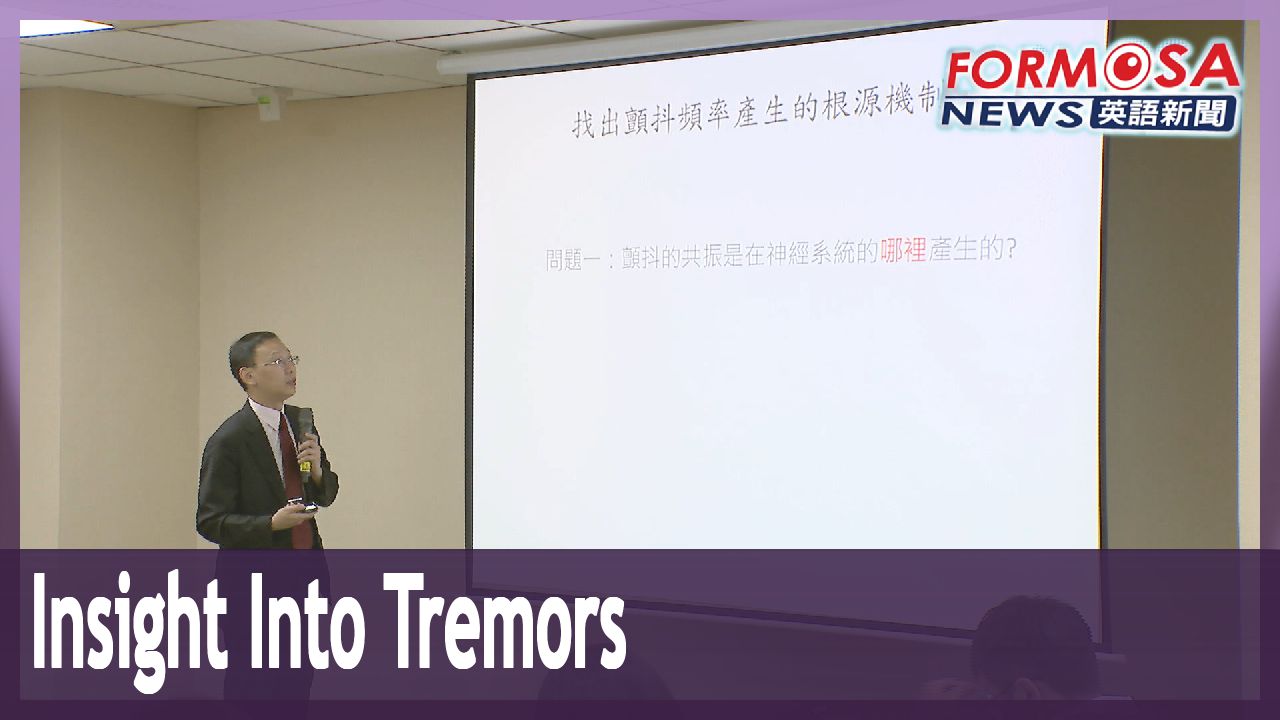
NTU researchers discover core mechanism of essential tremor
2024-07-31
Essential tremor is a common neurological condition that causes involuntary shaking. Despite its prevalence, the physiological process that causes the condition has puzzled scientists -- until now. Taiwanese researchers have discovered that the cerebellum in the brain calculates the frequency of essential tremors. This discovery could pave the way for potential treatments. FTV reporter Stephany Yang has more.
Essential tremor is a disorder that causes involuntary shaking. A team led by National Taiwan University has discovered that the cerebellum calculates the frequency of the shaking.
Pan Ming-kai
NTU Associate Professor of Pharmacology
We are focused on a disease called essential tremor, which is the most prevalent motor disease in humans. People don’t know how it comes. Specifically when you are shaking your hand, there is a specific frequency. For example, you shake your hand four times a second. It means 4 Hz. We don’t know how the brain calculates it. This study actually solves this problem to understand that first of all, it comes from the cerebellum. The cerebellum calculates this frequency. Second of all, we know how the neurons do this. It usually uses a very elegant way where thousands and thousands of neurons to calculate one thing so it will be very precise.
The team experimented with transcranial alternating current stimulation and found that it improved tremor symptoms in mice. Transcranial stimulation may have the potential to treat patients in the future.
Pan Ming-kai
NTU Associate Professor of Pharmacology
The third thing is that because we know how the cerebellum calculates the frequency. We can actally cancel the frequency using a technique called transcranial alternating current stimulation. It initiates a revolution because for the first time, we start to know how our biology, how nerve system do calculations, do math. This is actually not just for essential tremors. It is just a specific case. We actually know how the neurons calculate your movments and motions. So by knowing this, we can cure all the other types of motor disease.
Essential tremor occurs in about 4% of all adults, and about 20% of the elderly population. However, the cause is unknown.
Pan Ming-kai
NTU Associate Professor of Pharmacology
Because there are so many tremor patients, but each of them can have different causes. In precision medicine, in current therapy, you need thousands of different treatments to cure a single patient because you don’t know which cause it is. If we know where the frequency comes from, you can cancel the frequency to cure all these types of patients with one mechanism. This has already passed the animal testing and validating in humans. We are starting to do human trials.
The team’s research was published in the international journal “Science Translational Medicine” in May.
For more Taiwan news, tune in:
Sun to Fri at 9:30 pm on Channel 152
Tue to Sat at 1 am on Channel 53
台大團隊發現顫抖症治療契機 登上國際頂尖期刊
2024-07-31
原發性顫抖症是常見的動作障礙疾病,儘管這種疾病很普遍,但直到現在,原發性顫抖症仍無法找出確切病因。國立台灣大學醫學院藥理學科暨研究所副教授潘明楷研究團隊,發現顫抖是由小腦內部產生,只要調控病患小腦頻率,就可以產生治療效果。
原發性顫抖症是指身體或肢體不自覺顫抖的疾病。國立台灣大學醫學院藥理學科暨研究所副教授潘明楷研究團隊發現,顫抖是由小腦內部產生,只要調控病患小腦頻率,就可以產生治療效果。
[[國立台灣大學醫學院副教授 潘明楷]]
"我們關注的是一種稱為原發性顫抖的疾病,它是人類最常見的動作障礙疾病。人們不知道它是怎麼產生的,具體來說,當你手顫抖時會有一個特定的頻率,例如,每秒顫抖四次,等於4赫茲,但我們不知道大腦是如何計算它的。這項研究實際上解決了這個問題,首先我們知道,它來自小腦,是小腦在計算這個頻率。其次,我們知道神經元是如何做到這一點的,它通常使用一種非常優雅的方式,用成千上萬的神經元來計算一件事,因此它會非常精確。"
研究團隊進行「穿顱交流電刺激」的實驗,發現有效緩解改善了小鼠的顫抖頻率,未來有機會運用在治療患者。
[[國立台灣大學醫學院副教授 潘明楷]]
"第三件事是因為我們知道小腦是如何計算頻率。實際上,我們可以使用穿顱交流電刺激的技術來消除頻率。它引發了一場革命,因為這是第一次我們知道生物學、神經系統是怎麼進行計算,這其實不僅是針對原發性顫抖症,這是一個明確的案例,讓我們實際知道神經元如何計算你的動作和移動。因此,透過了解這一點,我們可以治癒所有其他類型的運動疾病。"
罹患原發性顫抖症的成人占4%、老年人占20%。然而,致病成因皆不同。
[[國立台灣大學醫學院副教授 潘明楷]]
"因為原發性顫抖症非常多,但每個人都有不同的病因。在精準醫療、目前的治療中,需要使用數千種不同的治療方法才能治癒單一患者,因為不知道病因是什麼。如果我們知道頻率從何而來,就可以消除頻率,用一種機制治癒所有這些類型的患者。這已經通過動物測試,目前正在進行人體驗證。我們也將開始進行人體試驗。"
團隊的系列成果,於今年5月發表於國際頂尖期刊「科學轉譯醫學」。
更多新聞內容,請鎖定:
民視台灣台(152頻道)週日至週五晚上9:30
民視新聞台(53頻道)週二至週六凌晨1:00
Related News