Quake warning system updated, droughts possible this autumn: CWA
Quake warning system updated, droughts possible this autumn: CWA
2024-08-30
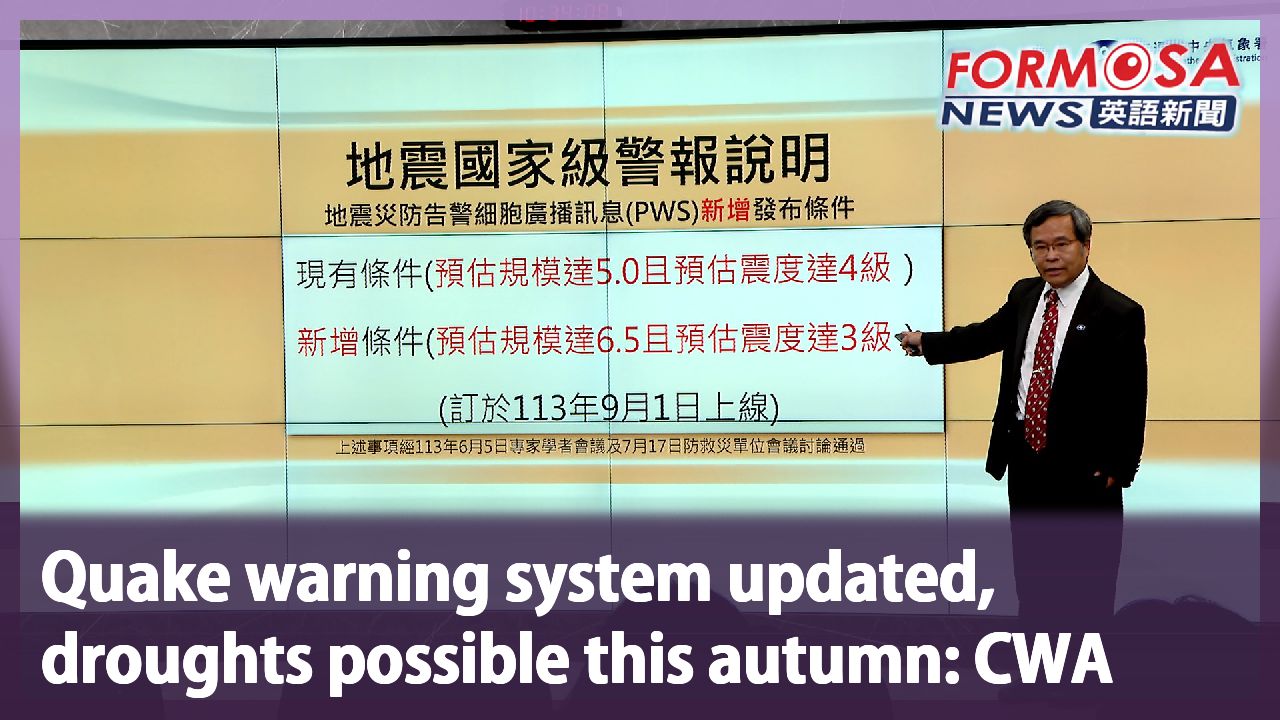
The government’s earthquake early warning system is getting an overhaul. Starting September, warnings will be expanded to include areas where the predicted intensity of the tremor is as low as 3, provided its magnitude is at least 6.5. In related news, meteorologists expect rain and temperatures this autumn to be within a normal range. However, they also don’t rule out warmer weather and rains heavier than average.
A 7.2 earthquake struck Hualien on April 3, shaking the ground in many areas of Taiwan. Its intensity reached a 4 in greater Taipei, which is in theory high enough for the government to send an early quake alert. But no warnings were sent out, giving rise to much controversy. Now, the system’s standards are getting an update.
Wu Chien-fu
Seismologist
The biggest energy release during the April 3 earthquake happened at the 16 to 17 second mark. Under the current system, we only send out warnings when the intensity hits the threshold at level 4. But after these adjustments, we can send a warning earlier, so that when the strong shockwave hits, everyone has two to three more seconds to react.
Under current rules, early warning messages are only sent out when an earthquake’s magnitude is 5 or more and its predicted intensity in the area is at least a 4. Starting Sept. 1, warnings will also be dispatched when the predicted intensity is 3 or more, provided the quake’s magnitude is at least 6.5. In related news, the Central Weather Administration says temperatures this autumn will be average or slightly warmer than usual. Precipitation is expected to be either within normal levels or more abundant.
Chen Yi-liang
Meteorologist
Usually, some low pressure systems form, and low pressure bands remain in the vicinity. When that happens, there is a possibility of rains all over Taiwan. After October, we’ll see some changes to low-pressure currents to the south of Taiwan, and northeasterly winds will start prevailing near Taiwan.
The meteorologist said that starting October, rains will mainly be concentrated in Northern Taiwan. He urged residents in Central and Southern Taiwan to conserve water, as the area could experience droughts.
For more Taiwan news, tune in:
Sun to Fri at 9:30 pm on Channel 152
Tue to Sat at 1 am on Channel 53
氣象署秋季氣候展望 中南部估10月進入"枯水期"
2024-08-30
中央氣象署今天宣布秋季的氣候展望,今年秋季台灣整體氣溫為正常到偏暖,雨量則以正常至偏多的機率較大。另位,地震國家警報方面,9/1起新增「預估規模達6.5以上,且震度達3級」的區域,就會發送地震簡訊,讓民眾有多2-3秒的時間應對。
0403花蓮發生芮氏規模7.2地震,當時搖晃有感、且達發布標準的大台北地區,卻沒收到國家級警報,引起各界議論,如今將新增發布標準。
[[氣象署地震測報中心主任 吳建富]]
“0403最大能量釋放,大概16秒、17秒的位置,也就是說如果我們等到,原有的規模的,還有震度的標準,可能就是在4級的地方發,那如果我們這樣調整,就會在前面先發,讓後面這個大震波來的時候,大家已經有多兩到三秒的一個預警的時間,來做一個反應”
以往"預估規模達5以上,震度達4級以上"才會發布警報,9/1起,新增"預估規模達6.5以上,預估震度達3級以上",就會發送警報。另外時序即將進入秋季,氣象署預估氣溫為正常至偏暖,雨量則以正常至偏多的機率較大。
[[氣象預報中心主任 陳怡良]]
“通常都還是會有一些低壓形成,有一些低壓帶在這附近存在,這時候台灣的雨量,還是全台灣各地,都有機會有一些降雨的,一直到10月份以後,我們可以看到,這個台灣南側的低壓環流,會有一些變化,而台灣附近開始,逐漸會有東北季風的情形”
不過氣象署也提醒,10月起台灣降雨逐漸集中在北部地區,中南部在氣候上將進入枯水期,呼籲民眾妥善利用水資源。
更多新聞內容,請鎖定:
民視台灣台(152頻道)週日至週五晚上9:30
民視新聞台(53頻道)週二至週六凌晨1:00
Related News