The Life of Chiang Wen-yeh: rediscovering a legend
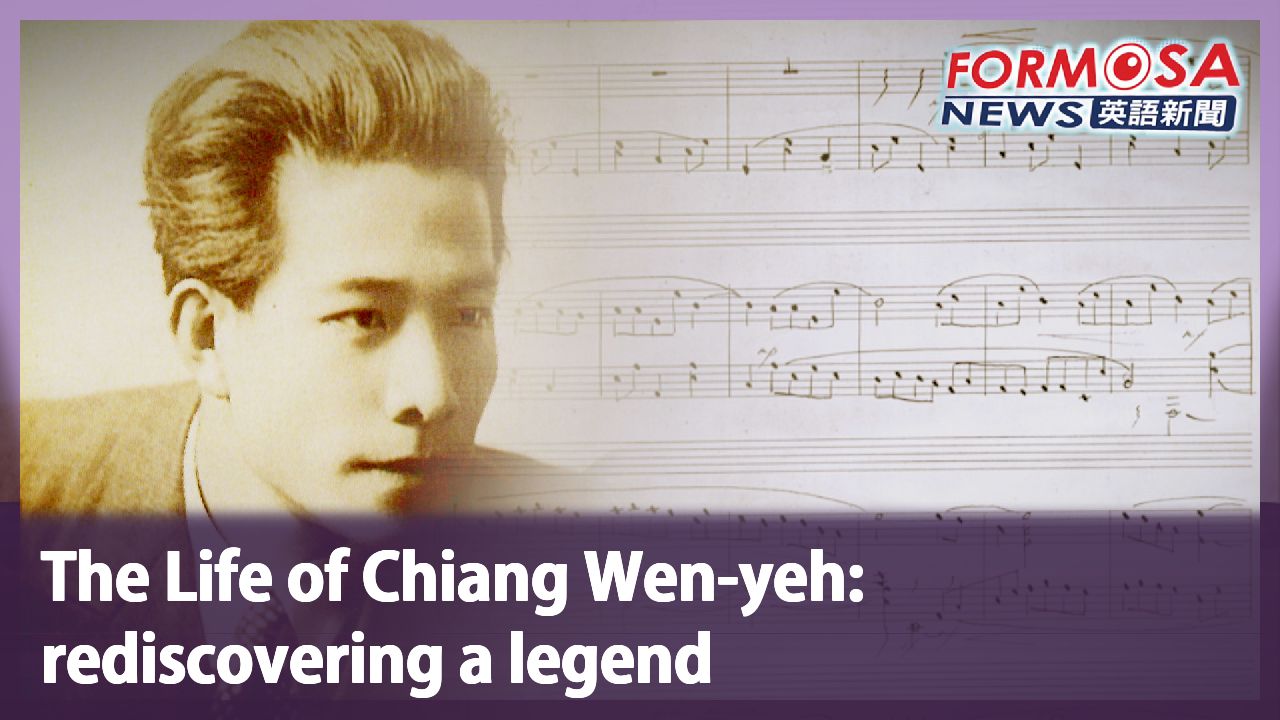
The Life of Chiang Wen-yeh: rediscovering a legend
2024-10-27
Tonight we conclude our series on legendary composer Chiang Wen-yeh. After being labeled a traitor, Chiang was imprisoned by the KMT government, which fled to Taiwan in 1949. Chiang decided to stay in China. But he then became a victim of the communists, first as part of the Anti-Rightist Campaign, and then during the Cultural Revolution. The music professor was put to cleaning toilets, and his musical work fell by the wayside. Much later, in the 1980s, his forgotten works were rediscovered by members of the Taiwanese diaspora. By that time, Chiang was paralyzed after a stroke, and was already on his deathbed. Here’s our Sunday special report.
In 1946, the KMT labeled Chiang a traitor, along with many other Japanese citizens of Taiwanese descent. Eventually, a group calling themselves the “Taiwan Retrocession Salutation Committee” rescued Chiang after 10 months in prison. After he was freed, a friend from prison introduced Chiang to a Catholic friar, Gabriele Allegra. Chiang then used Chinese musical modes to complete the first Catholic Chorale ever written in the Chinese language.
Chang Chi-jen
Composer
He was deeply moved by those words in the sacred music. A priest, Gabriele Allegra, encouraged him. Allegra’s Chinese name was Lei Yongming. He told Chiang, “Write these holy songs for us.” So Chiang did it. And they became popular in Catholic circles. So his songs have been sung in many Catholic churches in Taiwan, although they don’t know who Chiang Wen-yeh is.
Liu Suan-yung
National Taiwan Symphony Orchestra director
Why did he write such lovely sacred music? There’s a specific reason. Chinese music is pentatonic. Like in Gregorian chant, after each line, there’s a line for taking a breath for the next phrase, it’s very free. So for him, it was very easy to write sacred music in a pentatonic scale.
In 1949, the KMT withdrew to Taiwan. Chiang missed his birthplace, but having been imprisoned by Chiang Kai-shek, he decided to stay in China. China’s Central Conservatory of Music was founded in Tianjin by Zhou Enlai in 1950. Chiang was 40 years old, when he took up the role of composition professor there. He commuted on train from Beijing to Tianjin every week, and continued to compose music. But these happy years were short. In 1957, the Anti-Rightist Campaign began. Because Chiang was a member of the Taiwan Democratic Self-Government League, he was labeled a “rightist,” “struggled” against, and stripped of his job. At the time, there were only three Steinway pianos in China, and one belonged to Chiang. To make ends meet, he was forced to sell it. He had no piano, but the music was in his head. His composing slowed down considerably in this period, but never totally stopped.
Chang Chi-jen
Composer
The orchestration is magnificent in his “Drowned in Miluo River.” What’s special about his orchestration is that he loves to use the piccolo. The piccolo is probably more familiar in Taiwan. It’s very emotionally expressive. So this was his last orchestral work.
The Cultural Revolution began in China in 1966. Chiang was persecuted and sent to a labor camp, being set to work as a toilet cleaner. Almost all his manuscripts, records and sheet music files were confiscated. In 1970, he was sent, along with all the teachers and students of the Conservatory of Music, to a labor camp in Baoding City, Hebei. By this time, his health was failing. He was no longer composing.
Wu Ling-yi
Assistant professor of music, NTUA
China had this whole class revolution, and the Cultural Revolution. Of course, people like him were labeled part of the "Five Black Categories.” Their homes were searched, property confiscated. For example, people with Taiwanese elements, all their old works had to be taken away. So, apparently at that time all these works were taken away to the Beijing Music Society. Then his family of seven were all living in a tiny room of just 9 ping. Lots of families were crowded into a small down, and each family just had one room.
The “Gang of Four” fell from power in 1976, and two years later, Chiang was rehabilitated and got his job back, like many others. His health was declining after so many years of “re-education through labor.” But he managed to create a final symphony, “Voices of Alishan.” In the early 1980s as Chiang’s health steadily declined, disparate members of the Taiwanese diaspora began searching for him.
Chang Chi-jen
Composer
Through a series of events, after I arrived in the U.S., I was living at the home of Alexander Tcherepnin. Of course I came across his music collection. There was one person’s work that I thought was fantastic. His name was “Bunya Koh.” So I asked Mrs. Tcherepnin, who was still alive. She was Chinese. And she said, “This guy is Taiwanese.” “His Chinese name is Chiang Wen-yeh.”
Wu Ling-yi
Assistant professor of music, NTUA
There was a group of people in the U.S., starting with Professor Xie Lifa, who is a Taiwanese researcher of art history. He wanted to write a complete history of the art history of the older generation. So they were searching for documents. A Dr. Lin Heng-cheh in Los Angeles was constantly writing to Beijing, asking, “We have this Taiwanese composer, Chiang Wen-yeh, what are his whereabouts?” “Is he alive or dead?” “Is he there?” They kept on searching, and, amazingly, they found him.
Through these efforts, overseas Taiwanese finally got in touch with Chiang in obscurity. He had had a stroke, and was paralyzed and bedridden, his musical skills faded away. He passed away from a further stroke, in Beijing, on Oct. 24, 1983, at the age of 73. His last work, “Voices of Alishan,” was unfinished. His first major work, “Formosan Dance,” was a depiction of Taiwan, just like his final work, “Voices of Alishan.” His homeland was always cherished in his heart.
Liu Suan-yung
National Taiwan Symphony Orchestra director
If we look over his whole life, “Formosan Dance” was an important representative work, the start of his composing. His final, unfinished piece was “Voices of Alishan.” The tune was a mountain song that his mother had sung to him as a child.
The name Chiang Wen-yeh has been revived. Commemorative concerts and academic seminars about him have been held in Taiwan and China. Many of his works have either been lost or were never performed, and are a new challenge for musicians.
Hsieh Pei-yin
First violin, National Taiwan Symphony Orchestr
For me, what’s difficult about his work can be divided into two parts. He combines Western composition methods with Chinese scales. So it’s rather different to our normal Western three-note chords. What I find most difficult, personally, is interpreting his music. Much of his work was never released. So the most difficult thing is finding a way, with the limited information available, to faithfully represent his work.
Chen Rueipin
Pianist
What musicians worship above all is freedom. So in his work, what he wants is to express himself as freely as possible. He writes on the score, you can finish at the end of any bar. That gives us, as performers, huge room for imagination. But that’s also the most difficult thing! Because he lets you express totally freely.
Today, Chiang’s music is resounding again. His youngest daughter only realized that her father was not just a toilet cleaner because of this rediscovery by musicians.
Wu Ling-yi
Assistant professor of music, NTUA
Xiaoyun is their second daughter. She was grown up before she found out that her father had been so famous in Japan, that he was a great composer. It was much, much later that she found out about his many great achievements during the Japanese colonial era. She had always thought that her dad was a cleaner at the Conservatory of Music.
Chiang’s second wife, Wu Yun-chen, went through the horrors of the Cultural Revolution with him. His Japanese wife, Nobu Takizawa, worked hard to take care of their family in Tokyo, raising four daughters for 60 years.
Liu Mei-lien
Biographer of Chiang Wen-yeh
After the war, ships stopped traveling between Japan and China. So Mrs. Nobu had to raise four daughters alone in Tokyo, and that was a huge task. She had been the daughter of a wealthy family. She had to go and work in a department store. She sold dresses and umbrellas. During the bombing of Tokyo in WWII, she rented an air raid shelter just to hide her husband’s music and documents. A love like that… I can only say, what a blessing for Chiang Wen-yeh, to have had a wife like that.
In 1992, Chiang’s two wives met in Taipei, for the first and only time. They both attended the same seminar, and took this photograph together. Chiang’s discography spanned symphonies to piano tunes, operas to chamber suites, chorales, and solo works for voice. His style spanned classical Chinese splendor, religious solemnity and Taiwanese romance. While it may have lain forgotten for some decades, his talent is now celebrated again, and his work is ringing out off the page.
Lai Deh-ho
Composer
He was a suppressed genius. When one thinks of the vagaries of his fate, the fetters of the age he lived in, and his cruel persecution… It was a tragedy. Truly.
Born in Taiwan, raised in Japan, lived and died in China. With the turbulence of the age as a soundtrack, Chiang Wen-yeh lived a truly astonishing life.
For more Taiwan news, tune in:
Sun to Fri at 9:30 pm on Channel 152
Tue to Sat at 1 am on Channel 53
江文也傳奇 晚年遭勞改 音樂家淪工友
2024-10-27
音樂才子江文也的故事,來到了最後一集。因為漢奸罪名,被國民政府囚禁的他,在1949年,國民黨撤退的時候,決定不跟隨,而繼續留在中國,結果,卻在共產黨「反右運動」中遭到鬥爭,1966年的文化大革命,更被打入黑五類,從一位大學教授,淪為掃廁所的工友,音樂創作幾乎中斷。直到1980年代,一群海外台灣人開始尋找這位,消聲匿跡的當代音樂家,此時的江文也,已經中風,癱瘓在床。
1946年,江文也以及許多日本籍台灣人,被國民政府以漢奸罪名囚禁。最後在台灣人士組成台灣光復致敬團,到中國奔走營救下,江文也終於解脫十個月的牢獄之災。出獄後,因為獄中友人的引介,認識了天主教神父雷永明。江文也以大量的中國調式,完成音樂史上,第一部有中文歌詞的《天主教聖詠》。
[[作曲家 張己任]]
“聖歌裡面的那些文字,他自己很受感動。一個神父當初在鼓勵他,叫雷永明,那是他的中文名字。鼓勵他說,你就替我們寫這些聖歌,所以他(江文也)就寫出來,寫出來這個聖歌,就在天主教界流行。所以在台灣很多的天主教堂,都唱過他的歌,可是不知道他(江文也)是誰”
[[國立臺灣交響樂團團長 劉玄詠]]
“為什麼聖歌會寫得這麼好,有原因的,中國的曲子是五聲音階。像葛利果聖歌,每一段就會有一段,類似我們要吸一口氣,為了下一個樂句。很自由地。他用五聲音階去寫聖歌,對他來講是非常容易的事情”
1949年,國民政府撤退台灣,江文也雖然心繫故鄉,但因為曾遭蔣介石囚禁,讓他決定留在中國。1950年,周恩來在天津成立中央音樂學院,40歲的江文也,
轉往中央音樂學院,擔任作曲系教授。每個星期往返天津、北京的火車上,江文也仍舊不停創作。可惜好景不常,1957年,共產黨發起「反右運動」,江文也因為台灣民主自治同盟會員的身分,被列為右派份子,遭到批鬥,撤銷教授職務。當時全中國,只有三架史坦威鋼琴,其中一架在江文也家中,也被迫賣掉,貼補家用。沒有鋼琴,音符仍在江文也的腦海裡。儘管這時期創作明顯減少了,但他從來沒有放棄。
[[作曲家 張己任]]
“他的《汩羅沉流》管弦樂法用得非常好。江文也的管弦樂法他很特別,他很喜歡用短笛。短笛對台灣來講,大概也是比較熟悉,在情感上表達滿深,等於是他最後一個管弦樂的曲子”
1966年,中國發起文化大革命,江文也被批鬥、勞改,淪為掃廁所的工友,手稿、唱片、樂譜,幾乎全被沒收。1970年,江文也和中央音樂學院全院師生,下放河北保定勞改。此時的他,身體已經相當虛弱,也停止創作。
[[台灣藝術大學音樂系助理教授 吳玲宜]]
“當時中國整個階級的大革命,他們出現了文革,那當然他們像這樣子,一定被打入所謂黑五類的名單,黑五類一定要被抄家。譬如你有台灣的元素,一定把他以前的作品全部都搜走,所以那時候聽說這些作品,全部被搜到北京的音樂文協裡面去。他們全家七口人,住在非常小,九坪大的房子,好幾個家庭擠在一個小宿舍,一個家庭就擠一個房間”
1976年,四人幫垮台。兩年後,68歲的江文也終於獲得平反,恢復教職,然而多年的勞改生活,江文也的身體愈來愈羸弱,但他仍勉力創作交響樂《阿里山的歌聲》。當江文也的健康,愈來愈惡化的同時,1980年代初期,一群海外台灣人,不約而同開始尋找江文也。
[[作曲家 張己任]]
“我到美國之後,因為各種機緣,我就住在齊爾品家裡面,當然就碰到了齊爾品的收藏曲集。但是有一個人的作品,這個寫得真好,叫bunya koh。我就問齊爾品太太,他的夫人還活著,他太太是中國人,她就跟我講說,這是你們台灣人,叫江文也”
[[台灣藝術大學音樂系助理教授 吳玲宜]]
“當時在美國有一些人,從謝里法開始,謝里法老師是我們台灣美術史的研究家,他當時要把這些前輩的美術史資料寫很完整,所以他們一直去搜尋這些資料。洛杉磯一個林衡哲醫師,他就一直寫信去北京詢問說:我們有一個台灣的作曲家,江文也到底現在下落如何?到底有沒有活著?有沒有存在?他們就這樣一直去找,一直去找,居然就是被找出來”
海外台灣人的努力下,終於找到了,早已被大家遺忘的江文也,只是此時的他,中風癱瘓臥病在床,音樂才子的風光,早已煙消雲散。1983年10月24日,江文也因為腦血栓,逝世於北京,享年73。最後遺作《阿里山的歌聲》未能完成。人生第一首作品《台灣舞曲》,以及最後遺作《阿里山的歌聲》,都是描繪台灣。故鄉,始終是江文也心中,魂牽夢縈的地方。
[[國立臺灣交響樂團團長 劉玄詠]]
“綜觀江文也的一生,他從《台灣舞曲》,作為他創作出發的重要代表作,最後未完成的作品,是《阿里山的歌聲》。這個山歌其實是他母親,小時候唱給他聽的旋律”
江文也這名字重新被喚起,台灣、中國爭先辦起江文也紀念音樂會、學術研討會。江文也創作的許多曲目,不是遺失,就是從未被演奏,成為音樂家的極大挑戰。
[[國立臺灣交響樂團小提琴首席 謝佩殷]]
“江文也老師的曲子,對我來講困難的地方,可以分成兩個部份。他是結合西方作曲的手法,但是是加上中國的音階,所以跟我們一般,我們所謂西方的三和弦不太一樣。我自己覺得最困難的地方,其實是在他音樂詮釋的部份。他有很多曲子是沒有被發表過的,所以比較困難的地方是說,你要從這個比較有限的資料裡面,然後去想辦法,希望能夠忠實地呈現他的作品”
[[鋼琴家 陳瑞斌]]
“音樂家最崇拜的就是自由,所以他在他的作品裡頭,他要的是,能夠讓他盡量自由地發揮,他在樂譜上寫說,在任何一個小節結束都是可行的,這個給了我們演奏者,很大的一個想像空間,但是這對我們演奏者來講,是最難的,因為他完全開放式地讓你去表達”
江文也的音樂,再度響起。他的小女兒這才知道,掃廁所的父親,原來有段豐功偉業。
[[台灣藝術大學音樂系助理教授 吳玲宜]]
“小韻,是他的第二個女兒,其實到很大都不知道,她爸爸是當時在日本,這麼紅、這麼偉大的作曲家。她是一直到後來才知道,她爸爸其實在日本時代,有非常多的豐功偉業,她一直以為她爸爸是中央音樂學院的小工友”
夫人吳韻真跟著江文也,熬過文革的痛苦階段。至於日本的元配-瀧澤乃ぶ,為江文也苦守東京的家庭,四個女兒,長達一甲子。
[[江文也傳記作者 劉美蓮]]
“乃ぶ女士因為戰後兩邊的運輸,兩邊的船班斷掉了,她一個人在東京要養四個女兒,真的是非常辛苦。本來是一個千金小姐,沒辦法也只好去百貨公司當店員,賣過洋裝,也賣過雨傘,她甚至在東京大轟炸的時候,還去租一個防空壕,專門放老公的作品跟資料。這樣子的感情,我只能說江文也何其有幸,有這樣的妻子”
1992年,兩位夫人在台北第一次,也是唯一一次,因為學術研討會碰面,留下珍貴的鏡頭。江文也的作品,從管弦樂到鋼琴曲;從舞劇到室內樂;從合唱到獨唱,作品蘊含濃厚的中國古典、宗教聖樂以及台灣情感。他的音樂雖然沉寂了數十年,然而當音樂再度響起,江文也的才華仍被世人傳唱。
[[作曲家 賴德和]]
“他其實是被扼殺的天才。像他這樣的大起大落,還有所承受的時代枷鎖,被迫害的樣子,這是悲劇。真的是最大的悲劇”
出生於台灣,成長於日本,在中國終老。江文也以時代悲劇為音符,譜出他傳奇的生命樂章。
更多新聞內容,請鎖定:
民視台灣台(152頻道)週日至週五晚上9:30
民視新聞台(53頻道)週二至週六凌晨1:00
Related News