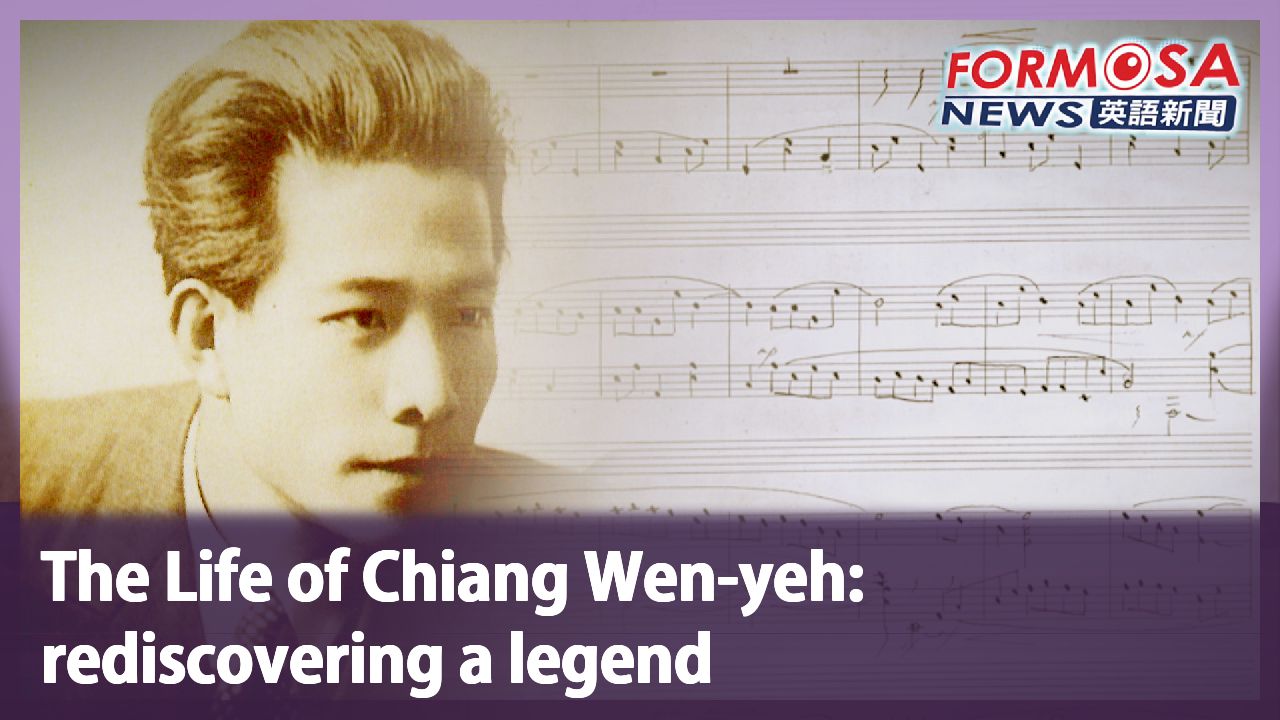
The Life of Chiang Wen-yeh: rediscovering a legend
Tonight we conclude our series on legendary composer Chiang Wen-yeh. After being labeled a traitor, Chiang was imprisoned by the KMT government, which fled to Taiwan in 1949. Chiang decided to stay in China. But he then became a victim of the communists, first as part of the Anti-Rightist Campaign, and then during the Cultural Revolution. The music professor was put to cleaning toilets, and his musical work fell by the wayside. Much later, in the 1980s, his forgotten works were rediscovered by members of the Taiwanese diaspora. By that time, Chiang was paralyzed after a stroke, and was already on his deathbed. Here’s our Sunday special report.
In 1946, the KMT labeled Chiang a traitor, along with many other Japanese citizens of Taiwanese descent. Eventually, a group calling themselves the “Taiwan Retrocession Salutation Committee” rescued Chiang after 10 months in prison. After he was freed, a friend from prison introduced Chiang to a Catholic friar, Gabriele Allegra. Chiang then used Chinese musical modes to complete the first Catholic Chorale ever written in the Chinese language.
Chang Chi-jen
Composer
He was deeply moved by those words in the sacred music. A priest, Gabriele Allegra, encouraged him. Allegra’s Chinese name was Lei Yongming. He told Chiang, “Write these holy songs for us.” So Chiang did it. And they became popular in Catholic circles. So his songs have been sung in many Catholic churches in Taiwan, although they don’t know who Chiang Wen-yeh is.
Liu Suan-yung
National Taiwan Symphony Orchestra director
Why did he write such lovely sacred music? There’s a specific reason. Chinese music is pentatonic. Like in Gregorian chant, after each line, there’s a line for taking a breath for the next phrase, it’s very free. So for him, it was very easy to write sacred music in a pentatonic scale.
In 1949, the KMT withdrew to Taiwan. Chiang missed his birthplace, but having been imprisoned by Chiang Kai-shek, he decided to stay in China. China’s Central Conservatory of Music was founded in Tianjin by Zhou Enlai in 1950. Chiang was 40 years old, when he took up the role of composition professor there. He commuted on train from Beijing to Tianjin every week, and continued to compose music. But these happy years were short. In 1957, the Anti-Rightist Campaign began. Because Chiang was a member of the Taiwan Democratic Self-Government League, he was labeled a “rightist,” “struggled” against, and stripped of his job. At the time, there were only three Steinway pianos in China, and one belonged to Chiang. To make ends meet, he was forced to sell it. He had no piano, but the music was in his head. His composing slowed down considerably in this period, but never totally stopped.
Chang Chi-jen
Composer
The orchestration is magnificent in his “Drowned in Miluo River.” What’s special about his orchestration is that he loves to use the piccolo. The piccolo is probably more familiar in Taiwan. It’s very emotionally expressive. So this was his last orchestral work.
The Cultural Revolution began in China in 1966. Chiang was persecuted and sent to a labor camp, being set to work as a toilet cleaner. Almost all his manuscripts, records and sheet music files were confiscated. In 1970, he was sent, along with all the teachers and students of the Conservatory of Music, to a labor camp in Baoding City, Hebei. By this time, his health was failing. He was no longer composing.
Wu Ling-yi
Assistant professor of music, NTUA
China had this whole class revolution, and the Cultural Revolution. Of course, people like him were labeled part of the "Five Black Categories.” Their homes were searched, property confiscated. For example, people with Taiwanese elements, all their old works had to be taken away. So, apparently at that time all these works were taken away to the Beijing Music Society. Then his family of seven were all living in a tiny room of just 9 ping. Lots of families were crowded into a small down, and each family just had one room.
The “Gang of Four” fell from power in 1976, and two years later, Chiang was rehabilitated and got his job back, like many others. His health was declining after so many years of “re-education through labor.” But he managed to create a final symphony, “Voices of Alishan.” In the early 1980s as Chiang’s health steadily declined, disparate members of the Taiwanese diaspora began searching for him.
Chang Chi-jen
Composer
Through a series of events, after I arrived in the U.S., I was living at the home of Alexander Tcherepnin. Of course I came across his music collection. There was one person’s work that I thought was fantastic. His name was “Bunya Koh.” So I asked Mrs. Tcherepnin, who was still alive. She was Chinese. And she said, “This guy is Taiwanese.” “His Chinese name is Chiang Wen-yeh.”
Wu Ling-yi
Assistant professor of music, NTUA
There was a group of people in the U.S., starting with Professor Xie Lifa, who is a Taiwanese researcher of art history. He wanted to write a complete history of the art history of the older generation. So they were searching for documents. A Dr. Lin Heng-cheh in Los Angeles was constantly writing to Beijing, asking, “We have this Taiwanese composer, Chiang Wen-yeh, what are his whereabouts?” “Is he alive or dead?” “Is he there?” They kept on searching, and, amazingly, they found him.
Through these efforts, overseas Taiwanese finally got in touch with Chiang in obscurity. He had had a stroke, and was paralyzed and bedridden, his musical skills faded away. He passed away from a further stroke, in Beijing, on Oct. 24, 1983, at the age of 73. His last work, “Voices of Alishan,” was unfinished. His first major work, “Formosan Dance,” was a depiction of Taiwan, just like his final work, “Voices of Alishan.” His homeland was always cherished in his heart.
Liu Suan-yung
National Taiwan Symphony Orchestra director
If we look over his whole life, “Formosan Dance” was an important representative work, the start of his composing. His final, unfinished piece was “Voices of Alishan.” The tune was a mountain song that his mother had sung to him as a child.
The name Chiang Wen-yeh has been revived. Commemorative concerts and academic seminars about him have been held in Taiwan and China. Many of his works have either been lost or were never performed, and are a new challenge for musicians.
Hsieh Pei-yin
First violin, National Taiwan Symphony Orchestr
For me, what’s difficult about his work can be divided into two parts. He combines Western composition methods with Chinese scales. So it’s rather different to our normal Western three-note chords. What I find most difficult, personally, is interpreting his music. Much of his work was never released. So the most difficult thing is finding a way, with the limited information available, to faithfully represent his work.
Chen Rueipin
Pianist
What musicians worship above all is freedom. So in his work, what he wants is to express himself as freely as possible. He writes on the score, you can finish at the end of any bar. That gives us, as performers, huge room for imagination. But that’s also the most difficult thing! Because he lets you express totally freely.
Today, Chiang’s music is resounding again. His youngest daughter only realized that her father was not just a toilet cleaner because of this rediscovery by musicians.
Wu Ling-yi
Assistant professor of music, NTUA
Xiaoyun is their second daughter. She was grown up before she found out that her father had been so famous in Japan, that he was a great composer. It was much, much later that she found out about his many great achievements during the Japanese colonial era. She had always thought that her dad was a cleaner at the Conservatory of Music.
Chiang’s second wife, Wu Yun-chen, went through the horrors of the Cultural Revolution with him. His Japanese wife, Nobu Takizawa, worked hard to take care of their family in Tokyo, raising four daughters for 60 years.
Liu Mei-lien
Biographer of Chiang Wen-yeh
After the war, ships stopped traveling between Japan and China. So Mrs. Nobu had to raise four daughters alone in Tokyo, and that was a huge task. She had been the daughter of a wealthy family. She had to go and work in a department store. She sold dresses and umbrellas. During the bombing of Tokyo in WWII, she rented an air raid shelter just to hide her husband’s music and documents. A love like that… I can only say, what a blessing for Chiang Wen-yeh, to have had a wife like that.
In 1992, Chiang’s two wives met in Taipei, for the first and only time. They both attended the same seminar, and took this photograph together. Chiang’s discography spanned symphonies to piano tunes, operas to chamber suites, chorales, and solo works for voice. His style spanned classical Chinese splendor, religious solemnity and Taiwanese romance. While it may have lain forgotten for some decades, his talent is now celebrated again, and his work is ringing out off the page.
Lai Deh-ho
Composer
He was a suppressed genius. When one thinks of the vagaries of his fate, the fetters of the age he lived in, and his cruel persecution… It was a tragedy. Truly.
Born in Taiwan, raised in Japan, lived and died in China. With the turbulence of the age as a soundtrack, Chiang Wen-yeh lived a truly astonishing life.
For more Taiwan news, tune in:
Sun to Fri at 9:30 pm on Channel 152
Tue to Sat at 1 am on Channel 53
2024-10-27