Pigeons carry bamboo tube home in traditional Chiayi race
Pigeons carry bamboo tube home in traditional Chiayi race
2025-04-22
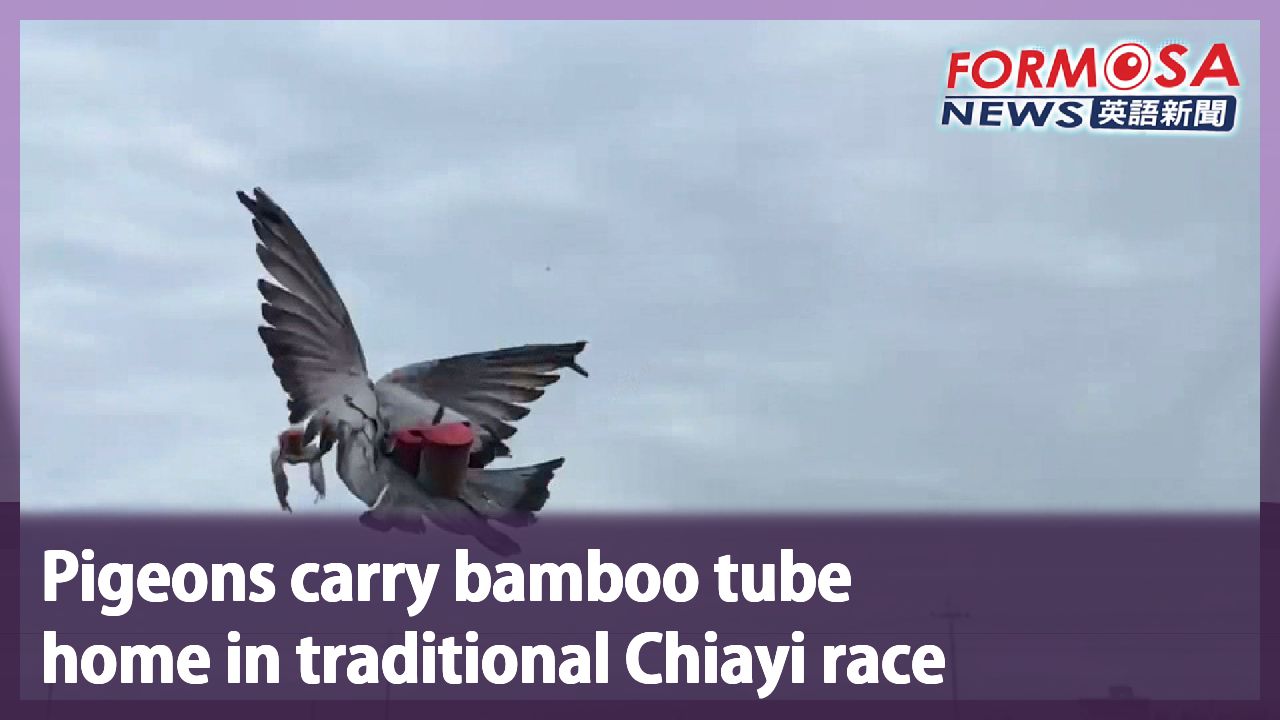
The pigeon race in Chiayi’s Yizhu Township has been around for a century. Originally used to send wartime messages, the pigeons are trained to endure long distance flights with a bamboo tube strapped to their backs. These days, it’s a local tradition. The pigeons are taken to their opponents’ hometown and must fly back to their own. Whoever has the most pigeons return is the winner.
Flocks of pigeons take flight as their bamboo cages are lifted. If you look closely, you can see that each one has a bamboo tube strapped to their back. This is the traditional pigeon race held in Chiayi’s Yizhu Township, with a century of history.
Chueh Yu-ching
Elementary school principal
Before, when army units needed to send messages back and forth, they used pigeons. Since their endurance is important, they strap a tube to their backs to increase the load.
Weng Chang-liang
Chiayi County Commissioner
It makes a sound when the wind blows, that’s why it’s called a pigeon whistle.
The county commissioner himself tried it out, showing how to make the bamboo tube whistle. There are large and small versions, depending on the size of the pigeon. The largest one can reach over 9 inches.
Hsieh Jung-che
Bamboo whistle maker
There are only a few pigeons that are able to carry ones this big. They have to be brave enough.
The competition is between villages. Pigeons are released in their opponents’ village and fly back through obstacles set up along the way. At the end, each village counts how many returned, and the one with the most wins. Villagers work on the offensive and defensive, so it’s not unusual to see competitors capturing their opponents’ pigeons. The owner then has to pay a ransom to get them back.
Yizhu resident
I have four pigeons and all four were captured. I spent NT$1,000 to get them back. I had to. In total I spent NT$4,000.
Huang Cheng-chieh
Yizhu resident
Yizhu is the only place north of the Bazhang River that holds this kind of pigeon race. Other races are all in Tainan. There are eight villages in total.
The Yizhu race lasts for a month and a half. It has long been a part of local life here, beloved by young and old who keep the tradition alive.
For more Taiwan news, tune in:
Sun to Fri at 9:30 pm on Channel 152
Tue to Sat at 1 am on Channel 53
#pigeons #pigeonracing #YizhuTownship #Chiayi #animalrace #tradition
嘉義義竹百年歷史"賽鴿笭" 鴿子揹木笭飛回家
2025-04-22
嘉義縣義竹鄉的「賽鴿笭」已經有百年歷史,早期是軍隊為了傳遞訊息,訓練鴿子長途飛行的耐力,而在鴿子身上綁上木笭。現在則成為村莊的趣味活動。綁上木苓的鴿子,帶到對手的村莊放飛,飛回自己的村莊,看誰飛回來的數量比較多,就算獲勝。
開打竹籠,成群鴿子立刻振翅飛翔,仔細看,每隻鴿子身上都背了一個木苓,這就是嘉義縣義竹鄉傳承百年的傳統競技活動「賽鴿笭」。
[[國小校長 闕裕清]]
"這是以前軍隊之間在做傳遞訊息的時候,他們都是用鴿子牠的耐力也很重要,所以他們就會在鴿子的身上背一個笭,然後增加牠的負重。"
[[嘉義縣長 翁章梁]]
"風在吹的時候它就會發出聲音,所以為什麼叫做鴿苓。"
縣長翁章梁親自示範,木笭如何發出聲音。這些木笭有大有小,依舊每隻鴿子的體型而綁上不同尺寸的木笭,最大的可到9寸6。
[[木笭製作師傅 謝榮哲]]
"沒有幾隻鴿子能夠背這個尺寸的木苓,鴿子要夠勇才能背得起來。"
至於比賽方式,則是村與村之間對決,參賽的鴿子會被帶到對手的村莊放飛,途中會遭遇人為設下的各種干擾,最後清點雙方飛回村莊的鴿笭數量,比賽採攻守交換制,因此比賽期間,不時可以看到村民捕捉對方的鴿子,一旦落入對方手中,主人得花錢才能贖回愛鴿。
[[義竹鄉民]]
"我有四隻鴿子比賽四隻都摔下來,花一千元抓回來、贖回來就對了,總共花了四千。”
[[義竹鄉長黃政傑]]
"義竹是八掌溪以北,唯一有玩賽鴿苓的鄉鎮,其他都在台南地區,總共有八個村莊在比賽。"
義竹「賽鴿笭」賽期長達一個半月,早已是當地人生活的一部分,男女老少都來參加,延續著這項充滿趣味的農村活動。
更多新聞內容,請鎖定:
民視台灣台(152頻道)週日至週五晚上9:30
民視新聞台(53頻道)週二至週六凌晨1:00
Related News