Tragic tree toppling turns attention on decades of neglect for campus trees
Tragic tree toppling turns attention on decades of neglect for campus trees
2025-08-08
Back in June, a sudden collapse of a tree collapse on the Feng Chia University campus, left one student dead. Through at first sight it may look like an unforeseeable natural disaster, arborists say there is much more to the story. The tree was showing signs of being infected with brown root rot, a highly contagious disease that’s present practically everywhere in Taiwan. The decaying roots and a constricted planter made the tree a ticking time bomb that could’ve come down at any moment. But what exactly causes root rot? And how can we prevent further tragedies? This and more in our Weekly Feature.
Drain drizzles from the dark skies, as tears stream down the faces of the bereaved.
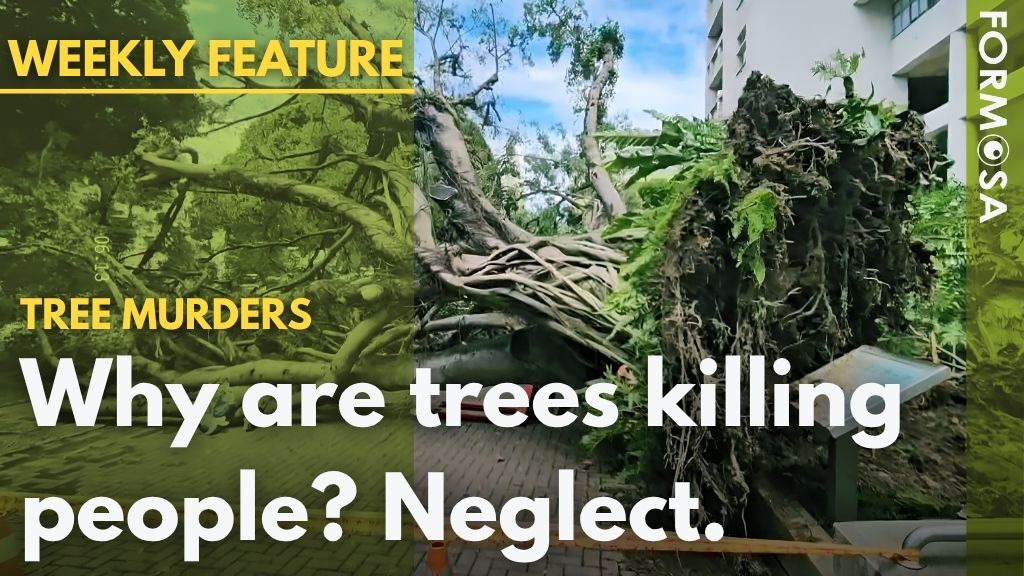
At about 5 in the afternoon on June 13, a big 60-year-old banyan tree at Feng Chia University collapsed without a warning, crushing and killing a postgraduate student.
Wu Meng-ling (June 16, 2025)
Taiwan Forestry Research Institute
We noticed there was a net-like pattern at the base of the tree, which could be a sign of fungal decay. This kind of netting is very often a symptom of brown root rot.
There were signs of disease in plain sight, from decay at the base of the tree to fungal growth on the branches. Experts inferred that the cause of the collapse was brown root rot, commonly known as “tree cancer” in Taiwan.
Lee Pei-jung
Taiwan Ecological Arboriculture Society
Healthy wood can’t be broken apart with your hands. But wood that’s decaying due to an infection of brown root rot, it becomes very spongy and crumbly.
The roots of the tree fall apart with a light touch, and give off a fungal odor. Brown root rot is a common disease in tropical and subtropical climates. Once a tree is infected, its roots and stalks break down, preventing the tree from absorbing water and nutrients. That ultimately results in the tree drying out and dying. But even trees that appear healthy can suddenly collapse when root rot weakens their grip on the soil.
Fu Chun-hsu
Taiwan Forestry Research Institute
Banyan trees have aerial roots, so when the main root system is infected by root rot, the tree may try to obtain water through aerial or adventitious roots. It might look like its fine on the surface. But the problem is with the wood inside, which provides structural support. That wood is decayed, so the tree could topple over without a warning.
Brown root rot is not just dangerous because of the lack of symptoms in the early stages of infection. The disease is also highly contagious. It can spread over long distances through spores and contaminate other trees in the area through root contact. Even soil with mycelium can carry the disease and infect healthy trees.
Fu Chun-hsu
Taiwan Forestry Research Institute
In Taiwan there are basically no places at all that are free of the disease. Every city and county has brown root rot. You can find diseased trees at practically every school. At least in 8 or 9 cases out of 10.
Fu Chun-hsu and his team at the Taiwan Forestry Research Institute have been fighting against brown root rot for more than a decade. They’ve found the best treatment to be a combination of surgical removal and soil fumigation.
Back in 2012, a century-old banyan tree in Kaohsiung’s Ciaotou District was found to have an advanced brown root rot infection. Locals couldn’t bear to lose the tree to the disease, so they raised NT$800,000 for a professional operation.
Lee Tsai-wan (2013)
Environmental engineering company staff
Before the surgery, we checked whether the roots were indeed infected, and we dug up the parts that were. Here you can see the infected parts. We have to clean all these infected areas over here and cauterize them.
The infected roots are snipped off and shaved down. Then, a steel frame is put in place to prop up the tree and hold up the branches. Thanks to the aerial roots, the tree can eventually regrow a healthy root system that allows it to absorb water and nutrients once again. To prevent reinfection, every care is taken to leave no trace of diseased tissue in the soil. Any fragments found are removed and incinerated. Then the soil itself is fumigated.
Chang Cheng-chun (2013)
Environmental engineering company
We take all of the soil from the infected area and put it aside. Then, we fumigate it. We use a solution with a granular soil fumigant that contains 98%-grade dazomet. When mixed with water, it produces a gas that kills the fungus in the soil.
Dazomet is the only fumigant authorized for use in Taiwan by the Ministry of Agriculture. The process is as follows: The granules are mixed in with the soil and watered to release a gas. To ensure a thorough disinfection, the soil must be covered with a tarp to trap the fumes in.
Voice of Chang Cheng-chun (2013)
Environmental engineering company
Half an hour after the dazomet granules come in contact with water, they start producing gas. So we cover the soil with a tarp right after we water it.
The surgery on the banyan tree in Kaohsiung was a resounding success. A decade later, the tree doesn’t even need its metal crutches any more, and it has regained its dense and lush canopy.
Fu Chun-hsu
Taiwan Forestry Research Institute
We use surgery to save trees that must be preserved, be it because they have cultural, sentimental or historical value. We’ve used this technique to save hundreds of trees around Taiwan.
But these procedures are pricy, costing hundreds of thousands of NT dollars. The more economical way to deal with infected trees is simply removal and incineration.
Fu Chun-hsu
Taiwan Forestry Research Institute
In areas affected by disease, we cut down the trees, dig out the roots and send them for incineration. Anything that we didn’t incinerate gets treated and sterilized with fumigants such as dazomet, or urea and lime.
The institute also has alternatives for areas where pesticides are banned. In some cases, the area can be flooded intentionally, or a bamboo grove is planted to keep the disease at bay. But there is no hard rule about treating diseased trees, so brown root rot continues to cause downed trees.
In the case of the fatal collapse at Feng Chia University, the school was already aware that the tree was infected. But instead of heeding the recommendations from the Taiwan Forestry Research Institute, they chose to spray the tree with pesticides, missing out on the chance to cure the tree. But other factors beside disease may have contributed to its sudden fall.
Chen Hung-kai
Friends of Daan Forest Park Foundation
This is where the tree was at Feng Chia University. I went and measured the space myself. It was just 6.7m wide, and only 6m deep. That’s a really small space for a tree that size.
Chen Hung-kai, a certified arborist, went to see the scene of the tragedy for himself. He noted that the banyan tree was in an undersized planter for its size. It also had to compete with nearby shrubs and plants for water. He found many other large banyan trees on campus were similarly constricted.
Chen Hung-kai
Friends of Daan Forest Park Foundation
Look at this big tree. The trunk is about 1m in diameter, and the planter is 2m from edge to edge and just 1.2m across inside. You can even see the trunk is eating the plank. It’s so top-heavy, how can you expect it to stay standing in a storm?
Older schools naturally have older trees. So what can they do to prevent another fatal collapse?
Tsai Yi-pei
Guangfu Elementary School
This is a weeping paperback. At about 6 in the evening on May 7, we got word that it had toppled onto the pavement at Guangfu South Road. Fortunately nobody was passing by.
Just over one month before the banyan fell in Feng Chia University, a tree was also downed by brown root rot at Taipei’s Guangfu Elementary School. The school immediately hired experts to inspect all its trees.
Chen Hung-kai
Friends of Daan Forest Park Foundation
We first do a VTA, or visual tree assessment. We inspect key areas, such as the base of the tree. Look, here there’s a hole, and it’s about 50cm deep. Cavities like these shouldn’t be larger than half of the diameter of the tree.
In addition to prodding at the roots with a metal rod, Chen does something peculiar with a secret tool.
Chen Hung-kai
Friends of Daan Forest Park Foundation
Look, the sound here is different. Pay attention. It’s normal here. It should sound like this. But here… It’s a lower pitch. But it’s different for every tree. But when you knock it, you can hear the difference. Here it’s all over the place. If we detect any decay, we carry out more advanced tests, to see whether there is risk of a fall. The more common tools in Taiwan are stress waves tomographic techniques and resistographs. In Japan they use gamma rays.
Many schools such as Guangfu Elementary hire landscape maintenance personnel for seasonal pruning, and are proactive about keeping brown root rot at bay. But still, tree collapses happen every year, so something is clearly amiss.
Chen Hung-kai
Friends of Daan Forest Park Foundation
Schools aren’t to blame. They think they are finding experts on the matter, they assume you have the relevant certifications. After all, if you’re in this industry, you should have the relevant qualifications. But who knows? Who would know if you do or don’t have the relevant knowledge. It’s really unclear.
There is currently no nationwide certification process for arborists or tree doctors, making it difficult for schools to assess the expertise of their gardeners. If unqualified teams miss signs of disease and allow brown root rot to spread, or if they botch the pruning, the results can be catastrophic.
Chen Hung-kai
Friends of Daan Forest Park Foundation
Branches that grow from the pith in the trunk, are very stable and well supported. But if you snip away at random or make a cut in the wrong spot, the connection between the branches and the trunk will be very weak. So next time a typhoon comes, or there are strong winds or heavy rains, they break off easily.
Nien Chih-wei
Taipei Department of Education
The Taipei City Government has a set of regulations regarding tree pruning. When schools hire contractors, the contract specifies that the workers must be professionals with basic competence in pruning. So, there shouldn’t be any problems regarding the pruning.
Perhaps the gardeners are not the problem. But that still leaves lots of dangerous trees on school campuses all over the country. The Taipei Department of Education is mulling regulations to make regular check-ups more frequent and thorough.
Hsiu Chin-ju
Guangfu Elementary School principal
We’re hoping to inspect all the trees before the start of the new school year, to address any problems during the holidays. That way, when students come, they will be safe.
There’s few better things than cooling off in the shade of a tree, but without professional care, these towering trees could become ticking time bombs.
Though they may seem natural disasters upon first glance, the tree collapses that capture news headlines are often caused by human neglect. Fortunately, there’s a group of tree lovers trying to turn things around.
#trees #tree #nature #arborist #pruning #landscape #gardener
For more Taiwan news, tune in:
Mon to Fri at 9:30 pm on Channel 152
Tue to Sat at 1 am on Channel 53
逢甲校樹倒塌壓死學生 推判「樹癌」褐根病惹禍 如何防治 實地診斷
2025-08-08
今年六月中,台中逢甲大學校園內,發生了一棵樹齡六十年的大榕樹倒塌的意外,總共造成一死三傷的憾事,令社會大眾相當錯愕。事實上,類似樹倒人亡的悲劇時有所聞:兩年前,同樣位在台中市的東海大學,也發生校內的相思樹突然倒下,砸死一名婦人的不幸案例。我們不禁要問,為何大樹殺人事件會一再上演?過去,許多樹倒事件都指向有「樹癌」之稱的「褐根病」釀禍,「褐根病」是什麼?有辦法治療嗎?跟著我們的鏡頭,一起找答案。
陰暗的天空滴著雨,逝者親友臉上的淚水,同樣止不住。
6月13日傍晚五點多,台中市逢甲大學校內,一棵樹齡約60年的大榕樹突然倒塌,造成一名就讀碩一的同學,傷重不治,成為這場「樹災」的犧牲者。
[[林業試驗所副所長 吳孟玲 (2025.6.16)]]
“我們在現場是有看到根基部,有所謂的網狀格紋,這是一種腐朽菌,褐根病是最容易引起網狀格紋的”
現場榕樹的根部,有著肉眼可見的腐朽,枝幹上也被發現菌枝面,專家初判,將矛頭指向有著「樹癌」之稱的褐根病。
[[台灣生態樹藝協會理事長 李佩蓉]]
“一般木材我們用手扳,應該是扳不斷的,可是因為它感染了褐根病菌,被腐朽了之後,你就可以看到它的木材,變得非常疏鬆,一撥就像海綿一樣整個散開了”
根部一剝就碎,靠近聞還有明顯的「菇味」,褐根病是熱帶和亞熱帶地區常見的植物根部病害,樹木被感染後根部和莖部會漸漸壞死,喪失傳輸和吸收水分及養分的功能,最終導致整棵樹枯死,但在都市裡,更常見的情況,是大樹雖然還沒死透,但因為根部腐朽,失去了支撐力,直接「軟腳」倒下。
[[林業試驗所研究員 傅春旭]]
“我舉個例子,比如像榕樹有氣生根,因為根系被褐根病形成障礙,水分的輸送形成障礙的時候,它可以透過氣生根或不定根,來完成它的水分運輸,所以你看起來,它好像沒那麼嚴重,可是問題是,木頭是在裡面的,它是做支撐用的,它在支撐的東西,一直被腐朽的情況下,它就可能在無預警的情況倒下來”
不只感染初期,幾乎看不出病徵,褐根病更可怕在感染力超強,可以利用孢子,進行長距離的傳播,病原菌也容易存活在病根上,透過接觸感染其他健康樹木,加上帶有菌絲的土壤,同樣具有傳染力。
[[林業試驗所研究員 傅春旭]]
“台灣應該沒有什麼叫非疫區,各縣市都有褐根病,每個學校幾乎都有,十之八九”
為了防堵不斷擴散的「樹癌」,傅春旭和林試所的學者與褐根病纏鬥十多年,他們發現最有效的治療方式,就是採取外科手術,加上土壤燻蒸法。
高雄市橋頭區著名的百年大榕樹,在2012年時,曾被發現罹患褐根病接近末期,當地里民因為不捨大樹就此倒下,湊足八十萬,幫大榕樹進行外科手術。
[[環境工程公司員工 李財萬]] (2013)
“手術的做法,第一個先探測根系有沒有得病菌,得了病菌之後我們再做開挖。這個就是病源菌,這個都要清創的位置都在這邊,這個事後都要碳化”
老樹染病的根部全部切除,磨平,斷根的樹還需要裝上「拐杖」,以鋼架支撐樹體避免倒塌,而少了根部的老榕樹,經過導氣根開根,有機會重新長出,能夠吸收水分和養分的健康根部,為了避免新長出的樹根再次感染褐根病,手術的壓軸,更是不可馬虎,要將土壤內殘留的病根一點不留的撿乾淨,送到焚化爐燒個精光,土壤也得進行燻蒸消毒。
[[環境工程公司副理 張承均]] (2013)
“就是把它原有感染範圍的土壤,我們全部移開,移到旁邊,我們再異地去做燻蒸,我們現在所使用的藥劑,是使用98%的邁隆粒劑,邁隆跟水拌合之後,它就會產生一些氣體,來做殺菌的動作”
邁隆是農業部目前唯一登記合法的推薦藥物,拌入土壤後澆水,便會產生殺菌氣體,這個時候,用帆布蓋在病土上方,便能燻蒸土壤消毒。
[[聲音來源:環境工程公司副理 張承均]] (2013)
“邁隆碰到水之後,大概在半小時以後就會慢慢的蒸散,所以我們施作的過程,只要澆水一澆完,就要馬上去做覆蓋動作”
採用林試所的方針,這場外科手術非常成功,大榕樹經過十多年,已不再需要柺杖幫忙支撐,樹葉也漸漸恢復翠綠茂密的模樣。
[[林業試驗所研究員 傅春旭]]
“當一棵樹木,我們覺得它有文化價值,情感價值,各方面的價值,它是非留不可的時候,我們會透過外科手術,把這棵樹給留下來,在台灣目前利用這個方式來獲得保存的樹木,應該有數百棵了”
不過像這樣的手術,動輒要花數十萬元,一般樹木染病後,大多會採取比較經濟實惠的方法,直接砍除病株,送進焚化爐。
[[林業試驗所研究員 傅春旭]]
“這邊是疫區,我們會把病樹砍了,砍掉,然後把病根挖起來,挖起來的病根我們是送焚化爐,或是一些設施把它燒掉,燒掉以後,你撿不乾淨的,剩下就靠燻蒸劑了,用邁隆或是尿素石灰進行處理,把它裡面變成淨菌狀態”
而考量到部分地區禁用農藥,林試所近年也推廣水淹沒法,以及在疫區種竹子,使當地林相改變等多種方式,努力杜絕褐根病擴散,但畢竟這些方法都只是建議,並沒有強制力,因褐根病倒下的大樹,仍然不計其數。
事實上,在逢甲的大榕樹倒下之前,校方便已經知道榕樹患有褐根病,但比起林試所的建議方針,校方選擇以灌藥方式搶救榕樹,錯失救樹良機,除此之外,大榕樹轟然倒下,除了生病,或許還有別的原因。
[[大安森林公園之友基金會副執行長 陳鴻楷]]
“這是逢甲大學倒下來那棵樹,我去現場丈量一下,它這個花台基本上長度有6米7,寬度的部分有6米,以這一棵樹來說,這個是非常小的”
陳鴻楷具有國際樹藝師執照,事發後也曾到逢甲大學看過案發現場,他指出倒下的榕樹,不只被放在過小的花台中,還要與周邊種植的花草,灌木,爭奪水分,生長環境不佳,而他也發現,就在這棵榕樹的周邊,還有許多面臨類似問題的大榕樹。
[[大安森林公園之友基金會副執行長 陳鴻楷]]
“你看它這也是很大的樹,它的頭徑已經有1公尺100公分了,結果它的框框,外框的部分才2米,內框的部分才1米2,所以你看,有一部分的枝幹,已經吃到木頭裡面,頭重腳輕,你認為這棵樹,如果真的比較(風雨大)的時候,它怎麼會撐得住呢”
普遍來說,愈老字號的學校,校園內的老樹通常也愈多,全台各校園該如何避免,下一起「樹倒人亡」的悲劇。
[[台北市光復國小主任 蔡宜蓓]]
“這裡有一顆白千層,這個是在5月7日,大概傍晚6點多的時候,我們有接獲消息說,學校有一棵樹,當時倒向光復南路的人行道,幸好那時候剛好沒有路人在這邊”
位於台北市的光復國小,今年五月剛發生校樹因褐根病倒下,隔月,逢甲大學就傳出意外,光復國小校方不敢大意,立刻找來專家,替校樹進行全方位檢查。
[[大安森林公園之友基金會副執行長 陳鴻楷]]
“一般我們做VTA,所謂目視診斷的時候,很重要的一件事情,我們大概會去檢查幾個事情,根基部,你看,這個根基部,這個地方就有空洞,這個空洞的部分,大概有50公分的深度,基本上整個空洞不能超過,樹的直徑的二分之一”
除了用鋼棒戳戳看,檢查根基部是否有空洞,陳鴻楷還有一個祕密道具。
[[大安森林公園之友基金會副執行長 陳鴻楷]]
“你看,這裡的聲音,聽起來就不一樣,你可以注意聽。這是正常的,它應該是這樣。你看這個。它的音頻會比較低,但是每一種樹不一樣,每一種樹不一樣,所以我們會去敲,你看,有異樣聲的時候,到這個地方都有。如果我們發現有一些腐朽,我們不知道這個腐朽會不會倒伏下來,基本上要做更進一步的精密儀器診斷,台灣現在目前比較普遍用的,就是用類似像應力波,像阻抗儀,在日本還有用伽瑪射線”
包含光復國小在內,全台各級校園,本來就會定期委託外部廠商進行樹木修剪,也積極配合褐根病相關的防治作業,然而樹倒意外依然連年發生,問題出在哪裡。
[[大安森林公園之友基金會副執行長 陳鴻楷]]
“學校單位他們也覺得很無辜,他們覺得去找專業的廠商,他也認為說你有專業證照,你是這個行業別,你應該有這方面的專業知識,誰會知道,誰會知道他們到底有沒有,這方面的專業知識,不清楚”
陳鴻楷指出,目前台灣還沒有統一的樹藝師,或是樹木醫生證照核發制度,導致學校難以判別廠商優劣,一旦委託的廠商不夠專業,抓不出病樹,導致褐根病擴散,或是進行了錯誤修剪,都會形成校園內的潛在威脅。
[[大安森林公園之友基金會副執行長 陳鴻楷]]
“我們本來這個枝條,從髓心長出來的這些定芽,它是有一個很穩定的結構,但是一旦我們亂修剪,或者砍錯地方,它長的那些不定芽,它的連結是很脆弱,所以颱風、強風,或者是豪大雨來的時候,它斷掉是可被預期的”
[[台北市教育局工程教育科科長 粘志偉]]
“台北市政府,其實有訂定一些修剪樹木的規定,學校委託專業廠商進來,其實合約裡面也會有附專業廠商,他表示對於園藝那一塊的修剪,應該有基本的職能,所以他們這塊修剪上,應該是沒有問題的”
廠商的專業,或許真的沒問題,但校園中樹木帶來的風險也確實存在,台北市教育局表示,正在考慮加強「校樹健檢」的頻率與強度。
[[台北市光復國小校長 修金莒]]
“我們都希望利用開學前做體檢,希望在假期當中就把它處理掉,學生來到學校,就是安全的校園”
人們種下大樹,是為了遮蔭蔽雨,卻因為缺乏專業照料和錯誤的對待,讓參天大樹,成為不定時的炸彈。
一件件大樹殺人的意外重複上演,不僅僅是天災,更是輕忽專業招致的人禍。
更多新聞內容,請鎖定:
民視台灣台(152頻道)週一至週五晚上9:30
民視新聞台(53頻道)週二至週六凌晨1:00
Related News