Tragic tree toppling turns attention on decades of neglect for campus trees
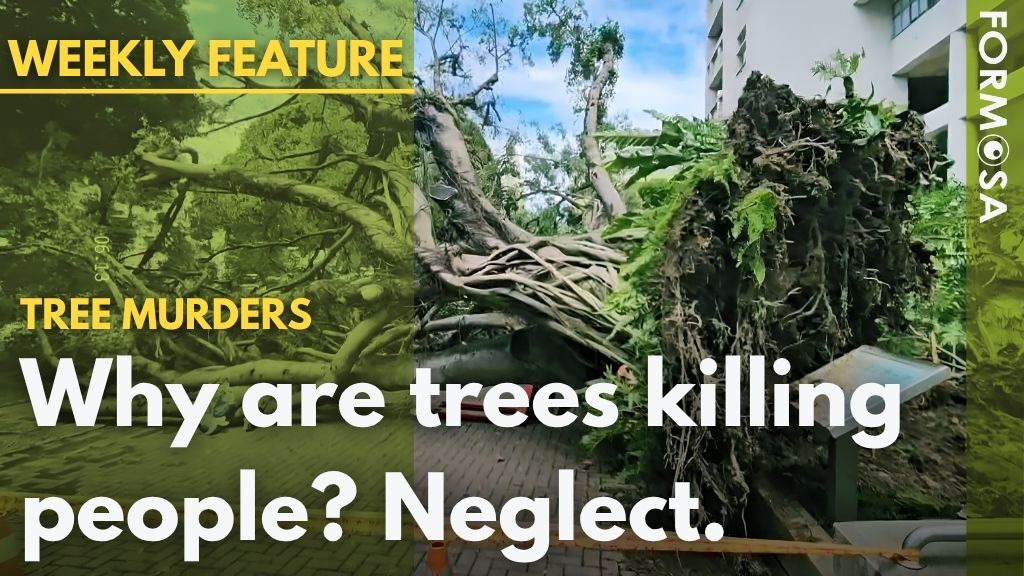
Back in June, a sudden collapse of a tree collapse on the Feng Chia University campus, left one student dead. Through at first sight it may look like an unforeseeable natural disaster, arborists say there is much more to the story. The tree was showing signs of being infected with brown root rot, a highly contagious disease that’s present practically everywhere in Taiwan. The decaying roots and a constricted planter made the tree a ticking time bomb that could’ve come down at any moment. But what exactly causes root rot? And how can we prevent further tragedies? This and more in our Weekly Feature.
Drain drizzles from the dark skies, as tears stream down the faces of the bereaved.
At about 5 in the afternoon on June 13, a big 60-year-old banyan tree at Feng Chia University collapsed without a warning, crushing and killing a postgraduate student.
Wu Meng-ling (June 16, 2025)
Taiwan Forestry Research Institute
We noticed there was a net-like pattern at the base of the tree, which could be a sign of fungal decay. This kind of netting is very often a symptom of brown root rot.
There were signs of disease in plain sight, from decay at the base of the tree to fungal growth on the branches. Experts inferred that the cause of the collapse was brown root rot, commonly known as “tree cancer” in Taiwan.
Lee Pei-jung
Taiwan Ecological Arboriculture Society
Healthy wood can’t be broken apart with your hands. But wood that’s decaying due to an infection of brown root rot, it becomes very spongy and crumbly.
The roots of the tree fall apart with a light touch, and give off a fungal odor. Brown root rot is a common disease in tropical and subtropical climates. Once a tree is infected, its roots and stalks break down, preventing the tree from absorbing water and nutrients. That ultimately results in the tree drying out and dying. But even trees that appear healthy can suddenly collapse when root rot weakens their grip on the soil.
Fu Chun-hsu
Taiwan Forestry Research Institute
Banyan trees have aerial roots, so when the main root system is infected by root rot, the tree may try to obtain water through aerial or adventitious roots. It might look like its fine on the surface. But the problem is with the wood inside, which provides structural support. That wood is decayed, so the tree could topple over without a warning.
Brown root rot is not just dangerous because of the lack of symptoms in the early stages of infection. The disease is also highly contagious. It can spread over long distances through spores and contaminate other trees in the area through root contact. Even soil with mycelium can carry the disease and infect healthy trees.
Fu Chun-hsu
Taiwan Forestry Research Institute
In Taiwan there are basically no places at all that are free of the disease. Every city and county has brown root rot. You can find diseased trees at practically every school. At least in 8 or 9 cases out of 10.
Fu Chun-hsu and his team at the Taiwan Forestry Research Institute have been fighting against brown root rot for more than a decade. They’ve found the best treatment to be a combination of surgical removal and soil fumigation.
Back in 2012, a century-old banyan tree in Kaohsiung’s Ciaotou District was found to have an advanced brown root rot infection. Locals couldn’t bear to lose the tree to the disease, so they raised NT$800,000 for a professional operation.
Lee Tsai-wan (2013)
Environmental engineering company staff
Before the surgery, we checked whether the roots were indeed infected, and we dug up the parts that were. Here you can see the infected parts. We have to clean all these infected areas over here and cauterize them.
The infected roots are snipped off and shaved down. Then, a steel frame is put in place to prop up the tree and hold up the branches. Thanks to the aerial roots, the tree can eventually regrow a healthy root system that allows it to absorb water and nutrients once again. To prevent reinfection, every care is taken to leave no trace of diseased tissue in the soil. Any fragments found are removed and incinerated. Then the soil itself is fumigated.
Chang Cheng-chun (2013)
Environmental engineering company
We take all of the soil from the infected area and put it aside. Then, we fumigate it. We use a solution with a granular soil fumigant that contains 98%-grade dazomet. When mixed with water, it produces a gas that kills the fungus in the soil.
Dazomet is the only fumigant authorized for use in Taiwan by the Ministry of Agriculture. The process is as follows: The granules are mixed in with the soil and watered to release a gas. To ensure a thorough disinfection, the soil must be covered with a tarp to trap the fumes in.
Voice of Chang Cheng-chun (2013)
Environmental engineering company
Half an hour after the dazomet granules come in contact with water, they start producing gas. So we cover the soil with a tarp right after we water it.
The surgery on the banyan tree in Kaohsiung was a resounding success. A decade later, the tree doesn’t even need its metal crutches any more, and it has regained its dense and lush canopy.
Fu Chun-hsu
Taiwan Forestry Research Institute
We use surgery to save trees that must be preserved, be it because they have cultural, sentimental or historical value. We’ve used this technique to save hundreds of trees around Taiwan.
But these procedures are pricy, costing hundreds of thousands of NT dollars. The more economical way to deal with infected trees is simply removal and incineration.
Fu Chun-hsu
Taiwan Forestry Research Institute
In areas affected by disease, we cut down the trees, dig out the roots and send them for incineration. Anything that we didn’t incinerate gets treated and sterilized with fumigants such as dazomet, or urea and lime.
The institute also has alternatives for areas where pesticides are banned. In some cases, the area can be flooded intentionally, or a bamboo grove is planted to keep the disease at bay. But there is no hard rule about treating diseased trees, so brown root rot continues to cause downed trees.
In the case of the fatal collapse at Feng Chia University, the school was already aware that the tree was infected. But instead of heeding the recommendations from the Taiwan Forestry Research Institute, they chose to spray the tree with pesticides, missing out on the chance to cure the tree. But other factors beside disease may have contributed to its sudden fall.
Chen Hung-kai
Friends of Daan Forest Park Foundation
This is where the tree was at Feng Chia University. I went and measured the space myself. It was just 6.7m wide, and only 6m deep. That’s a really small space for a tree that size.
Chen Hung-kai, a certified arborist, went to see the scene of the tragedy for himself. He noted that the banyan tree was in an undersized planter for its size. It also had to compete with nearby shrubs and plants for water. He found many other large banyan trees on campus were similarly constricted.
Chen Hung-kai
Friends of Daan Forest Park Foundation
Look at this big tree. The trunk is about 1m in diameter, and the planter is 2m from edge to edge and just 1.2m across inside. You can even see the trunk is eating the plank. It’s so top-heavy, how can you expect it to stay standing in a storm?
Older schools naturally have older trees. So what can they do to prevent another fatal collapse?
Tsai Yi-pei
Guangfu Elementary School
This is a weeping paperback. At about 6 in the evening on May 7, we got word that it had toppled onto the pavement at Guangfu South Road. Fortunately nobody was passing by.
Just over one month before the banyan fell in Feng Chia University, a tree was also downed by brown root rot at Taipei’s Guangfu Elementary School. The school immediately hired experts to inspect all its trees.
Chen Hung-kai
Friends of Daan Forest Park Foundation
We first do a VTA, or visual tree assessment. We inspect key areas, such as the base of the tree. Look, here there’s a hole, and it’s about 50cm deep. Cavities like these shouldn’t be larger than half of the diameter of the tree.
In addition to prodding at the roots with a metal rod, Chen does something peculiar with a secret tool.
Chen Hung-kai
Friends of Daan Forest Park Foundation
Look, the sound here is different. Pay attention. It’s normal here. It should sound like this. But here… It’s a lower pitch. But it’s different for every tree. But when you knock it, you can hear the difference. Here it’s all over the place. If we detect any decay, we carry out more advanced tests, to see whether there is risk of a fall. The more common tools in Taiwan are stress waves tomographic techniques and resistographs. In Japan they use gamma rays.
Many schools such as Guangfu Elementary hire landscape maintenance personnel for seasonal pruning, and are proactive about keeping brown root rot at bay. But still, tree collapses happen every year, so something is clearly amiss.
Chen Hung-kai
Friends of Daan Forest Park Foundation
Schools aren’t to blame. They think they are finding experts on the matter, they assume you have the relevant certifications. After all, if you’re in this industry, you should have the relevant qualifications. But who knows? Who would know if you do or don’t have the relevant knowledge. It’s really unclear.
There is currently no nationwide certification process for arborists or tree doctors, making it difficult for schools to assess the expertise of their gardeners. If unqualified teams miss signs of disease and allow brown root rot to spread, or if they botch the pruning, the results can be catastrophic.
Chen Hung-kai
Friends of Daan Forest Park Foundation
Branches that grow from the pith in the trunk, are very stable and well supported. But if you snip away at random or make a cut in the wrong spot, the connection between the branches and the trunk will be very weak. So next time a typhoon comes, or there are strong winds or heavy rains, they break off easily.
Nien Chih-wei
Taipei Department of Education
The Taipei City Government has a set of regulations regarding tree pruning. When schools hire contractors, the contract specifies that the workers must be professionals with basic competence in pruning. So, there shouldn’t be any problems regarding the pruning.
Perhaps the gardeners are not the problem. But that still leaves lots of dangerous trees on school campuses all over the country. The Taipei Department of Education is mulling regulations to make regular check-ups more frequent and thorough.
Hsiu Chin-ju
Guangfu Elementary School principal
We’re hoping to inspect all the trees before the start of the new school year, to address any problems during the holidays. That way, when students come, they will be safe.
There’s few better things than cooling off in the shade of a tree, but without professional care, these towering trees could become ticking time bombs.
Though they may seem natural disasters upon first glance, the tree collapses that capture news headlines are often caused by human neglect. Fortunately, there’s a group of tree lovers trying to turn things around.
#trees #tree #nature #arborist #pruning #landscape #gardener
For more Taiwan news, tune in:
Mon to Fri at 9:30 pm on Channel 152
Tue to Sat at 1 am on Channel 53
2025-08-08