Former WWII air-raid shelters see the light again
In the later years of WWII, Taiwan, then a Japanese colony, experienced frequent bombings by the US. As a result, many air-raid shelters were built all over the island. Keelung has the highest number of air-raid shelters from that era in Taiwan, thanks to its unique land formation. However, the shelters have become redundant following the war, and even with an ever-present risk of a cross-strait conflict, the old shelters are now useless against present-day arms. Now, Keelung has given new life to some of these once-abandoned spaces. Our weekly special report.
Sirens go off during an air raid drill. People take shelter where appropriate, which is usually the basement of a building. What would’ve been a routine exercise now appears more realistic than ever.
In the past, there weren’t any spacious basements for people to hide in, but tiny and dark tunnels and trenches. Larger ones can accommodate a few hundred individuals, but smaller ones only three to four.
At Keelung’s Heping Borough, entrances to these air-raid shelters can be seen along the hillside. But most are padlocked. We gained access through the borough’s community development organization who helped borrow the keys from the Maritime and Port Bureau, which oversees the shelters’ management.
We did not expect the shelter to be almost an entire story high. At the entrance, eroded signboards hint at age of these shelters. We also did not expect to see this: another shelter within a shelter.
It feels like an adventure entering the tunnel. There’s nothing but darkness ahead.
Hung Shun-fa
Heping Borough community development organization former head
This is what people refer to when they say it’s a different world entirely inside a cave. It does feel more comfortable and secure in this space.
The shelters were dug by coal miners in the past, and excavation marks can still be seen along the hillside. Although it’s pitch dark inside the cave, to keep those hiding safe, there are ditches to drain water from the mountain wall. It’s also very well-ventilated. Even though it’s over 35 degrees outside, the inside of the shelter feels air-conditioned and very comfortable.
Hung Shun-fa
Heping Borough community development organization former head
We’re taking the route at the back. There’s another at the front that takes you directly to the exit.
Taiwan’s air-raid shelters can be traced back to 1944, when Taiwan got involved in WWII during the Japanese colonial period. Many shelters were dug along the hillside to provide a hideout from US bombings. Because Keelung is a hilly area on relatively durable Daliao rock formation, the shelters can survive bombing. According to the city’s yearbook, there were more than 600 air-raid shelters at the time, the highest number in Taiwan.
Hung Shun-fa
Heping Borough community development organization former head
When the US war planes approached from Wanli, they began mass firing. The munitions hit the walls but nothing terrible happened.
Lee Cheng-jen
Keelung Community University lecturer
Being a harbor city at the frontline of war, we must dig many tunnels for hiding. Because of high population density, the bombing was more frequent. That’s why there are so many tunnels.
The end of WWII restored peace and the air-raid shelters eventually lost their purpose and became neglected. Today only the part used as a commanding center during the war is still in use by the police, as the city’s Civil Defense Center. Six officers work at the center, taking turns in shifts round-the-clock to take orders from the National Police Agency to practice issuing air-raid or tsunami alerts.
Peng Feng-chin
Keelung police Civil Defense Center
At specific times they call upon us and we respond. There are also two irregular calls that we must answer in addition.
Ho Tien-fu
Keelung police Civil Defense Center head
Normally officers are on duty here round-the-clock. They hold drills on issuing and transmitting alerts every day.
A community learning center lecturer gives us a guided tour at the historic air-raid shelter under the Khóo Tsú-song old house, the residence of a Japanese-era local governor, equivalent to a modern-day Keelung mayor. Due to his official standing, the air-raid shelter was built for his safety. From the material used—red bricks covered in plaster—it’s noticeably grander than most other shelters from that period.
Lee Cheng-jen
Keelung Community University lecturer
We want kids to learn about wartime history, not to encourage them to go to war, but to avoid war. Not everything must be resolved with war. It’s a kind of education.
To reconnect the city with the shelters, a student at National Taiwan University’s Graduate Institute of Building and Planning conducted field studies on historical air-raid shelters in Keelung, and even built this true-to-size model of the shelter under the Khóo Tsú-song old house at a scale of 1:100.
Lee Cheng-jen
Keelung Community University lecturer
We entered from here, from this entrance. You can see after you enter, that this tunnel is connected to one, two, three, four, five, five other entrances. The older generation, the grandmas nearby say that it can shelter 300 people at most.
Lee Lung-ching
Wen’an Bourough chief
We shouldn’t abandon them and have them become a safety and environmental blind spot. They should be revitalized and turned into educational venues for promoting local culture.
This is a century-old air-raid shelter in Wen’an Borough. The borough chief revitalized this space stretching 100m, paving the pathway with cement and installing light fixures. It used to be unbearably filthy and an infamous hideout for drug users. But now it’s an exhibition corridor with noticeable foot traffic in the local community.
Lee Lung-ching
Wen’an Bourough chief
After we started doing this, many schools would have kids come visit and allow schoolkids to learn about the local culture. If we can truly pass it on to the next generation, it would be a boon for society.
Many Keelung residences along the hillside have an air-raid shelter hidden behind them. The Wen’an borough chief is also a historian. He gave us a tour at a residential air-raid shelter.
Lee Lung-ching
Wen’an Bourough chief
I was born and raised here. When I was young, we would run around and play here. There are many air raid shelters here. Back in the days, the kids all played hide-and-seek here.
It takes considerable building material and labor to refill the redundant shelters. What’s more, present-day armaments are now more destructive and precise than before.
Hung Shun-fa
Heping Borough community development organization former head
These air raid shelters are effective against bombs and gun munitions, because the explosions weren’t so powerful then. But they’re no use against missiles or anything of the sort.
What if the unimaginable really happens? Will the old air-raid shelters be designated for wartime use?
Ho Tien-fu
Keelung police Civil Defense Center head
Because the air raid shelters have all exceeded the 30-year safe-use limit for brick structures, it’s unlikely they’ll be designated for wartime use.
Lee Lung-ching
Wen’an Bourough chief
They still function as shelters. We didn’t cause damage to them. The structure is still intact. We only cleaned them up a little, no damages.
The numerous early air-raid shelters of the past no longer have any function and require considerable manpower and funds to manage. Therefore, in 2019, the Ministry of the Interior delisted the air-raid shelters and gradually returned them to the land owners. Most of them were fenced off and padlocked, and the memory of war gets locked away too in darkness.
Lee Lung-ching
Wen’an Bourough chief
To be frank, the homeless will eventually cause damage to the shelters and they also hide inside to live. That may actually lead to more societal problems.
Lee Cheng-jen
Keelung Community University lecturer
The decision rests upon the local community. The local community does whatever the budget allows. If there isn’t enough budget, we can submit a proposal for a community design or cultural development project, and then the government can finance the project in part or entirely, and we’ll make the best-managed use of the site.
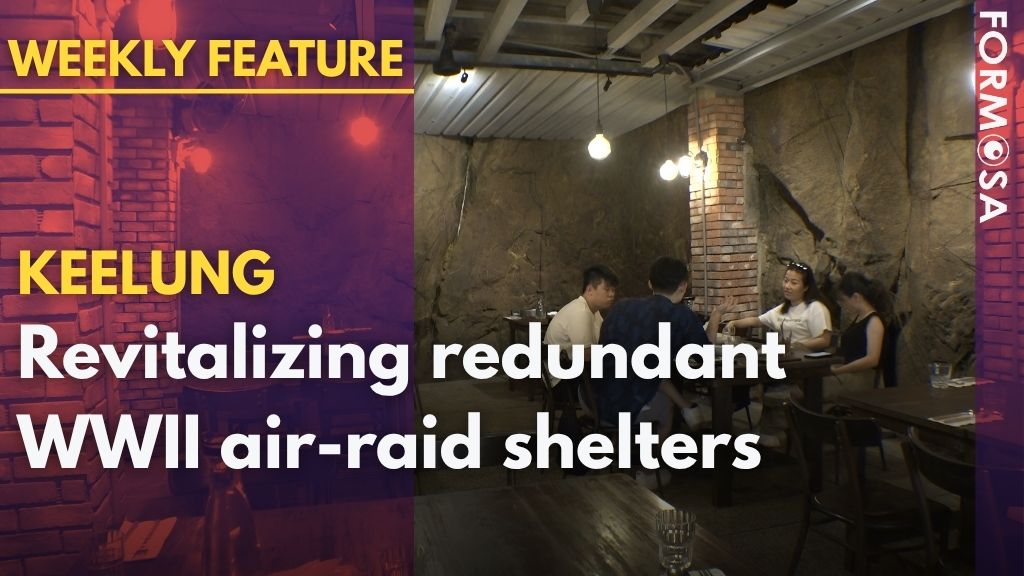
Some are already taking steps in revitalizing these spaces. In this former shelter, halogen lamps fixed upon the pillars cast a warm glow on foreign cuisine on offer.
Miao Hsu-ching
Restaurant owner
I didn’t renovate the space much, because the original state is part of the charm. We’ve only reinforced leaky spots.
The restaurant owner, Miao Hsu-ching was born in 1988, long after the war has ended. She wasn’t particularly fond of the air-raid shelters. As a child, her impression was that it’s where water snakes and other frightening creatures dwell. She was worried that her restaurant would have spiders, frogs or insects pop up here and there. And there are, but her customers don’t seem to mind.
Miao Hsu-ching
Restaurant owner
My customers are quite adorable. They’d say to us, “Look, there’s an adorable critter over there, should we go catch it?” Before we revamped this space, there were cascades from the mountains, well, waterfalls. Whenever it rains heavily, the water will enter from there and cause flooding.
Only simple waterproofing is done to retain the original state. But when it rains heavily, there will still be leakage, and the restaurant will be forced to close. Now that she’s gained experience revitalizing an old air-raid shelter, she knows what to look out for.
Miao Hsu-ching
Restaurant owner
If you want to set up a restaurant or a creative space, humidity is a great challenge. Artworks and handicrafts could get damaged.
Once locked away in darkness, these air-raid shelters are seeing the light again in a whole new way.
For more Taiwan news, tune in:
Mon to Fri at 9:30 pm on Channel 152
Tue to Sat at 1 am on Channel 53
#taiwan #keelun #WWII #WWIIhistory #history
2025-08-22