Healthcare is out of reach for most people in Madagascar
Many people in Taiwan and other developed nations take healthcare for granted. But what about those living in poverty-stricken countries? In Madagascar, an African island nation, 80% of the population lives below the poverty line, with an income of less than US$2 a day. When even putting food on the table is a struggle, basic healthcare becomes a luxury. Our weekly special feature.
Randi
Interpreter
This is the Moramanga market. It’s Sunday, which is a holiday in Madagascar. Everyone’s out on Sunday morning, to shop at the market. Shortly after, it will be very, very quiet in the afternoon.
On the streets of Moramanga, pedestrians walk alongside tricycles, taxis, cars and motorbikes. A dazzling array of stalls on both sides of the road embellishes the landscape. Shoppers crowd in to do their weekend shopping.
Randi
Interpreter
This is our staple food in Madagascar, cassava leaves.
The vendor crushes the leaves to form a paste, which is then cooked with pork. This is a dish often enjoyed by locals. But outsiders may be hesitant to try it, because of this extra topping.
Swarms of flies dart from one dish to another, but locals don’t seem to be too bothered.
Apart from the flies everywhere, another thing that seems particular to markets here caught our eye.
There’s a stall selling medicine every few steps. Why?
Randi
Interpreter
It’s because there aren’t so many pharmacies here. It’s more convenient to buy medicine at the market.
It’s also more affordable to get them at the market. But whether the vendors are operating legally and whether the medications are authentic are a cause for concern.
According to the United Nations Development Program, the primary school dropout rate in Madagascar is as high as 64.9%. With a lack of basic education, sanitation and adequate healthcare, children spend their days selling small goods and even begging from foreigners on the streets.
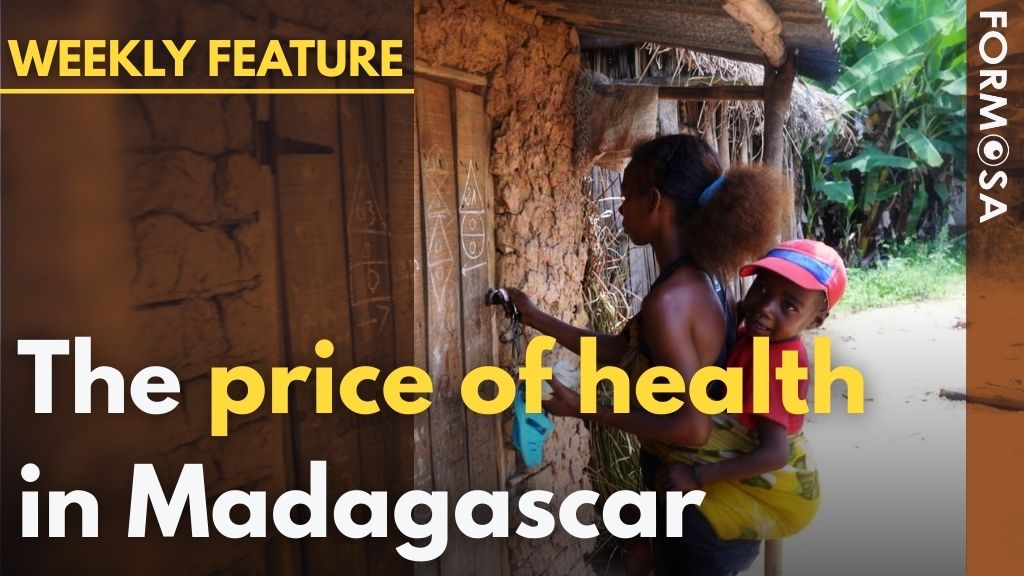
In the 35-degree heat, a 29-year-old woman named Linda carries her 6-year-old son on her back.
This is the only national highway in the east-west direction in Madagascar.
It takes more than an hour for them to reach a pit stop. She buys a drink and bread as refreshment. Before they leave, the store owner asks her why she’s carrying the boy. She says it’s because he can’t walk.
This house built with clay, twigs, wooden planks and hay is their home. Looking around, there seems to be a lack of running water, electricity and gas. Only a single light bulb dangles in a corner.
But they still try to make themselves comfortable. The bed the family shares has a lace-trimmed mosquito cover.
She sets up a fire on the ground, then places the pot on top. A plate of rice and some dried fish, that’s their lunch.
Linda
Local resident
My husband is a carpenter. He goes out to work every day. I take care of our kid. We do struggle. We can’t afford to go to the doctor in the city, unless seriously ill. We’re used to how our son can’t walk. The doctors here can’t do much anyway.
The boy only eats rice on most days. An unbalanced diet has affected his development in such a way that he still can’t walk at six years old.
According to the United Nations International Children’s Emergency Fund, more than 60% of Madagascans cannot afford to eat meat. Most people only eat rice on a daily basis, leading to malnutrition. The village head told us that most families in the village live like Linda’s.
Sean
Village head
Most people live in villages and grow rice, bananas and cassava, or do woodwork. Their daily wage is between 6,000 and 7,000 ariary, less than US$2.
Even though the economy relies on agriculture, extreme weather events of drought and storms are destroying crops and holding back incomes, making Madagascar one of the poorest countries in the world. As many as 80% of the population live below the poverty line. Healthcare is a luxury in this country.
Sean
Village head
Our incomes are really low. If we get sick, we just grit our teeth and try to get over it. Instead of going to the doctor’s, we use traditional remedies, like banana leaves, which are crushed and applied as a paste or ingested.
The village, which is 160km away from Antananarivo, the capital has a population of around 2,000 but not a single clinic. Healthcare is inaccessible in distance and cost.
But it’s not just inaccessible for the underprivileged. It’s also expensive for the middle class.
We’re now at a middle-class neighborhood in the northwest of Antananarivo. The weather’s good, and a 52-year-old woman named Shirley had taken the bus to visit the local market. Around half a year ago, she noticed that her stomach has become more and more bloated, which made her lose her appetite for food and even water.
Their two-storey house is painted an eye-catching shade of turquoise. Inside, it has an attic and the walls are painted terracotta brown. Very few locals live so comfortably.
Rick
Shirley’s brother-in-law
I am a tour guide living in the northwest of Antananarivo. I live quite comfortably. My wife runs a bed and breakfast and a restaurant. Business is very good during peak holiday season, so we have the means to take care of Shirley.
To treat her condition, Shirley has to travel 6 to 7 hours every week from her home to a hospital downtown to get paracentisis. This costs 40,000 ariary every month, which is around half that of locals’ monthly wage. Without help from family, she might not be able to afford treatment.
Shirley
Local resident
I don’t have an income. I can’t carry heavy things. I can’t really take care of myself. I’m so grateful of my sister and her husband for their help.
Rick
Shirley’s brother-in-law
It’s true that it costs us a lot and the hospital’s really far away. Sometimes we struggle too. But we’re family, so we’re happy to help.
But not everyone’s so fortunate.
Most people live like Linda, in places without running water or stable electricity. Even in cities and in hotels, power could go out any time.
Lai Kuan-yu
FTV reporter
I’m now at Moramanga, Madagascar. You can see that it’s raining heavily outside, and there’s even thunder. Why is it pitch black? It’s because it’s now 9:30 p.m. but there’s a blackout. Actually, since we got here, there may be three to four blackouts every day. This shows us just how unstable electricity supply is.
Inadequate infrastructure and poor sanitary conditions led to widespread infectious diseases such as malaria and plague. On top of food shortage and hunger, locals often have to endure severe illness.
To get a better understanding of local healthcare, we traveled to a village four hours away from the city center to see the only clinic there.
The clinic is nestled in the neighborhood in a private residence. The signage appears weathered. The doctor comes out to greet us and leads us inside.
Donarivelo
Physician
If we need an enclosed space, for example, for antenatal checks, surgeries, injections, we do it here in this room. We have running water here. This is the room for inpatient care. All the beds are here.
Four beds are placed inside this six-ping room. Patients that may require very different treatments all have to stay in the same space. The doctor says malaria is quite rampant in the country.
Donarivelo
Physician
Sometimes I just don’t have enough beds. Malaria peaks between March and May every year. It’s really quite rampant in Madagascar. I may have more inpatients, and may have to hang mosquito nets around the beds.
It’s also quite expensive to get treated for malaria.
Donarivelo
Physician
For example, if someone gets malaria, each treatment will cost 40,000 ariary. It’ll take at least three treatments and three days inpatient. Most people coming to get treated may only have 2,000 to 3,000 ariary on them, so they’ll ask me if I can just give them medication. I don’t know what to say.
Infectious diseases such as malaria plague the local population. But because it’s quite expensive for them to get treated, many don’t and some even lose their lives.
Donarivelo
Physician
Many people don’t know how dangerous malaria is. They may even believe in the rumor that getting an injection at a clinic leads to death, so they don’t seek timely treatment. When they come here with their face discolored yellow or red, it’s already so severe it could be life-threatening.
Even though the doctor seems to be proud of his facilities, it comes nothing close to what most people can easily access in Taiwan. The same can be said in other local townships.
We’re now on the other side of the hill, visiting another village and clinic. Like the previous one, it only has basic facilities.
Lesna
Nurse
The bigger problem is the lack of imported medication and medical equipment, as well as the shortage of hospital beds. For example, there are some basic testing apparatus that we don’t have. Consultations also cost money, and we’ll only give advice and treatment when we get paid. If you don’t have money, the government won’t pay for you. You may have to wait until family and friends are willing to pitch in, or have charities help you pay.
The quality of healthcare aside, what’s more pressing is how unaffordable it is. We interviewed a young couple at the hospital: 30-year-old Pasida and his wife, who caught malaria.
Pasida
Local resident
My wife and I make charcoal. I borrowed money from our boss. I’m afraid of losing her.
Pasida looks utterly defeated in tattered clothes, but he must hang on, difficult as life is.
This is what healthcare looks like in a poverty-stricken nation.
For more Taiwan news, tune in:
Mon to Fri at 9:30 pm on Channel 152
Tue to Sat at 1 am on Channel 53
#Madagascar #healthcare #Africa #charity #TaiwanCanHelp
2025-09-05