Japan’s Kumamoto promises to spare no effort following helicopter crash
Japan’s Kumamoto promises to spare no effort following helicopter crash
2026-01-21
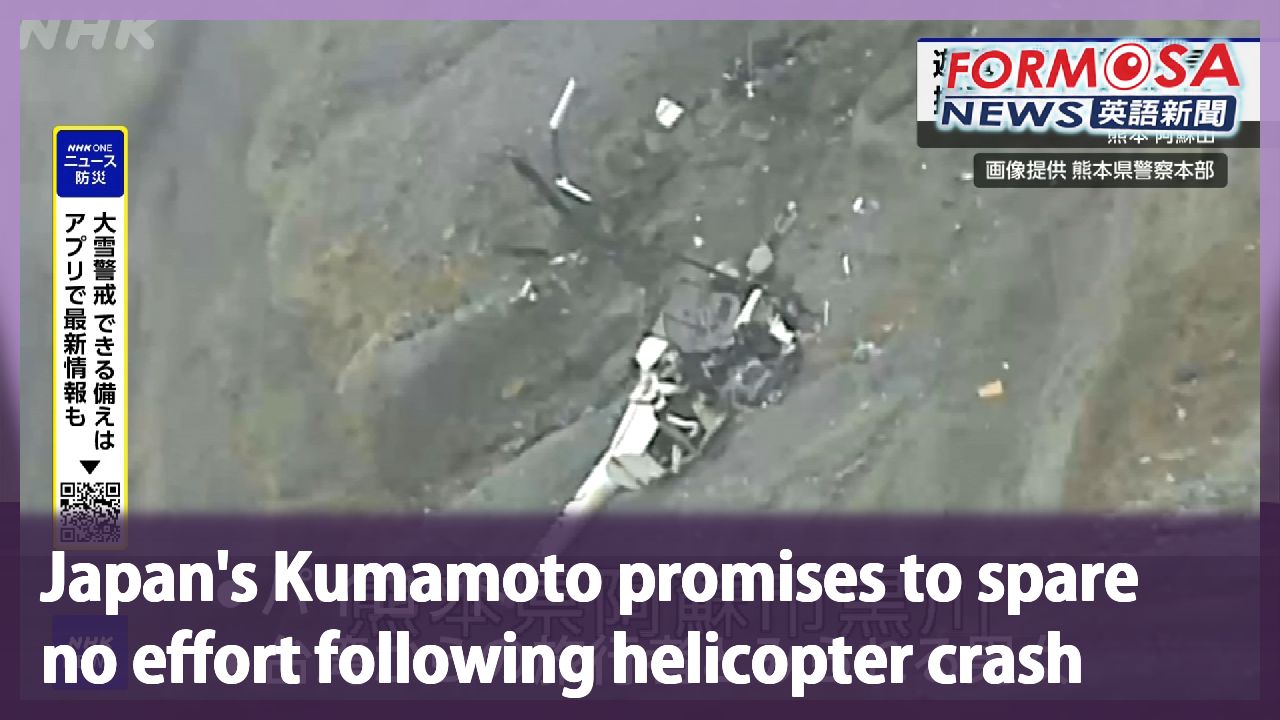
Search-and-rescue continues for two missing Taiwanese tourists and a Japanese pilot, following a helicopter crash near Mount Aso in Japan’s Kumamoto Prefecture. Japanese authorities have found the helicopter’s remains, but the three victims are still missing. Due to unfavorable weather and geographical conditions, it’s going to be a tough mission for Japanese authorities. Still, the governor of Kumamoto Prefecture promised to spare no effort.
The police temporarily suspended search-and-rescue efforts last night, and resumed it on site this morning, as they assessed the situation and continued to track down the three victims’ whereabouts.
Early in the morning, Japanese authorities gathered almost 50 rescuers by Mount Aso in Kumamoto Prefecture. They are now part of a command center guiding the search-and-rescue mission for the two missing Taiwanese tourists and Japanese pilot. The conditions were harsh, with temperatures dipping as low as -4.2°C. Snowfall persisted, and volcanic gases filled the air, making it difficult to get close to the crater and thus hindering their efforts.
The search is on. However, due to harsh weather and a high concentration of volcanic gases, it’s a tough road ahead for the mission.
Thick smoke significantly lowered visibility around the crater and drones couldn’t be deployed, making the mission almost impossible. A day earlier, rescuers identified remains of the helicopter by the largest crater of Mount Aso. However, the two Taiwanese tourists and the 64-year-old Japanese pilot remain missing. The incident sparked discussions about the helicopter itself.
They flew on a Robinson R44, a light, four-seat single-engine helicopter. It’s simple, lightweight and cost-effective. According to an expert, turbulence can be quite strong near a volcanic crater, making this non-fixed-wing, single-engine aircraft a rather risky choice.
Hwang Tay-lin
Chang Jung Christian University
This is the single-engine Robinson R44 helicopter. It was actually manufactured more than 30 years ago. In the event that the engine malfunctions, there isn’t another engine to keep it up. Additionally, it can be quite turbulent in volcanic areas. A light helicopter plus turbulence multiplies the risk.
Family members of the two Taiwanese tourists arrived in Japan Wednesday, assisted by Taiwan’s representative office in Fukuoka. The governor of Kumamoto Prefecture, Kimura Takashi also issued a statement on video, promising to spare no effort in the search-and-rescue mission.
For more Taiwan news, tune in:
Mon to Fri at 9:30 pm on Channel 152
Tue to Sat at 1 am on Channel 53
#kumamoto #travel #japan #helicopter #breakingnews
阿蘇火山直升機2台人失聯! "低溫+濃霧"救援困難
2026-01-21
日本阿蘇火山,週二發生觀光直升機意外,兩名台灣旅客及一名駕駛,目前下落不明,搜救人員已經掌握直升機殘骸位置,但因為濃霧以及低溫下雪,搜救人員難以靠近,無人機也無法執行。專家分析當時他們搭乘的小型單引擎直升機,面對火山的不穩定氣流,容易產生較大風險。
“警方等單位昨晚暫時中斷搜救,今晨起持續在現場,確認相關狀況,並尋找3人的行蹤。”
一大早,將近50名日本搜救人員,在熊本阿蘇山的廣場集結,成立指揮中心,搜尋失聯的台灣遊客,但當地天候惡劣,清晨最低溫一度來到零下4.2度,山區不斷出現降雪,加上火山氣體濃度偏高,人員根本難以靠近,搜救行動一度受阻。
“目前正在搜尋行蹤,但由於天候惡化,加上火山氣體濃度偏高,搜救行動進展困難。”
偏偏火山口濃霧籠罩,能見度低,無人機也無法執行,搜救面臨考驗,前一天,搜救人員在阿蘇中岳第一火口內東北側,發現直升機殘骸,但沒有找到,兩位台灣遊客,以及64歲的日本籍的資深駕駛,當時他們搭乘的直升機也引起討論。
這架直升機,為羅賓遜R44,屬於小型單引擎直升機,最多可載四人,結構簡單、成本低,重量也輕,專家分析火山口氣流混亂,如果又搭乘非固定翼的單引擎飛機,風險更高,一旦出事難以挽回。
[[長榮大學航運管理學系教授 黃泰林]]
“這台是R44單引擎的直升機,其實它出廠大概也超過30年了。萬一有引擎失效的話,它就沒有辦法再靠另外一具引擎來產生動力,再加上在火山地區,氣流非常不穩定,小型直升機又配上了不穩定的氣流,風險是加乘的效果。”
家屬已經在週三抵達日本,台灣駐福岡辦事處提供協助,熊本縣知事木村敬也親自指示,會全力搜救,只盼盡快找到人。
更多新聞內容,請鎖定:
民視台灣台(152頻道)週一至週五晚上9:30
民視新聞台(53頻道)週二至週六凌晨1:00
Related News