Turtle eggs hatch on Xiaoliuqiu in rare winter occurrence
Turtle eggs hatch on Xiaoliuqiu in rare winter occurrence
2026-03-18
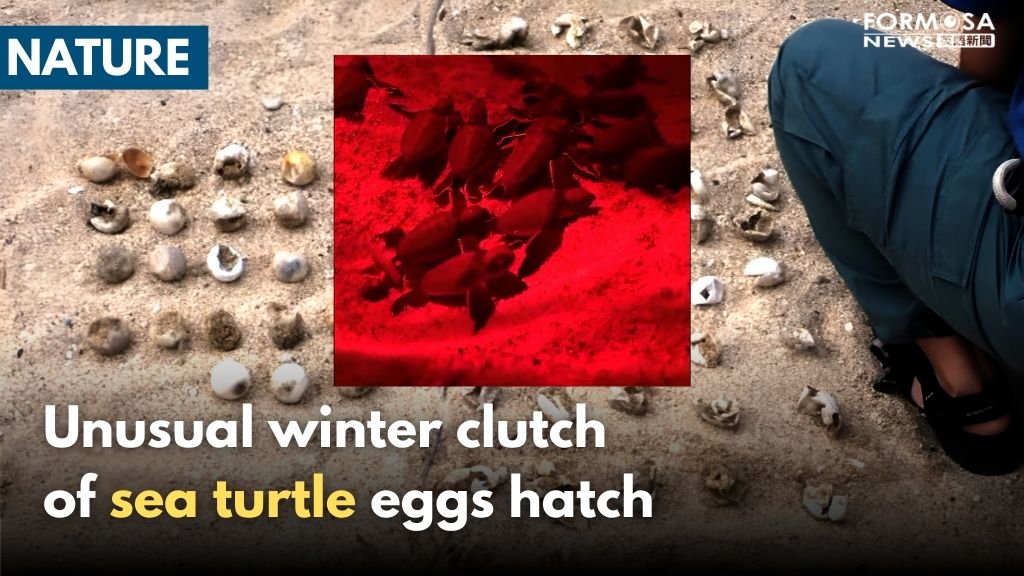
Sea turtles usually lay eggs in the summer, but one decided to lay her clutch last December on the off-shore island of Xiaoliuqiu, with about 70 baby sea turtles hatching recently. Experts say that temperature is important in determining the sex of the hatchlings. In the past, warm temperatures averaging above 31°C have produced more females, but this time, the average temperature was around 25°C, so most of the hatchlings have turned out to be male.
A mother sea turtle was recorded laying her eggs in December last year. When she finished, she returned to the sea. After about 83 days, baby sea turtles hatched and made their own way to the sea.
These adorable baby turtles slowly but surely climb out from their nest. Sea turtles usually nest in the summer, but this time the mother laid her clutch in the winter. What’s more, of the 94 eggs laid, an astounding 70 hatched.
Lai Yun-ju
Ocean Conservation Administration official
If the temperature by the nest averages around 28°C, it will produce male hatchlings. If the average temperature is above 31°C, we can be fairly certain that most of the hatchlings will be female.
Since this turtle laid in winter, the average temperature was even lower at 25.2°C, so it’s likely that most of the hatchlings were male. This sea turtle laid eggs on Xiaoliuqiu once before in 2023. Three years later she came back, but in a different season.
Lee Tsung-hsien
Marine biologist
This could be a sign that human activities have caused air, water, and sand temperatures to rise. In order to adapt to these climatic changes, female sea turtles may start coming ashore to lay eggs during cooler weather.
Sea turtles rarely lay eggs in the winter, making this case very valuable for research. But this could be a sign that climate change and rising global temperatures are continuing to alter the marine environment. Sea turtles could lay their eggs in either winter or summer, so look out for turtle nests and be sure not to disturb them.
For more Taiwan news, tune in:
Mon to Fri at 9:30 pm on Channel 152
Tue to Sat at 1 am on Channel 53
#seaturtle #eggs #nesting #babyseaturtle #hatchlings #temperature #climatechange #globalwarming #Xiaoliuqiu
罕見! 全球暖化海龜"冬季產卵" 成功孵化70隻稚龜
2026-03-18
屏東小琉球罕見的出現海龜冬季產卵的景象,而且近日還成功孵化出70隻稚龜,由於海龜通常是夏季產卵,因此這次的狀況相當特別,加上氣溫關係,以往超過31度較容易孵化雌性海龜,這次平均氣溫在25.2度,因此很可能多數會是雄性海龜。
人員拍下去年12月一隻母龜,進行產卵的畫面,完成產卵後,母龜回大海,而經過83天的孵化,近日好幾隻稚龜順利破殼而出。
小海龜從沙子中努力爬呀爬,實在超可愛,人員拍下驚喜瞬間驚呼連連,因為這是海龜罕見在冬季產卵,而且還成功孵化。根據統計,這窩卵共計94顆,孵化率約百分之74。
[[海保署海洋生物保育組科長 賴韻如]]
“如果卵窩是在平均是在28度以下的話,牠會產生出雄性的稚龜,平均溫度如果高於31度的話,我們就大多可以肯定,牠大多數的卵窩會產生出雌性的稚龜。”
由於是冬季,這次卵窩孵化期間平均溫度是25.2度,因此可以判斷這次的小海龜,可能以雄性為主。其實這隻海龜早在2023年,就曾在小琉球蛤板灣產卵,當時歷經73天孵化,相隔約三年,再次來到同一個地點,不過卻換了季節。
[[海生館副研究員 李宗賢]]
“是不是這也意示著說,人類的活動造成了,比如說氣溫、水溫還有沙溫,這些氣溫在升高的時候,這些母海龜牠們為了要適應氣候的變遷,牠們會變得在天氣比較冷的時候才上來生蛋。”
雖然海龜冬季產卵相對少見,是研究的珍貴資料,不過專家也提醒民眾,這很可能是氣候變遷、全球暖化持續改變了海洋環境,海保署也呼籲,近期沙灘可能陸續出現至龜孵化,民眾要多加留意,避免干擾。
更多新聞內容,請鎖定:
民視台灣台(152頻道)週一至週五晚上9:30
民視新聞台(53頻道)週二至週六凌晨1:00
Related News