Families pool time to get rest from caring for elders
Families pool time to get rest from caring for elders
2026-03-27
As Taiwan enters a super-aged society, the demand for long-term care is rising, while a shortage of caregivers continues to put pressure on families and the system alike. For those caring for loved ones with dementia, the burden can be especially heavy, with little time to rest. The Ministry of Health and Welfare has rolled out a new solution, a mutual respite service that turns idle hours at care centers into shared support networks. Families take turns volunteering alongside professional caregivers, creating a cooperative model that allows each caregiver to earn valuable time off. The initiative aims to ease the strain on households by encouraging families to support one another so no one has to face the challenges of caregiving alone.
For families who have elders with dementia, getting asked the same questions over and over again is just daily life. But it can be exhausting. That’s especially so when day care centers close on the holidays and working adults don’t even get to catch a break on the weekend. That’s why Ms. Lee and Mr. Chiang decided to join a mutual respite program to take care of 80-year-old Ms. Chiang.
Lee Yu-shan
Ms. Chiang’s daughter-in-law
They find a caregiver, so she gets lunch and snacks in the afternoon. Families take turns volunteering. That’s pretty much it.
Chiang Wei-hsin
Ms. Chiang’s grandson
She gets to exercise, and an instructor plays games with them. It’s really worth it.
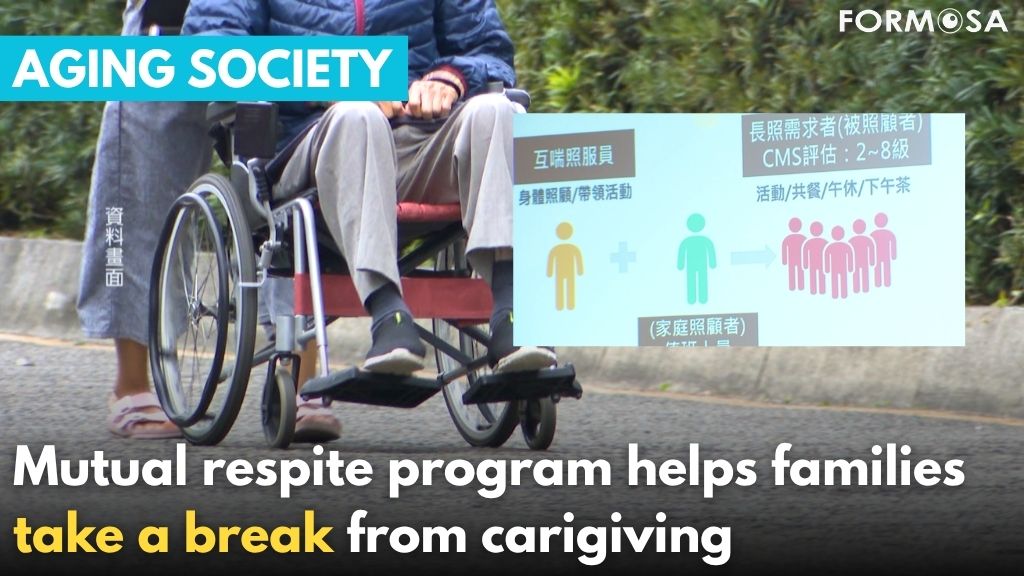
Ms. Chiang’s relatives take turns volunteering so that she can attend special classes. The Ministry of Health and Welfare launched the mutual respite platform as part of Taiwan’s Long-term Care Plan 3.0. Six to eight families are made into a group with one caregiver to make use of day care centers that would otherwise close on weekends. The sessions are supported by volunteers from each family, who take turns so that everyone can have some free time. Volunteering one day equals two days of rest.
Chen Cheng-fen
NTUNHS
The venues can be opened on weekends, with fees costing just NT$200 for a full day or NT$100 for half a day. Rates are free for low-income and medium-low-income families.
There are currently 50 groups set up around Taiwan. All participants have to do is sign up for a location and a time slot online. Prices are affordable, at just NT$200 for eight hours.
Lue Jen-der
Deputy Minister of Health and Welfare
It provides downtime to let caregivers rest. We’re promoting this time bank and we hope that in the future, if it is feasible, we can incorporate future time imbursements.
Families who with elders included in the Long-term Care 3.0 plan are eligible to apply and help each other get some free time to rest.
For more Taiwan news, tune in:
Mon to Fri at 9:30 pm on Channel 152
Tue to Sat at 1 am on Channel 53
#longtermcare #respite #care #caregiver #timebank
當志工1天換休息2天 "互助喘息"服務納長照3.0
2026-03-27
台灣邁入高齡社會,長照體系也面臨人力不足困境,衛福部宣布將"互助喘息服務",納入長照3.0,以時間銀行為概念,運用照顧中心的閒置時段,派出一位專業照服員,邀請民眾來當照顧志工,參與一個時段,能換2倍時段休息,讓更多家庭組成照顧小隊,輪流支援、流輪休息。
患者同樣問題重複好幾次,對失智症家庭來說是日常,壓力不斷累積,多數日照中心因為假日沒營業,讓平日要工作的照顧者,到了週末都無法好好休息,為了有更好體力,照顧80歲的蔣媽媽,兒子、媳婦和孫子,決定參加互助喘息服務。
[[照顧者 李宇姍]]
“他們會找照顧員,還有我們長輩有午餐,還有下午的點心,家屬就是輪流去當志工,這樣就可以了。”
[[照顧者 蔣煒鑫]]
“陪長輩一起運動,有老師帶,然後一起玩遊戲,覺得真的很值得。”
一家人輪流當志工,讓媽媽開心去上課,衛福部將互助喘息平台,納入長照3.0體系,運用日照中心假日空閒時間,將6到8個家庭組成單位,由政府提供一名照服員,搭配各家庭成員輪流值班,換取各自喘息空間,只要值班一天,就能換取兩天休息時間。
[[台北護理健康大學長期照護系教授 陳正芬]]
“空間的提供者,他可以開放週六或是週日的時間,一天只要200元,半天就是100元,低收入跟中低收入是免費的。”
目前全台有50個據點加入,民眾可線上預約值班地點與時段,價格也相對親民,家人到照顧機構,自付額八小時200元。
[[衛福部政務次長 呂建德]]
“第一個是喘息,讓照顧者喘息。第二個是我們現在目前本部正在積極推動的時間銀行,未來如果可行的話,我們就會考慮納入到未來的給付。”
只要家中有人符合長照3.0資格,就可以申請喘息服務,大家彼此幫忙,不用孤軍奮戰。
更多新聞內容,請鎖定:
民視台灣台(152頻道)週一至週五晚上9:30
民視新聞台(53頻道)週二至週六凌晨1:00
Related News