New Chinese law for “ethnic unity” could make anybody legally liable
New Chinese law for “ethnic unity” could make anybody legally liable
2026-07-01
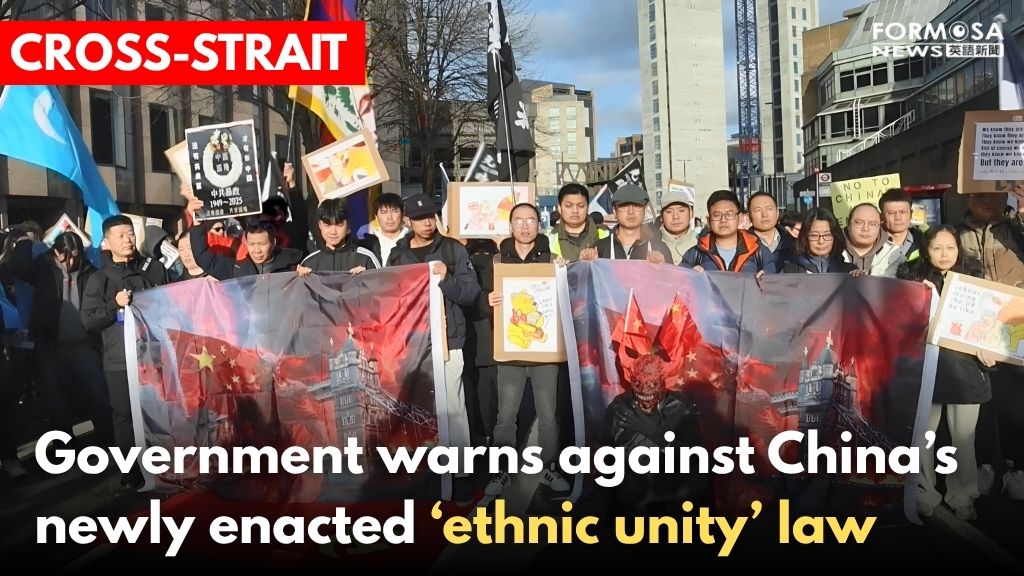
China’s Law on Promoting Ethnic Unity and Progress went into effect today, meaning Chinese citizens, people living in Hong Kong, Macau or Taiwan, and even non-Chinese in every part of the world are subject to the law. The law’s vague legal concepts essentially allow the CCP to punish anyone, anywhere, who, quote "undermines the ethnic unity and progress" of China. Several political scholars in Taiwan shared their opinions on the law’s true aim.
Liang Wen-chieh
Mainland Affairs Council spokesperson
The CCP’s Law on Promoting Ethnic Unity and Progress expands their scope of long-arm jurisdiction, which allows them to repress people abroad. The law uses vague legal concepts that inherently have nothing to do with rule of law. Instead, the law’s ultimate goal is about political intimidation, essentially causing a chilling effect that forces ordinary citizens into self-censorship.
Fan Shih-ping
NTNU political science professor
It’s about social stability. The law’s viewed as a tool that their regime uses to maintain its authority.
Wu Se-chih
Taipei University of Marine Technology professor
China uses this kind of law in hopes that it can suppress people abroad. China has dispatched many secret police in overseas offices in order to help carry out this Law on Promoting Ethnic Unity and Progress, which is a cause for concern in the international community.
Article 63 of the Law on Promoting Ethnic Unity and Progress states that individuals or groups outside of China that "undermine ethnic unity and progress or create ethnic division" could potentially be legally liable for their words or actions. The law’s legal concepts are vague, as the CCP could punish anyone it deems to be "undermining ethnic unity." Essentially, a person could be considered guilty if he or she had, in the past, written or shared an article that refers to China’s suppression of Taiwan or topics like Taiwanese sovereignty or independence. Furthermore, Western countries that support Xinjiang or criticize the CCP could also be legally punished.
For more Taiwan news, tune in:
Mon to Fri at 9:30 pm on Channel 152
Tue to Sat at 1 am on Channel 53
中國"民族團結法"7/1啟動 梁文傑示警:實行政治威脅及恐嚇
2026-07-01
中國「民族團結促進法」7月1號上路,包含中國人、港澳台民眾甚至全球公民,都納入管轄範圍,但法律定義模糊,只要被中國認定違反民族團結、破壞統一,就算喊"維持現狀"都可能遭中共刑法追訴,來聽聽陸委會副主委梁文傑以及學者怎麼說。
[[陸委會副主委 梁文傑]]
“(這部法律)擴大中共對境外的長臂管轄,和跨境鎮壓。它運用這些不確定的法律概念,它根本目的並不是為了落實法治,而是要實行政治威脅和恐嚇,迫使民眾來產生一種寒蟬效應,然後自我審查。”
[[師大東亞學系教授 范世平]]
“維穩,當作它執政還有維護政權穩定的一個工具而已。”
[[台北海洋科大教授 吳瑟致]]
“中國利用這樣子的法律,希望能夠達到跨境鎮壓的效果。中國在海外也派駐了許多海外秘密警察,配合這次的民族團結法的推動,確實會引起國際社會的擔憂。”
中國"民族團結促進法",第63條"跨國鎮壓條款"規定,所有境外組織與個人,只要實施「破壞民族團結」或製造民族分裂行為、都將依法追究,但法律概念模糊,只要中共定義你破壞團結,都可能被列懲治,甚至曾發文或轉發中國對台施壓、兩案主權獨立等貼文也可能被定罪,西方國家挺新疆、譴責中共,也可能遭中國刑法追訴。
更多新聞內容,請鎖定:
民視台灣台(152頻道)週一至週五晚上9:30
民視新聞台(53頻道)週二至週六凌晨1:00
Related News