Language vitalization efforts by Taiwanese of Hakka heritage
Since the promulgation of the Development of National Languages Act in 2018, schoolkids must earn credits for a national language other than Mandarin. This could be Taigi, also known as Taiwanese, Hakka, or any of the 16 Indigenous languages. With Mandarin being the dominant language for the overall society, other national languages are usually a heritage language for most people. Still, not all heritage languages are equal. Sinitic languages spoken in Taiwan, including Taigi and Hakka, are far more dominant than Indigenous languages. And between Taigi and Hakka, the former is much more prevalent. But that does not stop Hakka people from embracing their language and culture. Let’s take a look at our special report on how the Hakka language is being revitalized in different parts of the nation.
As many as 90% of residents in Hengshan Township, Hsinchu County identify as Hakka. Aspects of Hakka culture, evident on Neiwan Old Street, are more than just tourist attractions. It’s embedded in daily lives.
The local Dadu Primary School has a little more than 200 students. All of them, from first- to sixth-graders, have gathered to learn their Hakka-language school anthem.
Hakka singer-songwriter Liu Jung-chang teaches at Dadu Elemetary School’s ukulele club. He composed the new school anthem, which debuted around a decade ago.
Liu Jung-chang
Singer-songwriter
I believed the new school anthem should be easily disseminated and catchy. The lyrics must be easy for kids to pick up, so that they know it after just one to two takes.
Liu opted to compose a catchy Hakka-language school anthem, so that kids would be willing to sing it often. It’s a lifeline for the local heritage language. Even though 75% of Dadu Elementary schoolkids are of Hakka descent, their Hakka-language skills suffer owing to a strong dominant Mandarin society-wide.
Liu Jung-chang
Singer-songwriter
Kids have to sing their school anthem. So it’d be great to have Hakka-language school anthems in predominantly Hakka neighborhoods, and Indigenous-language ones respectively, be it Atayal, Saisiyat or Amis. At least schoolkids can sing one song in their heritage language, and that song is also current.
Efforts to promote Hakka are challenged even in Hakka villages, not to mention in urban areas, where the language is hardly ever spoken.
As soon as Lin Chiung-han takes a seat in the classroom, the teacher descends from the lectern and sits with him for an one-on-one session. That’s because he’s the only one taking this Hakka class at Taipei’s Datong High School for mandatory local heritage language coursework at the middle school level.
Tso Chun-hsiang teaches three Hakka courses at Datong High School, each with less than five students enrolled. One is attended by a single student, Lin himself.
Lin Chiung-han
7th grader at Datong High School
In primary school, there was a larger group. There are also fast answer races, so one person speaking Hakka will encourage others to do the same. That way, everyone makes quick progress. The one disadvantage now is that I have no classmates to discuss with.
Even though Lin is the only student in the classroom, he’s still eager to learn, because Hakka is the primary language of communication between him and his maternal grandparents, who live in a Hakka village in Miaoli.
Lin Chiung-han
7th grader at Datong High School
My grandma took care of me until kindergarten. She spoke Hakka to me. At home, she watches news and listens to the radio in Hakka, and that’s how I picked up the language.
Although Lin is only one of the handful of students taking Hakka, there are far more students of Hakka descent opting to take Taigi instead.
Tso Chun-hsiang
Hakka language teacher
Most kids would take Taiwanese Taigi for local language credits. There’s a saying in Holo, “to take the larger slice of the watermelon.” Conformism makes it so that fewer and fewer students learn Hakka. It’s a vicious cycle. People are led to believe that Hakka is of no use in the future.
When fewer students of Hakka heritage opt to learn their language, teachers suffer too.
Tso Chun-hsiang
Hakka language teacher
Whether it’s parents or the wider society that discourages kids from taking Hakka in school, we teachers have less classes to teach. It’s simply not possible for one to make a living solely from teaching the language.
Kids may wish to join the Taigi-speaking majority. It could also be that parents believe it’s more practical for kids to learn Taigi. Either way, that makes the minority language even more susceptible to language death outside of Hakka villages. But on the bright side, some parents are proudly hanging on to their heritage.
On weekend mornings, 7-year-old Tsai-ni enjoys quality time with the family practicing speaking Hakka with her father over breakfast.
She’s currently a second-grader in Banqiao, New Taipei, and the only one in her homeroom learning Hakka. But at least she gets to attend Hakka classes with five other kids. Still, she’s sad that she couldn’t be with her friends in Hakka classes.
- How many people are you friends with in class?
- Five.
- What did they choose?
- Minnan.
- I told mom and dad I want to learn Minnan, because all my friends are learning Minnan.
- What did mom and dad say?
- They won’t let me.
Mr. Wu
Father
Because we’re Hakka, we hope our child can take Hakka language classes. It’s okay if she doesn’t become fluent. I think it’s alright if she’s able to understand conversational Hakka. It’s great that Hakka is offered at school, so she has more exposure to the language. Also, when we visit our parents, her grandparents and great-grandparents can still exchange a few words with her.
The Wu’s visit grandpa and grandma every weekend to keep the family close and give their daughter more opportunities to speak Hakka.
Mr. Wu
Father
I could understand and speak Hakka as a kid. It’s because I grew up hearing the older generations using the language. I was immersed in it in everyday life. If there’s something I didn’t understand, I’d ask my father. Little by little I learned the language.
Even though the Wu’s hope to create more opportunities for their daughter to use the language, her grandparents still mainly speak to her in Mandarin. Still, it’s better than nothing.
Mr. Wu
Father
Some Hakka villages are also tourist attractions, such as Nanzhuang, Beipu. Many tourist attractions in Taoyuan, Hsinchu and Miaoli are Hakka villages. She can practice speaking Hakka with local businesses. For example, I’d ask business owners to repeat in Hakka for my kid, and give her money to pay for us. She enjoys it too.
Luckily, the families of Tsai-ni and Lin still speak Hakka at home. But what about other kids whose parents and grandparents no longer speak the language fluently?
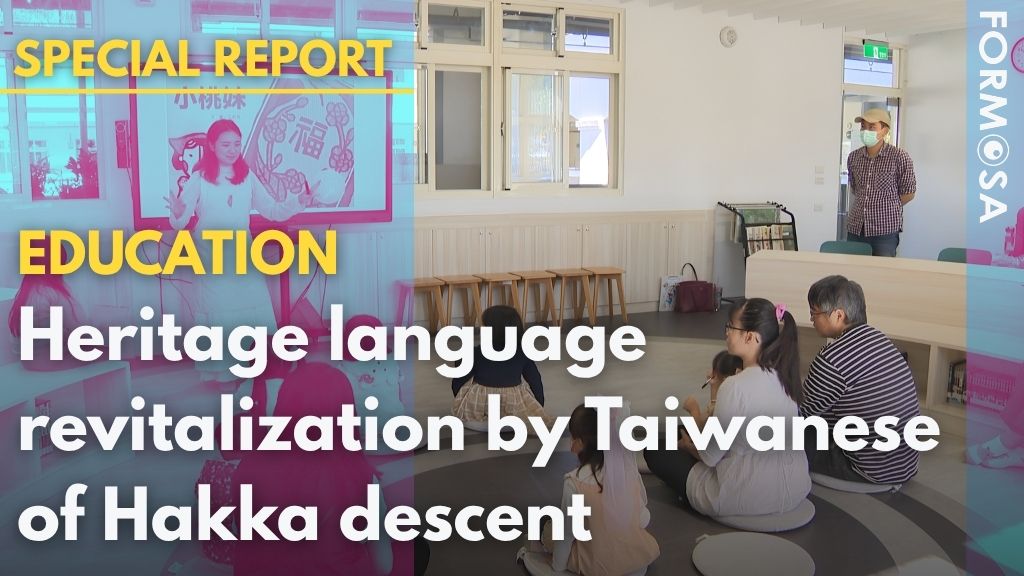
At Hengshan Junior High’s reading room, kids are excited for a picture book read aloud.
The book of the day is “Little Peach Girl,” a story about Hakka-style red tortoise cake. It’s read in Hakka and some Mandarin. This is a Hakka-language parent-and-child co-learning event hosted by Play Art Group, a local cultural and educational organization.
Play Art Group found that even though kids may learn Hakka at school, they often have no one to practice with at home or elsewhere, eventually resulting in attrition. So they hope to get parents involved and introduce Hakka into the household.
With an engaging story, kids easily pick up vocabulary related to the dish. But there’s more. They’re invited to make their own red tortoise cake.
From the screen to real-life, kids engage with Hakka culture with all five senses. Kids love these workshops.
Parent
Workshop participant
We’re three generations under the same roof. Her grandma speaks Hakka to her at home. We also want our kid to learn it.
Parent
Workshop participant
We live in Hsinchu County, where there are many Hakka speakers. We’re of Minnan descent, so we can’t really speak Hakka and can’t teach our kids Hakka, so we try to participate in Hakka-language events, so they have more opportunities to hear and learn the language.
The family friendly events allow kids and parents to learn Hakka together. For many families, it’s also an opportunity to pick up vocabulary.
Parent
Workshop participant
Last time we learned expressions for different types of bridges and many words for colors.
Liu Jung-chang
Singer-songwriter
Kids enjoy storytelling. Parents taking part with them may not be fluent in their heritage language, but they can still learn. Through repetition, kids can learn with their parents.
Though fluent speakers of Hakka are on the decline, it seems that there’s still hope.
Lin Chiung-han
7th grader at Datong High School
Hakka is not as mainstream, because most people are Taigi speakers. There are fewer people who will be able to pass on the culture and language. By choosing to take Hakka, the culture and language are still being passed on and made known to a greater number of people.
From mandatory heritage language coursework, to extracurriculars and even the home, Hakka is kept alive.
As long as the language and culture are still being taught, there’s always a chance for its revival.
For more Taiwan news, tune in:
Mon to Fri at 9:30 pm on Channel 152
Tue to Sat at 1 am on Channel 53
#taiwan #languages #heritagelanguage #hakka #taigi
2026-07-29