Language vitalization efforts by Taiwanese of Hakka heritage
Language vitalization efforts by Taiwanese of Hakka heritage
2026-07-29
Since the promulgation of the Development of National Languages Act in 2018, schoolkids must earn credits for a national language other than Mandarin. This could be Taigi, also known as Taiwanese, Hakka, or any of the 16 Indigenous languages. With Mandarin being the dominant language for the overall society, other national languages are usually a heritage language for most people. Still, not all heritage languages are equal. Sinitic languages spoken in Taiwan, including Taigi and Hakka, are far more dominant than Indigenous languages. And between Taigi and Hakka, the former is much more prevalent. But that does not stop Hakka people from embracing their language and culture. Let’s take a look at our special report on how the Hakka language is being revitalized in different parts of the nation.
As many as 90% of residents in Hengshan Township, Hsinchu County identify as Hakka. Aspects of Hakka culture, evident on Neiwan Old Street, are more than just tourist attractions. It’s embedded in daily lives.
The local Dadu Primary School has a little more than 200 students. All of them, from first- to sixth-graders, have gathered to learn their Hakka-language school anthem.
Hakka singer-songwriter Liu Jung-chang teaches at Dadu Elemetary School’s ukulele club. He composed the new school anthem, which debuted around a decade ago.
Liu Jung-chang
Singer-songwriter
I believed the new school anthem should be easily disseminated and catchy. The lyrics must be easy for kids to pick up, so that they know it after just one to two takes.
Liu opted to compose a catchy Hakka-language school anthem, so that kids would be willing to sing it often. It’s a lifeline for the local heritage language. Even though 75% of Dadu Elementary schoolkids are of Hakka descent, their Hakka-language skills suffer owing to a strong dominant Mandarin society-wide.
Liu Jung-chang
Singer-songwriter
Kids have to sing their school anthem. So it’d be great to have Hakka-language school anthems in predominantly Hakka neighborhoods, and Indigenous-language ones respectively, be it Atayal, Saisiyat or Amis. At least schoolkids can sing one song in their heritage language, and that song is also current.
Efforts to promote Hakka are challenged even in Hakka villages, not to mention in urban areas, where the language is hardly ever spoken.
As soon as Lin Chiung-han takes a seat in the classroom, the teacher descends from the lectern and sits with him for an one-on-one session. That’s because he’s the only one taking this Hakka class at Taipei’s Datong High School for mandatory local heritage language coursework at the middle school level.
Tso Chun-hsiang teaches three Hakka courses at Datong High School, each with less than five students enrolled. One is attended by a single student, Lin himself.
Lin Chiung-han
7th grader at Datong High School
In primary school, there was a larger group. There are also fast answer races, so one person speaking Hakka will encourage others to do the same. That way, everyone makes quick progress. The one disadvantage now is that I have no classmates to discuss with.
Even though Lin is the only student in the classroom, he’s still eager to learn, because Hakka is the primary language of communication between him and his maternal grandparents, who live in a Hakka village in Miaoli.
Lin Chiung-han
7th grader at Datong High School
My grandma took care of me until kindergarten. She spoke Hakka to me. At home, she watches news and listens to the radio in Hakka, and that’s how I picked up the language.
Although Lin is only one of the handful of students taking Hakka, there are far more students of Hakka descent opting to take Taigi instead.
Tso Chun-hsiang
Hakka language teacher
Most kids would take Taiwanese Taigi for local language credits. There’s a saying in Holo, “to take the larger slice of the watermelon.” Conformism makes it so that fewer and fewer students learn Hakka. It’s a vicious cycle. People are led to believe that Hakka is of no use in the future.
When fewer students of Hakka heritage opt to learn their language, teachers suffer too.
Tso Chun-hsiang
Hakka language teacher
Whether it’s parents or the wider society that discourages kids from taking Hakka in school, we teachers have less classes to teach. It’s simply not possible for one to make a living solely from teaching the language.
Kids may wish to join the Taigi-speaking majority. It could also be that parents believe it’s more practical for kids to learn Taigi. Either way, that makes the minority language even more susceptible to language death outside of Hakka villages. But on the bright side, some parents are proudly hanging on to their heritage.
On weekend mornings, 7-year-old Tsai-ni enjoys quality time with the family practicing speaking Hakka with her father over breakfast.
She’s currently a second-grader in Banqiao, New Taipei, and the only one in her homeroom learning Hakka. But at least she gets to attend Hakka classes with five other kids. Still, she’s sad that she couldn’t be with her friends in Hakka classes.
- How many people are you friends with in class?
- Five.
- What did they choose?
- Minnan.
- I told mom and dad I want to learn Minnan, because all my friends are learning Minnan.
- What did mom and dad say?
- They won’t let me.
Mr. Wu
Father
Because we’re Hakka, we hope our child can take Hakka language classes. It’s okay if she doesn’t become fluent. I think it’s alright if she’s able to understand conversational Hakka. It’s great that Hakka is offered at school, so she has more exposure to the language. Also, when we visit our parents, her grandparents and great-grandparents can still exchange a few words with her.
The Wu’s visit grandpa and grandma every weekend to keep the family close and give their daughter more opportunities to speak Hakka.
Mr. Wu
Father
I could understand and speak Hakka as a kid. It’s because I grew up hearing the older generations using the language. I was immersed in it in everyday life. If there’s something I didn’t understand, I’d ask my father. Little by little I learned the language.
Even though the Wu’s hope to create more opportunities for their daughter to use the language, her grandparents still mainly speak to her in Mandarin. Still, it’s better than nothing.
Mr. Wu
Father
Some Hakka villages are also tourist attractions, such as Nanzhuang, Beipu. Many tourist attractions in Taoyuan, Hsinchu and Miaoli are Hakka villages. She can practice speaking Hakka with local businesses. For example, I’d ask business owners to repeat in Hakka for my kid, and give her money to pay for us. She enjoys it too.
Luckily, the families of Tsai-ni and Lin still speak Hakka at home. But what about other kids whose parents and grandparents no longer speak the language fluently?
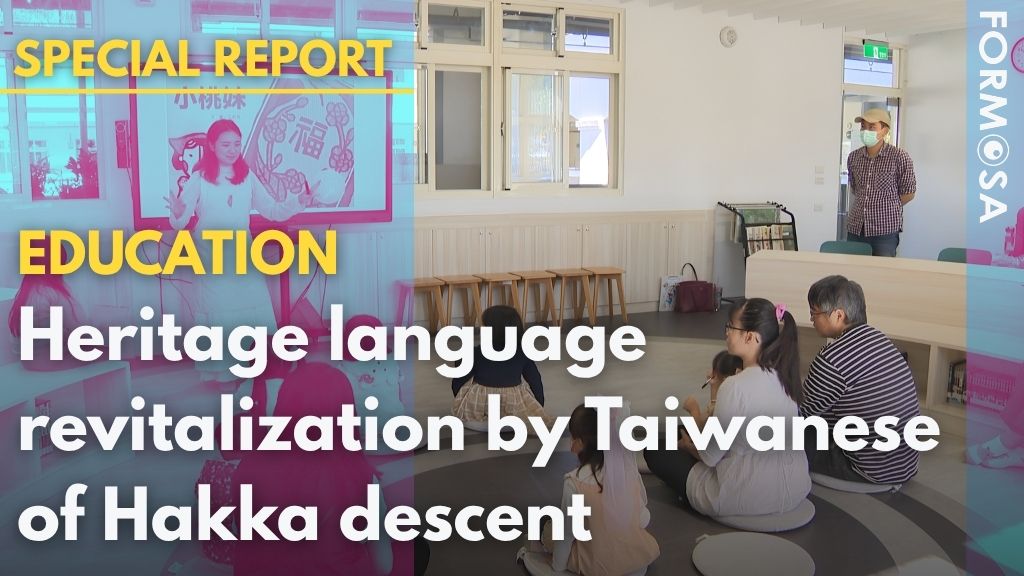
At Hengshan Junior High’s reading room, kids are excited for a picture book read aloud.
The book of the day is “Little Peach Girl,” a story about Hakka-style red tortoise cake. It’s read in Hakka and some Mandarin. This is a Hakka-language parent-and-child co-learning event hosted by Play Art Group, a local cultural and educational organization.
Play Art Group found that even though kids may learn Hakka at school, they often have no one to practice with at home or elsewhere, eventually resulting in attrition. So they hope to get parents involved and introduce Hakka into the household.
With an engaging story, kids easily pick up vocabulary related to the dish. But there’s more. They’re invited to make their own red tortoise cake.
From the screen to real-life, kids engage with Hakka culture with all five senses. Kids love these workshops.
Parent
Workshop participant
We’re three generations under the same roof. Her grandma speaks Hakka to her at home. We also want our kid to learn it.
Parent
Workshop participant
We live in Hsinchu County, where there are many Hakka speakers. We’re of Minnan descent, so we can’t really speak Hakka and can’t teach our kids Hakka, so we try to participate in Hakka-language events, so they have more opportunities to hear and learn the language.
The family friendly events allow kids and parents to learn Hakka together. For many families, it’s also an opportunity to pick up vocabulary.
Parent
Workshop participant
Last time we learned expressions for different types of bridges and many words for colors.
Liu Jung-chang
Singer-songwriter
Kids enjoy storytelling. Parents taking part with them may not be fluent in their heritage language, but they can still learn. Through repetition, kids can learn with their parents.
Though fluent speakers of Hakka are on the decline, it seems that there’s still hope.
Lin Chiung-han
7th grader at Datong High School
Hakka is not as mainstream, because most people are Taigi speakers. There are fewer people who will be able to pass on the culture and language. By choosing to take Hakka, the culture and language are still being passed on and made known to a greater number of people.
From mandatory heritage language coursework, to extracurriculars and even the home, Hakka is kept alive.
As long as the language and culture are still being taught, there’s always a chance for its revival.
For more Taiwan news, tune in:
Mon to Fri at 9:30 pm on Channel 152
Tue to Sat at 1 am on Channel 53
#taiwan #languages #heritagelanguage #hakka #taigi
客語班師生「一對一」上課 共學扎根 能否解決客語消失危機
2026-07-29
2018年《國家語言發展法》通過,在校園裡,從國小到高中、都有台灣台語、客語以及16族原住民族語的必修課程,然而,明明都是母語,長期以來客語,因為在客庄以外的使用人口較少,推動上面臨重重困難,像是在台北市,就有學校的客語課,出現老師和學生「一對一」上課的窘境,令人好奇,這些人為何仍堅持「逆風」學客語,一起來看我們的報導。
內灣老街所在的新竹縣橫山鄉,客家人口比例高達九成,濃厚的客家味不只是觀光賣點,更是當地人日常生活的一部分。
橫山鄉的大肚國小,全校小一到小六兩百多位學生齊聚一堂,準備用客語學唱他們的新校歌。
客家音樂人劉榮昌在大肚國小,擔任烏克麗麗社團的指導老師,已經十多年,這首全新的客語校歌,正是他為了大肚國小所量身打造的。
[[打幫你樂團詞曲創作人兼團長 劉榮昌]]
“新世代的校歌,我覺得最主要是,它要可以被容易傳唱、活潑,在用詞方面,我會希望小朋友大概唱一次、兩次,他就可以自己朗朗上口。”
希望新的客語校歌,能讓學生願意多開口,常常唱,就是因為大肚國小即便位於客庄,有75%的學生是客家人,但學生的客語能力,仍隨著大環境變化不斷弱化,即便只是學唱一首客語校歌,也是把母語找回來的方法。
[[打幫你樂團詞曲創作人兼團長 劉榮昌]]
“校歌是必須要唱的,假設客語地區有客語校歌,原住民語地區有當地的,不管是泰雅或者是賽夏的,或是阿美他們自己的校歌,學生至少會唱一首,這件事情就,至少一首然後它是新的。”
連在客家庄的學校推廣客語都會面臨困境,進到都市中的校園,更是幾乎聽不見客語的聲音。
林同學走進教室後,老師直接走下講台,坐在他旁邊,開始一對一上課,因為台北市大同國中這堂本土語文課,只有他一名學生。
左春香老師在大同國中開設三堂客語課,選課人數都不到五個人,而林同學選的這堂課人數最少,只有他一個人上課。
[[台北市大同國中七年級學生 林炅翰]]
“國小的時候他們是團體上課,會有搶答,問問題的時候,所以一個人可以帶動所有人說客語,大家進步能比較快。不方便的地方就是沒辦法討論。”
雖然班上只有自己一個人,林同學的學習熱情不減,因為客語是他和住在苗栗的外公外婆溝通的橋梁。
[[台北市大同國中七年級學生 林炅翰]]
“從小給外婆帶到幼稚園,就是小小班,外婆從小說著,家裡又播客語新聞、廣播,聽著就會了,耳熟能詳。”
事實上在大同國中裡像林同學一樣有客家背景的學生並不少,多數學生卻還是選擇去上台語課。
[[客語老師 左春香]]
“以本土語言科來講的話,多數人選的就是台灣台語,河洛話講「西瓜偎大邊」,多數從眾心理,客語學生會愈來愈少,會變成一個惡性循環,你會說客家話未來是用不到的。”
客語學生愈來愈少,竟也讓客語師資跟著出問題。
[[客語老師 左春香]]
“因為家長或者是整個社會需求的問題,選課的人越來越少,我們老師等於能夠接到的課,假設是要靠這個課程來做為生活薪資所得的話,它其實是不夠的。”
不論是學生想跟同學一起學台語,還是家長因為實用性不鼓勵,都讓客庄外的客語傳承面臨危機,但也有少數家庭反其道而行。
周末早晨,是采霓一家重要的親子時光,這段時間除了全家人要一起吃早餐,7歲的采霓還有一個重要任務,和爸爸練習講客家話。
采霓目前在板橋就讀國小二年級,是班上唯一選修客語的學生,雖然比大同高中的林同學好一點,她和校內的其他五名同學一起上客語課,但不能和班上的好朋友待在一起,還是讓她覺得有點挫折。
-妳有幾個好朋友在班上?
-五個
-他們都選什麼?
-閩南語
-我曾經跟爸爸媽媽說我想學閩南語,因為我的好朋友都選閩南語
-爸爸媽媽怎麼說?
-他們說不行
[[采霓爸爸 吳先生]]
“因為一方面自己是客家人,所以會希望小朋友可以接觸一些客語的課程,不用到很流利沒有關係,你只要聽得懂一些生活用語,我覺得就很OK,剛好學校也有這樣的課程,讓她可以去多接觸、多學習,比如說有時候回老家,長輩、阿太(曾祖父母)可以跟她稍微問候一下。”
為了維繫家人感情,也想讓采霓多點練習客語的機會,采霓一家每周都會固定拜訪阿公、阿婆。
[[采霓爸爸 吳先生]]
“我以前小時候聽得懂客語,會講,都是看長輩他們平常溝通,從生活中學,有時候聽不太懂的就問我爸,一點一滴累積學習。”
雖然為了配合才剛開始學客語的采霓,祖孫之間的溝通仍以華語居多,但刻意在生活環境裡製造練習說客語的機會,對采霓還是多少有幫助。
[[采霓爸爸 吳先生]]
“比如說客家庄的景點,南庄、北埔,桃竹苗那邊滿多景點都是客家庄,也可以跟店家互動,去講一些(客語),比如說買東西的時候叫她去付錢,我跟老闆說,怎麼算,翻譯給小朋友聽,請小朋友付錢,她自己也覺得滿有趣。”
不論是對采霓還是對大同國中的林同學來說,家庭都是他們練習講客家話的最佳環境,但如果連長輩、父母都已經不太會講客家話,又該怎麼辦呢?
讀繪本時間,橫山國中圖書室裡,每位小朋友看起來都興奮又期待。
今天選讀的繪本是介紹客家美食紅粄的《小桃妹》,說故事的過程以客語為主,華語為輔,這是由地方文化團體「幫你玩藝術工作室」,所推動的「親子共學」客語活動。
「幫你玩藝術工作室」發現,過去小朋友在學校學了客語,回家卻經常面臨沒有練習的環境,或是沒有說客家話的對象等問題,日漸生疏,因此鼓勵家長和孩子一起參與,希望讓家庭成為客家話的練功場。
小朋友被故事情節吸引,自然而然學會好幾種粄食的客家話,但這樣還不夠,親子一起動動手,更能加深記憶。
聽故事、DIY、吃美食,用五感體驗客家文化,活動包裝過的客語課,有趣、不乏味,小朋友不只不排斥,還會吵著要上。
[[家長]]
“我們是三代同堂,所以阿婆在家裡也會跟她講,我們想說讓小朋友也接觸。”
[[家長]]
“剛好住在新竹縣,也知道新竹縣很多都是講客語的,我們本身是閩南人,比較不會講客語,也比較不會去教小朋友講客語,所以就希望能夠來多參加客語活動,讓他多接觸、多了解。”
透過親子「共學」活動,不只小朋友可以學到客家話,家長也能跟著練習,日漸生疏的母語,甚至學會一兩個新的字詞。
[[家長]]
“像上一回我們就學到一些紅毛橋、水泥橋之類的,還有顏色的”
[[打幫你樂團詞曲創作人兼團長 劉榮昌]]
“小朋友都喜歡聽故事,在這個過程裡面,也許家長不見得會說母語,但家長可以學,家長在不斷操作的狀態下,孩子跟家長都會一起學會。”
客語的消失危機或許尚未解除,但已經漸漸看得到希望。
[[台北市大同國中七年級學生 林炅翰]]
“因為客語「非主流」,大多數的人都是說台語。客語來說較少人可以傳承到這個文化,說這個語言,所以我覺得選客語,讓這個文化傳承下來,這個語言傳承下來,更多人會知道。”
學校打造「講客」風氣,校外還有文化活動能夠親子共學,回到家甚至全家一起
練習講客家話。
撒下的一顆顆客家文化種子,正在悄悄萌芽。或許不久後會向下扎根,日漸茁壯。
更多新聞內容,請鎖定:
民視台灣台(152頻道)週一至週五晚上9:30
民視新聞台(53頻道)週二至週六凌晨1:00
Related News