Gov’t struggles to recruit and retain public service vets
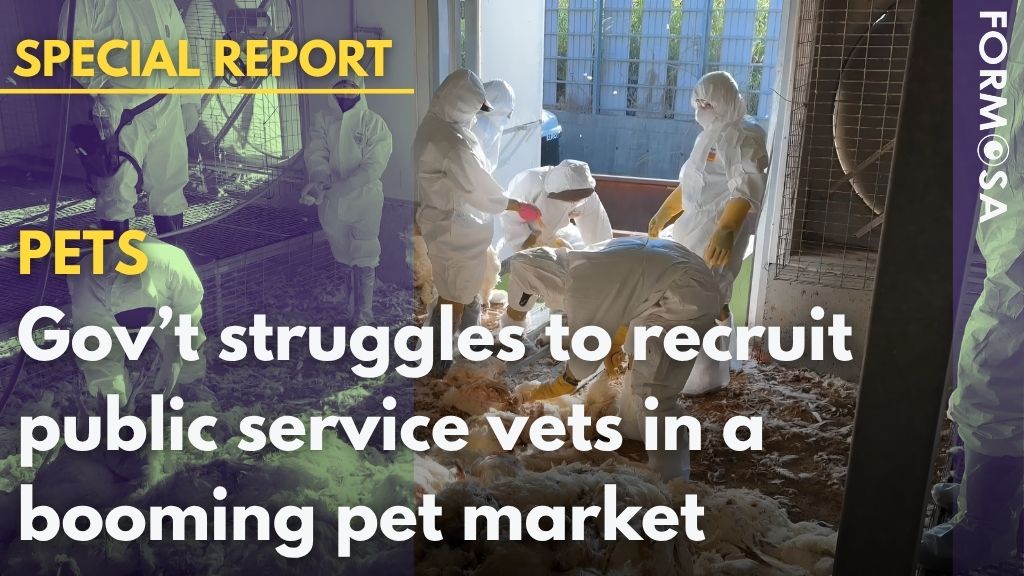
Taiwan’s 2.5 million registered pet cat and dogs has outnumbered kids aged 14 and under. Increasing pet ownership has made private vet practices increasingly attractive for graduating vet students. So much so, that the government is now struggling to hire and retain public service vets that oversee the health of livestock animals, which is crucial for food safety and public health. Of the 6,000+ practicing vets, only a little more than 10% work in public service. The rest specialize in companion animals. Even though the government has introduced bonuses for public service vets that do not also practice privately, that is still not enough to solve the problem. But is it just about money? Let’s find out in our special report.
The vet gives Black Bean the dog a thigh massage, going deeper gradually.
Liu Han-chien
Veterinarian
I’m now pressing into the gluteal muscles, the buttocks, because the gluteal muscles promote hi joint extension. This muscle has to relax for this function to be fully utilized.
Black Bean survived flooding in Hualien’s Guangfu Township, but got its hind leg ran over by a construction vehicle, putting its life at risk at one point. Its owner couldn’t bear to give it up, so Black Bean was entrusted to a volunteer to get treated in Taipei. Now, it’s gradually regaining its ability to walk.
Pet cats and dogs are now considered members of the family by many owners, who therefore willingly devote to them attention and resources. This trend is reflected in the career path of vet school graduates: around 70% go into pet care.
Other than pet care, there is a smaller group of vets who contribute their expertise in other fields.
Wearing a lab coat, holding a dropper in hand and monitoring data on the screen, these public service vets are conducting antibody serology tests.
Public service vets are practitioners who have passed the national exam to become civil servants. Their duties include animal inspection and quarantine, and animal protection services such as treatment and sheltering.
Tan Da-lun
Taiwan Veterinary Medical Association
Many of our disease prevention, quarantine, and food safety measures rely on these public service vets. They have to visit pig farms, chicken farms, and cattle farms in various places to see if there are any outbreaks or other issues. They have to conduct epidemiological investigations and teach farmers how to use disinfectants. These are all things that public service vets are responsible for.
Most of their world involves animal transmittable disease prevention. They’re also responsible for culling should there be unusual animal deaths, as well as identify the pathogen within 24 hours to prevent the spread of diseases.
Deng Ming-chung
Director General, Veterinary Research Institute
Testing may look easy, but the single word “testing” encompasses several tens—even up to 100—steps, and each step involves more than just one item.
Veterinary Research Institute Director General Deng Ming-chung remembers the African swine fever outbreak in 2025. At the time when spontaneous mass deaths on a Taichung farm was first reported, officials initially ruled out African swine fever as the cause, since Taiwan had ASF-free status. Instead, tests were conducted for classical swine fever and other respiratory diseases, but all turned out negative. It was then that officials believed it was African swine fever.
Deng Ming-chung
Director General, Veterinary Research Institute
Oftentimes, we do not see the specimens on the frontline. But we can observe them through other means. For example, we look at the extent of lesions, the characteristics of the lesions, and the mortality rate of the specimens they send in. We consider all these factors comprehensively, and at that time we suggested that they should test for both classical swine fever and African swine fever. And the African swine fever test did come back positive.
Thanks to the public service vets, the outbreak was successfully contained before it could escalate. The vets also completed the culling, identified the virus and devised epidemic control measures—all under a tight schedule, even sacrificing rest and sleep.
Tan Da-lun
Taiwan Veterinary Medical Association
They’re not considered as conventional workers, so their overtime is deemed as voluntary. Last year, during the ASF outbreak, I witnessed epidemic prevention officers of the central government and vets of the local government work into the wee hours, until 2 or 3 a.m., only to clock in again between 7 and 8 a.m. to continue with epidemic prevention and quarantine work. These people have it really tough, and they’re not afforded the same protection as usual workers.
What’s more, even during such an emergency, their animal protection work—dealing with the public’s reported cases—didn’t stop.
At 7 a.m., the Taipei Animal Protection Office’s rescue team has already arrived at the National Chengchi University campus to catch stray dogs, because members of the public reported that they bite. Catching stray dogs is not an easy task—you could get injured. Sometimes, people oppose having strays captured, leaving animal protection officers sandwiched between their duties and public expectations.
Tan Da-lun
Taiwan Veterinary Medical Association
Even if they were to make the tiniest mistake—no, not even that— if people aren’t satisfied with what they do by the very slightest, especially if those people are animal rights activists, the officers could become targets of attack by city councilors or the media.
Increasing animal rights awareness makes it so that animal protection offices must swiftly respond to reports of animal abuse and issue statements to the public.
Chen Ying-hao
Taipei Animal Protection Office director
Animal protection cases, which we deal with, are widely watched by society. For example, there was a video posted online recently, in which the owner beat his pet corgi. Something like this would quickly go viral on the same night it’s posted, and the animal protection office must respond just as quickly.
Rescue doesn’t end once the animals are captured. They need to be taken care of, and updates must be posted online so the animals can be successfully adopted.
If not, their longer care falls on the shoulder of public service vets.
Huang Chi-ting
Vet and Zhonghe Animal Shelter director
We really do need to spend a lot more time on animals that have deteriorated, or are older, or with reduced mobility. They also require more frequent medical interventions. For example, you’ll have to give them painkillers or joint supplements. They really do require more frequent treatment and intervention. It becomes a greater burden for frontline staff, whether physically or psychologically.
Before 2017, sheltered animals can be euthanized 12 days after being posted up for adoption. Putting down animals so frequently was a huge burden for Chien Chih-cheng, a former public service vet in Taoyuan. She had euthanized 700 dogs in just two years on the job.
Tan Da-lun
Taiwan Veterinary Medical Association
Animal euthanization is done by local government agencies. There wasn’t a no-culling policy before, so many animals that weren’t doing well, after an evaluation by the vet, would be put down. She withstood a lot of pressure by animal rights activists. They characterized her as an assassin with a lust for animals’ blood. But she was actually an animal lover.
As a civil servant, she was only carrying out orders, even if reluctantly. In May 2016, Chien took her own life by giving herself a lethal injection.
Stepping across a pile of cow dung, vet students at National Chung Hsing University are here at the livestock research center on campus for practical training. Today, they’re practicing collecting blood samples from cattle for tests and administering vaccines.
- Isn’t it dangerous to collect a sample like this?
- Yes.
- Some cattle will kick. We have clamps to prevent that. The method must also be correct. We should be drawing blood from a vein.
Fu Shih-ting
Vet student, National Chung Hsing University
They can pull off a spin hook kick towards the back. Once when I was drawing blood from a more skittish cow, it kicked me on the thigh. It was painful. I got bruises all over the area.
It’s not just hard work. There’s also risk of infection. However, most farm vets seem uninterested in public service, despite greater job stability. Their responses reveal why there’s a shortage for public service vets.
Duan Yun-chieh
Veterinarian
Public service jobs are more administration-related and public facing. You do a lot of administrative work. But most vets are motivated by the prospects of clinical work involving animals.
Dr. Duan Yun-chieh is a large animal vet. He often conducts intrarectal palpation on the job, which is really not so different from public service vets, who also conduct regular tests on animals. Duan did want to enter the public sector at one point, specifically at the zoo. He changed his mind after finding out that he won’t be doing as much clinical work there.
Chen Ying-hao
Taipei Animal Protection Office director
We have a quota for 26 vets, and we’re now 9 short, meaning the vacancies are only 65% filled. If I were to hire 4 people this year, that would encourage 4 vets to resign, and so the shortage continues.
The shortage can also be attributed to a booming private market for pet care. A pet vet can expect to earn NT$100,000 with five years of experience.
Jacky Peng-wen Chan
Associate Dean, NCHU Vet School
As companion animals become more common, many of our students who’ve completed training and graduated, about 60% to 75%, would enter the market for companion animal care.
As an incentive to attract and retain public service vets, the government now offers them a bonus of NT$10,000 to NT$30,000 a month, depending on seniority, for not practicing privately. This scheme aims to close the gap in remuneration between the public and private sectors. However, that doesn’t get to the root of the problem. Their jobs should be streamlined instead.
Tan Da-lun
Taiwan Veterinary Medical Association
You must separate animal protection and treatment. For example, the Pingtung County Animal Disease Control Center designates animal protection to the agricultural department, instead of giving the job to inspection and quarantine. Inspection and quarantine can only be done by qualified professionals. That’s the most important thing. Animal protection, that is, taking care of strays can be given to graduates of animal science or other degrees that involves empathy, such as psychology, or even others. These graduates can take care of stray dogs, so that vet manpower isn’t wasted.
Although the work of public service vets isn’t highly visible, it’s crucial for the country’s disease prevention. A shortage in manpower would have serious ramifications.
Tan Da-lun
Taiwan Veterinary Medical Association
That will have great ramifications for the country’s disease prevention, quarantine and inspection, animal protection and food safety. Speaking of the African swine flu outbreak: the local government has honestly done their best to contain it. I don’t think they would have succeeded with a greater shortage in manpower. That would be devastating for the economy and food safety.
For more Taiwan news, tune in:
Mon to Fri at 9:30 pm on Channel 152
Tue to Sat at 1 am on Channel 53
#vets #publichealth #pets #vetjobs #publicservice
2026-09-03