NCU student photographs rare ‘red sprite’ phenomenon over Taoyuan
NCU student photographs rare ‘red sprite’ phenomenon over Taoyuan
2026-11-09
Wang Tung, a student in the Department of Space Science and Engineering at National Central University, was able to capture the exceedingly rare phenomenon known as “red sprites” three times, right from the school rooftop. Also called “space lightning,” red sprites are transient luminous events in the upper atmosphere that are almost impossible to detect with the naked eye. The conditions for viewing them are extremely complex, demanding both patience and a fair amount of luck.
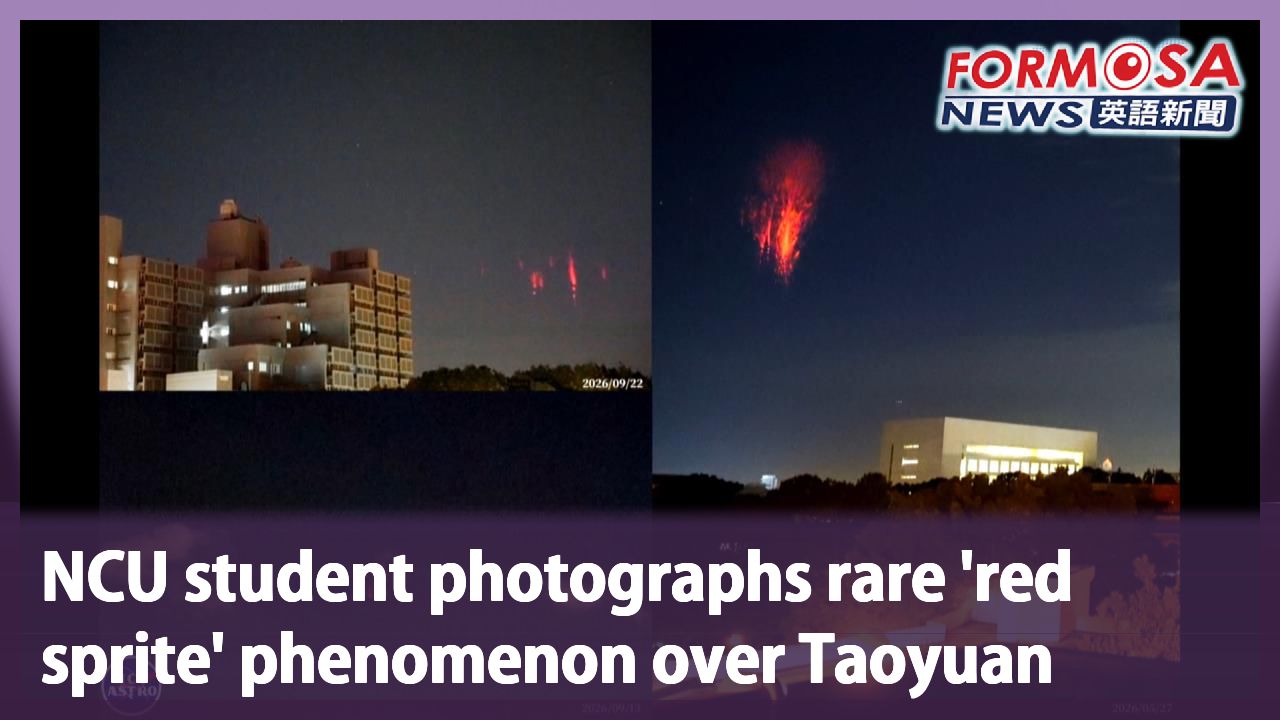
Streaks of red shine across the night sky in this photo of the exceedingly rare upper-atmosphere phenomenon known as “red sprites.” They only last a few milliseconds, making it almost impossible to see with the naked eye.
This photo even shows a rare branching structure known as an “angel sprite.” Usually observed in higher-latitude areas such as Europe and Japan, it’s unusual that the phenomenon was seen from right here, on the rooftop of National Central University’s Department of Space Science and Engineering.
Wang Tung
NCU student
It’s very difficult for an average person to photograph this phenomenon. So at first, I just treated it like a stretch goal. I actually didn’t notice that on the 10th second of filming, a red sprite appeared! It was pure luck. If I had gone up to the roof just a little bit later, I wouldn’t have seen it.
Red sprites are created from radiation generated by excited nitrogen molecules, making them exceptionally rare and easily obscured by weather, cloud cover, and angle of observation. Wang was able to capture his first image in May after hearing a classmate mention that thunderstorms in China present prime conditions for red sprites to form. His patience paid off, providing the experience he needed to successfully capture two more images.
Kuo Cheng-ling
NCU professor
Usually when we observe upper-atmospheric lightning, there’s a severe weather event happening on the ground, like a thunderstorm or hail storm. Especially as we’re seeing more severe weather, red sprites will become more common around Taiwan.
Wang’s professionalism and perseverance allowed him to achieve his goal and provide invaluable observational data, even on a campus plagued by light pollution. Even without professional equipment, anyone with a little knowledge and patience can take advantage of the right conditions to photograph this natural wonder.
For more Taiwan news, tune in:
Mon to Fri at 9:30 pm on Channel 152
Tue to Sat at 1 am on Channel 53
#redsprite #NCU #spacelightning #spacescience #astronomy #photography
中央大學太空系學生三度捕捉 罕見高空放電"紅色精靈"
2026-11-09
中央大學太空科學與工程學系的學生王瞳,竟然在學校頂樓,三度成功拍到非常罕見的高空放電現象「紅色精靈」,紅色精靈又稱「太空閃電」,是高空短暫發光事件,肉眼很難察覺,觀測條件也很繁雜,非常需要耐心與運氣。
夜空出現一抹紅色光芒,這是非常罕見的高空放電現象「紅色精靈」,持續時間只有數至數十毫秒,肉眼極難察覺。
其中一張甚至出現神似魚尾的分支結構,稱為「天使精靈」,過去較常在歐洲、日本等較高緯度地區觀測到,這次居然被中央大學太空系的學生,在學校頂樓拍到了。
[[中央大學太空科學與工程學系 王瞳]]
“一般人很難拍到的一個現象,所以我那時候只是把它列為一個夢幻目標,然後其實我沒有注意到說,我開始拍的第十秒,就有紅精靈跑出來了,就是運氣很好,可能說我晚一點點上頂樓,我都看不到這個現象”
紅色精靈的光芒,來自氮分子受到激發後產生的輻射,容易被氣候、雲層、觀測角度影響,十分難得。今年五月王瞳拍下第一張紅色精靈,因為他聽學長說中國出現雷爆,是紅色精靈出現的時機,就在頂樓守候,成功捕捉,後續也根據經驗,兩度拍下奇景。
[[中央大學教授 郭政靈]]
“通常我們觀測到高空閃電,實際上地面就會有發生雷暴,然後發生冰暴,發生這種劇烈天氣,尤其是現在這個劇烈天氣的影響下,其實在臺灣附近,其實更容易發生這種紅色精靈”
王瞳的專業與堅持讓他在光害明顯的校園,也成功圓夢,並提供了難得的觀測數據,幸運的是,就算沒有專業設備,民眾只要具備觀測知識,配合天候條件,也有機會拍到罕見的高空奇景。
更多新聞內容,請鎖定:
民視台灣台(152頻道)週一至週五晚上9:30
民視新聞台(53頻道)週二至週六凌晨1:00
Related News