Taiwanese Navy relies on Albatross drones to protect Taiwan waters from threat
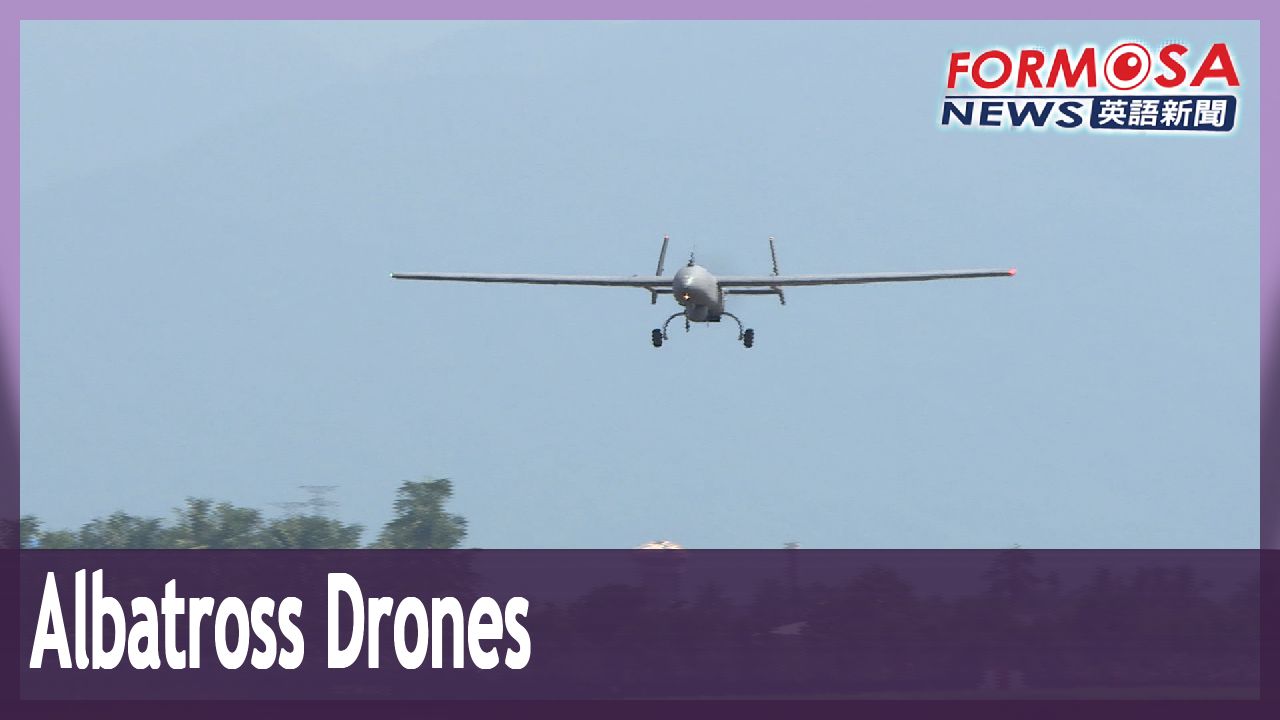
Since the invasion of Ukraine by Russia, the use of military drones in warfare has spurred worldwide interest. Taiwan has its own indigenous military drone, the “Albatross,” also known as the Chung Xiang II. The R.O.C. Navy has more than 30 of the drones in use, and employs them to carry out surveillance and reconnaissance of Taiwanese waters. We got to meet some Albatross “pilots” to learn more about this lynchpin of Taiwan’s naval protection net.
Naval officers bring the Albatross gradually up from the tarmac into the air.
Once the drone reaches a certain height, a ground operator takes over the controls. Images are transmitted by laser and come out crystal clear.
Chi Wu-chun
Naval Maritime Reconnaissance
They have optical lenses assemblies that can magnify by 20 and 30 times, with a continuous focus of 12.5 times, as well as a black and white heat imaging function. The laser detector measures the drone’s distance to its target.
Pi Hsiang
FTV reporter
The Albatross drone beside me has been in service for many years, and has become one of the key tools currently used for surveillance and reconnaissance. This August it played an importance reconnaissance role as China was conducting military drills around Taiwan.
The Albatross measures 8.7 meters across and is 5.3 meters long. It can fly up to 12 hours in the air. The medium-size drone was developed and built in Taiwan. The drones were transferred from the Army to the Navy in 2017, and are stationed at bases including Pingtung, Hengchun and Taitung. The Navy has more than 30 Albatrosses in service, and with China’s aggressive posturing growing more frequent in recent years, the Albatross has become a favored tool, able to undertake long surveillance flights without consuming excessive resources.
Chao Chun-lin
Naval Maritime Reconnaissance
Since Russia’s invasion of Ukraine, we have gradually started to see the usage of drones on the battlefield. Recently, when the CCP held its military drills in August, we were commanded to carry out our duties in a specific maritime zone. We set up our equipment every day, takeoff and landing, carrying out targeted surveillance of the designated zone.
Every movement of China’s warships near Taiwan is closely monitored by Taiwan’s Navy. But to operate a device like this, officers have to pass a series of exacting tests.
Naval officers first undergo basic takeoff and landing training with this lifelike simulation for three months. Next they study modules such as battle maneuvers, and handling emergencies. It takes, on average, a year of training to become a drone pilot charged with guarding Taiwan’s coasts.
2022-10-17