Taiwanese Navy relies on Albatross drones to protect Taiwan waters from threat
Taiwanese Navy relies on Albatross drones to protect Taiwan waters from threat
2022-10-17
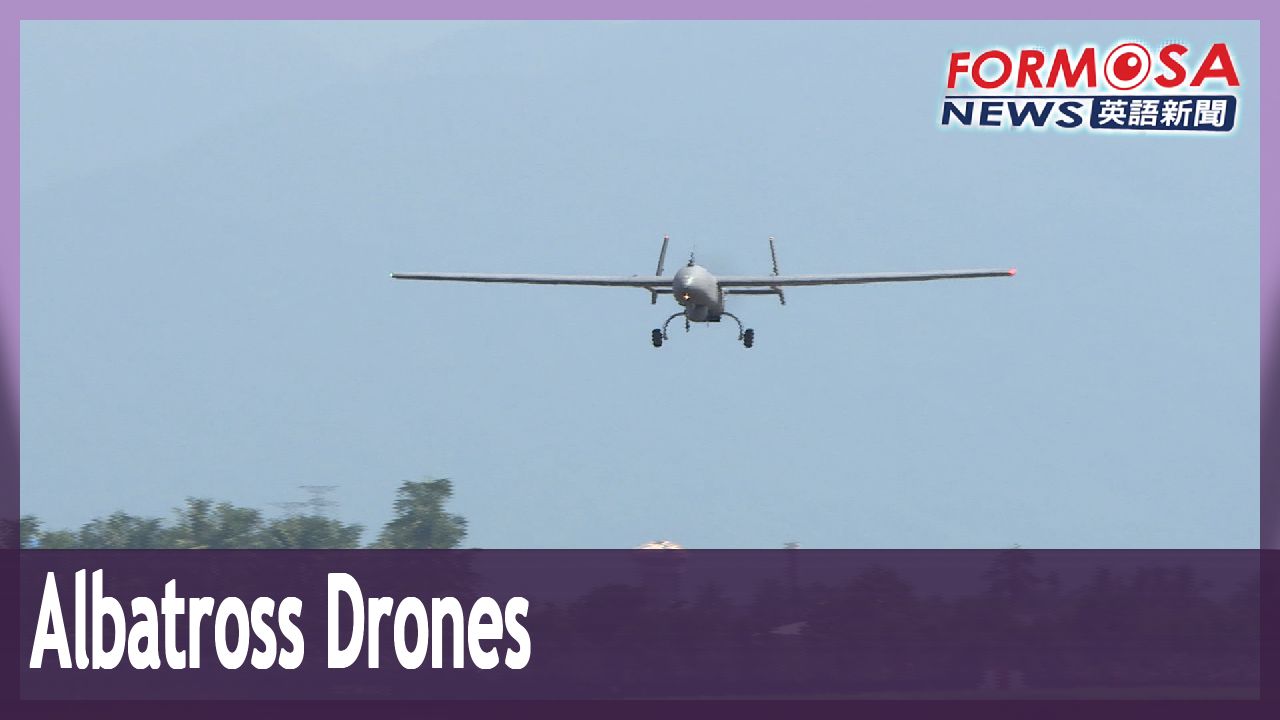
Since the invasion of Ukraine by Russia, the use of military drones in warfare has spurred worldwide interest. Taiwan has its own indigenous military drone, the “Albatross,” also known as the Chung Xiang II. The R.O.C. Navy has more than 30 of the drones in use, and employs them to carry out surveillance and reconnaissance of Taiwanese waters. We got to meet some Albatross “pilots” to learn more about this lynchpin of Taiwan’s naval protection net.
Naval officers bring the Albatross gradually up from the tarmac into the air.
Once the drone reaches a certain height, a ground operator takes over the controls. Images are transmitted by laser and come out crystal clear.
Chi Wu-chun
Naval Maritime Reconnaissance
They have optical lenses assemblies that can magnify by 20 and 30 times, with a continuous focus of 12.5 times, as well as a black and white heat imaging function. The laser detector measures the drone’s distance to its target.
Pi Hsiang
FTV reporter
The Albatross drone beside me has been in service for many years, and has become one of the key tools currently used for surveillance and reconnaissance. This August it played an importance reconnaissance role as China was conducting military drills around Taiwan.
The Albatross measures 8.7 meters across and is 5.3 meters long. It can fly up to 12 hours in the air. The medium-size drone was developed and built in Taiwan. The drones were transferred from the Army to the Navy in 2017, and are stationed at bases including Pingtung, Hengchun and Taitung. The Navy has more than 30 Albatrosses in service, and with China’s aggressive posturing growing more frequent in recent years, the Albatross has become a favored tool, able to undertake long surveillance flights without consuming excessive resources.
Chao Chun-lin
Naval Maritime Reconnaissance
Since Russia’s invasion of Ukraine, we have gradually started to see the usage of drones on the battlefield. Recently, when the CCP held its military drills in August, we were commanded to carry out our duties in a specific maritime zone. We set up our equipment every day, takeoff and landing, carrying out targeted surveillance of the designated zone.
Every movement of China’s warships near Taiwan is closely monitored by Taiwan’s Navy. But to operate a device like this, officers have to pass a series of exacting tests.
Naval officers first undergo basic takeoff and landing training with this lifelike simulation for three months. Next they study modules such as battle maneuvers, and handling emergencies. It takes, on average, a year of training to become a drone pilot charged with guarding Taiwan’s coasts.
監控敵情動態 台灣研發銳鳶無人機曝光
2022-10-17
烏俄戰爭爆發以來,全世界都注意到了無人機,在戰場上的重要性。近年來中國更有不少無人機,來到金門上空侵門踏戶,甚至有軍方的無人機,直接穿越台海中線挑釁。而其實台灣,也有自行研發的無人機種,可以輕鬆監控敵情動態,這回也罕見,對外曝光。
海軍人員手指輕輕一動,銳鳶無人機,從跑道的盡頭緩緩加速,直接起飛。
上升到一定高度,由陸地導控車的人員接手操控,地面上的影像,透過雷達傳回,通通一清二楚。
[[海軍戰術偵蒐大隊區隊長戚務濬]]
“20倍及30倍的光學鏡組,具有12.5倍的連續變焦的,黑熱像白熱像的功能,雷射測具的部分,是測量載具對目標(的距離”
[[民視記者 畢翔]]
“記者旁邊這款銳鳶無人機,已經正式服役多年,成為目前監控敵情的利器之一,像是今年八月中國圍台軍演,就扮演了重要情蒐的角色”
銳鳶無人機翼展8.7公尺,長5.3公尺,滯空時間可長達12小時,是我國自製研發的中型無人機,2017年撥交海軍,進駐屏東、恆春、與台東等地,數量約30多架,近年來中國軍艦擾台日益頻繁,如何長時間跟監又不會耗費過多資源,銳鳶無人機,就成了首選。
[[海軍戰術偵蒐大隊長趙君臨]]
”從烏俄戰爭之後,我們慢慢體現到無人機,在戰場上的運用,前一陣子在8月份中共的軍演,我們也依令在特定海域執行我們的任務,每天都會備定我們的裝備,再做起飛和降落,到指定海域作目標偵蒐”
中國軍艦在台灣外海的一舉一動,全都被我方掌握,無所遁形。只是要操作這麼一架無人機,也要通過層層的考驗。
透過逼真的模擬機,海軍官兵要先經過長達三個月的基礎起降訓練,接著還有戰術動作、緊急事故處理等關卡,平均長達一年的訓練期,才能成為一名合格鎮守台灣海疆的無人機"飛行員"。
Related News