Leaders of the G7 nations express plans to reduce economic reliance on China
Leaders of the G7 nations express plans to reduce economic reliance on China
2023-05-21
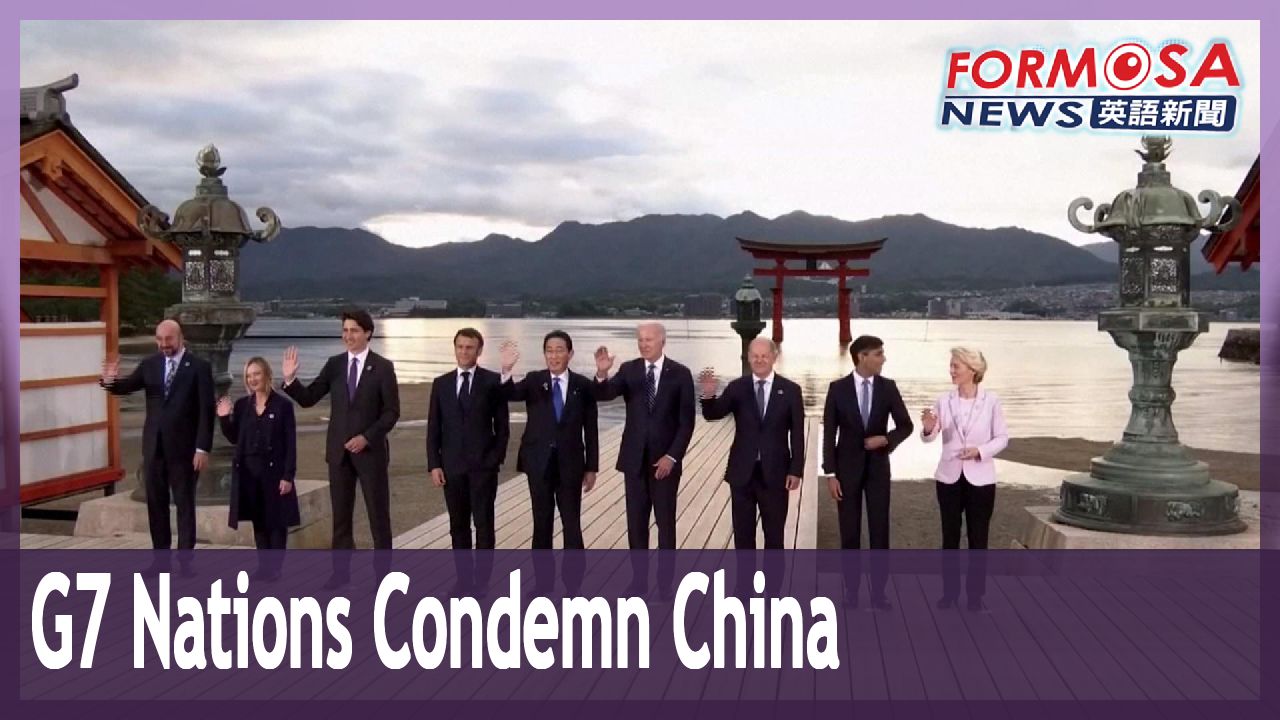
Let’s now turn to the G7 summit held in Hiroshima, Japan over the weekend. The leaders of G7 nations expressed consensus over the need to deter China’s military expansion, and to reduce their countries’ economic reliance on China. The leaders said peace across the Taiwan Strait was crucial to global security and stability, and that China’s expansion in the South China Sea was without legal basis. While the aim is not to completely decouple from China, the countries had expressed the need for economic resilience to make sanctions against China effective, should a conflict over Taiwan ever occur.
Leaders of the G7, issued a joint statement strongly condemning China, including expressing grave concern over Beijing’s pursuit of militarization in the East and South China seas. They expressed that there was no legal basis for China’s expansion in the South China Sea, and criticized China for its lack of transparency in developing nuclear weapons, saying that information on its nuclear weapons program should be released.
Chen Shih-min
National Taiwan University professor
This is the toughest stance ever taken against China, and it represents that a consensus has been reached, that China is currently the biggest challenge to the democratic value system led by the G7.
The leaders’ statement also reiterates that peace and stability in the Taiwan Strait is a crucial part of stability and prosperity in the global community. The leaders said they would resolutely oppose the use of military force by China to unilaterally change the status-quo in the Taiwan Strait.
Japanese Prime Minister Kishida Fumio and U.K. Prime Minister Rishi Sunak also expressed support for Taiwan.
Kishida Fumio
Japanese prime minister
Regarding the situation in Taiwan, the G7 believes in the importance of peace and stability in the Taiwan Strait, and will promote the peaceful resolution of cross-strait issues. All G7 members have reached an agreement on this.
Rishi Sunak
UK prime minister
When it comes to Taiwan, our position on Taiwan is longstanding and hasn’t changed. [It’s] a belief in a free and open Indo-Pacific region.
The U.K. pledged to deploy an aircraft carrier strike group to the Pacific Ocean in 2025 – a move clearly aimed at China. In addition to military measures, the leaders’ declaration urges countries to reduce their dependence on China in key supply chains, so as to avoid being economically pressured by China.
Jake Sullivan
US national security advisor
The communique will note that each country has its own independent relationship and approach. To borrow a phrase from the European Union itself, [we’re] looking to de-risk, not decouple, from China.
Chen Shih-min
National Taiwan University professor
Before it attacked Ukraine, Russia was under the belief that it could use its oil supplies as a leverage to avoid sanctions from European countries. The G7 clearly hopes that China would not be in a similarly mindset.
The researcher said that G7 nations had learned from Russia’s war of aggression against Ukraine, and were therefore preparing to reduce economic reliance on China as a means of effectively sanctioning China in the event of a conflict involving Taiwan.
G7聲明重申台海和平穩定 暗批中國經濟脅迫
2023-05-21
正在日本廣島登場的G7峰會,世界矚目,尤其七大工業國領袖,在20號發表聯合聲明,譴責中國在東海及南海的軍事化行動,並無合法依據。並重申,台海和平是國際社會,不可或缺的一部分。同時領袖宣言草案中,還將敦促各國降低對中國依賴。學者分析,就是要避免,台海發生衝突,各國因為經濟依賴,而不敢得罪中國。
七大工業國領袖,發表聯合聲明,強烈譴責中國,包含針對中國在東海和南海追求軍事化的情況表達"嚴重關切",南海的擴張並無合法依據,更批評中國發展核武缺乏透明性,應公布核武資訊。
[[台大政治系副教授 陳世民]]
“這是有史以來對中國最嚴厲的一次,代表達成共識就是,中國是目前對G7帶頭的民主價值體制,構成最大的挑戰”
聯合聲明也重申,台海和平與穩定,是國際社會安全與繁榮不可或缺的一部分,並堅決反對中國以武力片面改變現狀。
日本首相岸田文雄以及英國首相蘇納克,都紛紛表態力挺台灣。
[[日本首相 岸田文雄(5.19)]]
“關於台灣局勢,G7認為,台灣海峽和平穩定的重要性,促使兩岸問題和平解決,各國對此達成一致”
[[英國首相 蘇納克(5.19)]]
“關於台灣,我們在台灣問題上的立場,一直都沒有改變,維持印太地區自由開放”
英國承諾2025年,要部署航母打擊群重返太平洋,擺明就是衝著中國而來。除了軍事手段,領袖宣言中還將敦促各國在關鍵供應鏈上,降低對中國依賴,避免來自中方的經濟壓迫。
[[白宮國家安全顧問 蘇利文]]
“公報將指出每個國家都有各自獨立的關係和方式,借用歐盟的一句話,我們希望消除風險,而不是與中國脫鉤”
[[台大政治系副教授 陳世民]]
“俄羅斯開戰前以為有石油這工具,它認為歐洲國家,不會對它打烏克蘭做抵制,對G7國家而言,它很顯然就是不希望中國有類似這種錯誤認知”
學者分析,有烏俄戰爭前車之鑑,七大工業國很清楚,只有降低各國對中依賴,才能有效制裁中國。
Related News