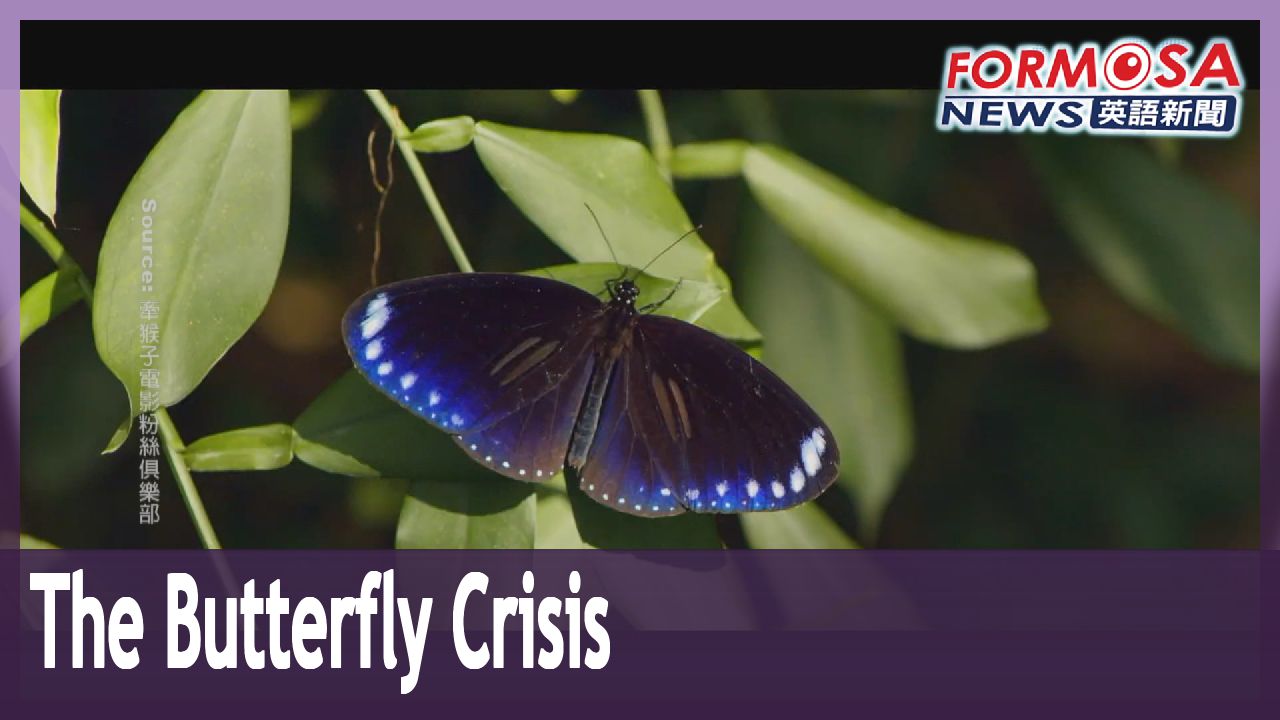
Director sounds alarm about dwindling purple crow butterfly population
Purple crow butterflies are a sight to behold in Taiwan, but they’re getting more rare by the year. Urbanization and pollution have caused their populations to dwindle, reducing their breeding grounds to a handful of locations. Today we meet film director Chan Chia-lung, who has loved butterflies since his youth. Chan has devoted five years to producing a documentary about the purple crow butterfly, so that the public can gain an appreciation for this once-common insect. Our reporter Stephany Yang met up with Chan to find out more.
Chan Chia-lung has spent five years studying and filming the purple crow butterfly, of which four subspecies can be found in Taiwan. Its wings are covered in small iridescent scales that shine in striking hues of blue and violet depending on the angle of the light. Capturing their beauty in full requires specialized equipment.
Chan Chia-lung
Film director
We used the world’s best cameras from Hollywood. They are ultra-high-speed 4K resolution cameras that shoot 1,000 frames per second. That’s the only way we could capture the color changes. Previously, it seemed that only endangered animals needed protection. But perhaps you have noticed, even animals like sparrows are gradually disappearing from our lives. The same is true for purple crow butterflies. It used to be that we could see the butterflies everywhere. But now we’ve built houses in their habitat, so they are disappearing too. They can no longer thrive in urban areas because of the severe pollution there.
Chan’s love affair with butterflies began in the fifth grade, when he was given a book about them. He says purple crow butterfly populations have gradually dwindled in recent years due to climate change and urban development. In an attempt to turn the tide, the director started conducting ecological research and preservation work in the year 2000. In his latest project, he spent five years researching and filming a documentary titled “Lost Butterfly.”
Chan Chia-lung
Film director
I have studied butterflies since I was a child. I have a deep affection for them. Everyone knows about the purple crow butterfly, because it is the most common butterfly in Taiwan. But because of that we also overlook them. These butterflies, which were so common in our lives, are now facing a crisis and disappearing. This is what “Lost Butterfly” wants to discuss.
Every September, purple crow butterflies travel more than 150 kilometers for their seasonal migration. They overwinter in Southern Taiwan, in a place known locally as the “Purple Butterfly Valley.” Not all of them make it, as many are killed by cars on a freeway that crosses the valley. To create a safer path for the insect, the National Freeway Bureau sets up nets along the road. It even closes some lanes to traffic if more than 250 butterflies are detected crossing the road in one minute. This policy is unique in the world.
Lin Yu-chang
Interior minister
We hope to showcase Taiwan’s unique subspecies of the purple crow butterfly. In Taiwan, we have established an overwintering valley for butterflies. The purple crow butterfly is very special in their winter migrations. So for their sake, we launched protocols so that they can fly across the highway. This is very important.
Chang visited various places in Taiwan to conduct research for his documentary. He discovered that Kenting was a safe place for purple crow butterflies to reproduce.
Chan Chia-lung
Film director
We conducted a survey about the purple crow butterfly at Kenting Park National Park last year, and we discovered that the park is one of the largest breeding grounds in Taiwan’s plains. In the past, the purple crow butterfly could be found all over the plains and in low-altitude areas. Now, Kenting National Park is the only forested national park down in the plains. The purple crow butterfly is preserved at Kenting National Park, which receives a large number of butterflies in the annual migrations.
Hsu Shu-kuo
Kenting National Park deputy director
The grounds of Kenting National Park have been preserved quite well. Our park is actually protected by the National Park Law. We have strict controls, so any digging has to first be approved by the national park. That’s allowed us to preserve many low-altitude habitats, which allow wildlife to breed here.
Through his documentary, Chan hopes to raise greater awareness of the crisis butterflies face, and to showcase their beauty to the world.
2023-05-21