The Life of Chiang Wen-yeh: the early years in Japan
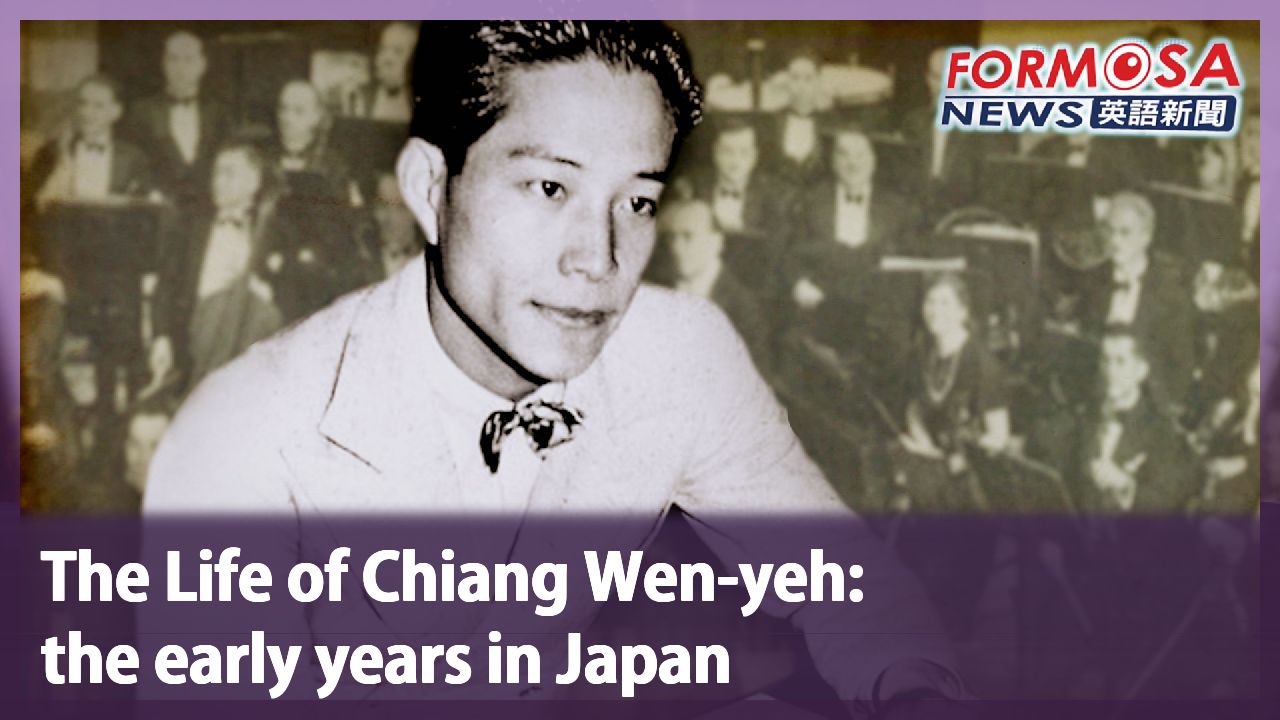
The Life of Chiang Wen-yeh: the early years in Japan
2024-10-13
Tonight in our Sunday special report, we begin a three-part series about legendary Taiwanese composer, Chiang Wen-yeh. He was born in Taiwan, educated in Japan, and lived out his later life in China. At the age of 26, he participated in the 1936 Olympic art competition and received an honorable mention in a field populated by many great composers. His life was marked by ups and downs, including a stint in a forced labor camp. In today’s episode, we dive into the life of a musical genius, focusing on his early career in Japan.
The 11th Summer Olympics was held in August 1936 in Berlin, Germany: the first modern Olympics to have an opening ceremony, live TV broadcasts, and a lighting of the torch. The ceremony was newfangled, but the events stuck to tradition. Alongside sport, there were five art competitions: painting, literature, sculpture, architecture and music.
Liu Mei-lien
Biographer of Chiang Wen-yeh
In ancient Greece, the word “Olympics” certainly referred to sport competitions. In the 1912 Olympics in Stockholm, Sweden, they added an art competition for the first time. And the two sections were considered equal: the sport and the art. The art competition was still being held by the time of the 1936 Games in Berlin. Japan sent five competitors to compete in the music event.
Taiwanese composer Chiang Wen-yeh was the standout star, at the age of 26. His work “Formosan Dance” won an Honorable Mention.
Liu Suan-yung
National Taiwan Symphony Orchestra director
When “Formosan Dance” was in competition, and Western composers looked at its structure, its composition may have seemed immature, but the Western judges saw in this work the integration of Asian and Taiwanese elements, incorporated with a certain sophistication. Compared to the other works put forth at that time, which were composed by Chiang’s teachers in a more academic style, when people looked at “Formosan Dance,” which was sent to Berlin, of course they saw a style that was more in line with modernism.
“Formosan Dance” established Chiang’s talent.
He was born Chiang Wen-pin during the Meiji era, on June 11, 1910, which happened to be Dragon Boat Festival. His birthplace was Sanzhi Township in Taipei. He grew up in a wealthy family. His father Chiang Chang-sheng and mother Cheng Kui had three sons, of whom he was the middle child. When he was 6, the family moved to Xiamen, China. At 8, he entered Xuying School for Taiwanese Boys.
Liu Mei-lien
Biographer of Chiang Wen-yeh
Chiang Wen-yeh’s father was a businessman. In those days, all of Taiwan’s businessmen lived in Dadaocheng, Taipei. His father was called Chiang Chang-sheng, and his business was shipping, freight shipping. I think, because he was a businessman, he was probably involved in many different trades. The family was certainly extremely wealthy.
When Chiang was 13, his mother died of ill health. His father was too busy with work for childrearing. Chiang and his older brother were sent to Japan, to study at Ueda High School in Nagano. Chiang was already passionate about music.
Chiang Wen-chung (interviewed in 1995)
Oldest brother of Chiang Wen-pin
As soon as he picked up the harmonica, he wouldn’t put it down. He kept playing until he had the piece perfect. He often played in the school orchestra. The violin, the piano… ever since he was small, he was absolutely captivated by music.
As a music-addicted youth, Chiang loved to sing and had a fine voice. In 1928, he joined the electronics course at Musashi Institute of Technology. But all he could think about was music, and he took extra classes at Tokyo Conservatory of Music. But bad news soon came from Xiamen: Chiang’s father had had a stroke. Money became tight for the family, and Chiang had to take on an evening job.
Wu Ling-yi
Assistant professor of music, NTUA
Their fortunes fell, and there wasn’t much money. So while he was at college, he had to take an evening job. He had studied basic music theory, so he went to Columbia Records to copy music. Lots of musical groups needed extra copies of the violin and cello parts. So his first job was transcribing music. And he learned a lot of general musical knowledge through the transcription job. The school sent him to work in a printing factory, but he didn’t really like that. So he went and auditioned in many places, because he had a lovely voice. So he went and tried out for many choirs.
Liu Mei-lien
Biographer of Chiang Wen-yeh
On the same day he graduated college, he saw Colombia Records wanted to hire singers. So he ran to apply for it, in his college uniform. He got it, and put out a record immediately. In those days, records were called shellacs. It was a 78-rpm shellac.
Liu Mei-lien
Biographer of Chiang Wen-yeh
Why was the record launched so fast? It played into wartime government strategy. It would only work like that for government and military strategy. That’s why Chiang was famous overnight.
His rich voice delighted the company. Chiang Wen-pin decided to adopt a stage name: Chiang Wen-yeh, or “Bunya Koh” in Japanese. In 1932, at the age of 22, he entered Japan’s first National Music Competition. He was nominated for the vocal prize, but the judges didn’t award any grand prize. The next year, the same: He got a vocal nomination and no grand prize was named. After receiving these honors twice in a row, he caught the attention of the Fujiwara Opera, and was hired as a baritone by the group.
Wu Ling-yi
Assistant professor of music, NTUA
At that time, Fujiwara Opera was one of the best opera groups in Tokyo, and he had a great role. So he got quite directly into the Japanese music scene. He also had a genius for composing. In 1932, he got into Fujiwara Opera with his voice, and that November, he declared in an essay for a musical society that he’d become a composer.
Not content with his vocal theory knowledge, Chiang found a teacher and dove into composition.
Liu Mei-lien
Biographer of Chiang Wen-yeh
I think he was extremely diligent. He wasn’t just sincere in training his voice. To study composition, he taught himself but he also went to classes with a teacher. His teacher was Kōsaku Yamada, who was one of Japan’s finest musicians. His nickname was “Japan’s Music Mogul.” So his status was No. 1 among Japan’s musicians. But everyone in Japan’s music scene knew that the two had very different styles, so Chiang didn’t study with him for very long.
Chiang devoted himself to composing. Many of his early works have a profound “Oriental” flavor.
Chen Rueibin
Pianist
All this is “Oriental.” He was always deeply influenced by Japan. This is a simple “Oriental” tune from start to finish.
In 1934, Chiang joined a musical group that toured “the provinces.” They toured Taiwan, and he was deeply touched by seeing the sights and sounds of his homeland, writing his first piece for piano: “Night in the City.”
Liu Suan-yung
National Taiwan Symphony Orchestra director
Of course, performing on the tour in Taiwan was very inspiring for him, seeing the places where he grew up, his homeland. Although he didn’t spend all his youth here, for him, the culture and the lifestyle instilled in him from his mother and father made all this feel very intimate and natural. After he toured Taiwan in 1934, he went back to Japan and wrote a piece. It had a prelude, “Fantasy of the White Egret,” then, “Listening to the Mountain Tribes Speak,” and, “Night in the City.” “Night in the City” was eventually rearranged into “Formosan Dance.”
As he was enjoying exploring composition, Chiang also fell for a woman: Nobu Takizawa. She was a girl from a rich family in the city of Ueda. Chiang was just a poor singer, and a second-class citizen from a colony. The Takizawa family fiercely opposed the match.
Nobu Takizawa (interviewed in 1995)
First wifeof Chiang Wen-yeh
There was nothing for it, in the end. He even said, “Even if you run to the ends of the Earth, I will follow you.” I thought, “Well, he likes me so much, and he’s not a bad guy.” Taiwan was a colony of Japan then, and he was Taiwanese, not Japanese. My family didn’t want me to marry a Taiwanese. So I decided to elope.
In September 1934, Takizawa and Chiang eloped. She took with her some valuable jewelry. After their marriage, he devoted himself to work. But everything was expensive: pens, manuscript paper, record players…Takizawa had to sell her jewelry, and took on sewing work to help make ends meet. Chiang stopped auditioning for singing work. He focused on composing, and quickly won silver for composition in the Third National Music Competition. He was also nominated the following year, then won silver two years in a row.
In early 1936, a snowstorm hit Tokyo, the deepest snow for 50 years. During that snowstorm, Chiang returned to the work called “Night in the City,” inspired by Taiwan. He rearranged it into a symphonic piece, and renamed it “Formosan Dance.” It passed a selection committee in Japan, and, beside works by four other Japanese composers, was sent to the art competition of the 1936 Berlin Olympics. That piece, the first real work by 26-year-old Chiang, produced after less than four years composing, beat Japanese professors and rivals from across the world, to win an Honorable Mention.
Wu Ling-yi
Assistant professor of music, NTUA
He always had lots of melodies in his head. Inspiration came and he just wrote it down. The recognition of those great composers in Germany was what made him the happiest. He had entered lots of contests, big and small, in Japan, but he had never won first prize. It was because he was “from the colony,” so he could never win more than second place.
Chiang could not be truly feted in Japan, even after his great success at the Olympics. Japan’s media gave his win a muted reception. But it was huge news in Taiwan. Frustrated with “second-class citizen” status, Chiang accepted a job from Taiwanese musician Ko Cheng-ho: teaching at Peking Normal University. In fall 1938, he boarded a ship for China, where he would be inspired by classical Chinese music, as well as by another tumultuous love affair.
For more Taiwan news, tune in:
Sun to Fri at 9:30 pm on Channel 152
Tue to Sat at 1 am on Channel 53
1936奧運藝文奪獎 亞洲第一人 音樂奇才江文也
2024-10-13
一連三個禮拜的深入報導,要為您介紹台灣音樂史上的傳奇人物江文也。江文也出生於台灣,在日本受教育,終老於中國。這位天才型作曲家,26歲,參加1936年,奧林匹克運動會的藝文競賽,就打敗各國大師級作曲家,榮獲奧運「特別獎」。 不過因為他的殖民身分,讓他在日本總是低人一等,今天的第一集,帶您來看看他的成就,及在日本生活的點滴。
1936年8月,第11屆奧林匹克運動會,在德國柏林舉行。會場上第一次出現開幕式表演活動、第一次電視轉播、第一次以火炬接力方式點燃聖火。奧運開幕許多創新手法,但是競技項目依舊維持傳統。不只運動,還有藝文比賽,分為繪畫、文學、雕刻、建築、音樂五大類。
[[江文也傳記作者 劉美蓮]]
“奧林匹克這個名詞,在古時候的希臘,的確是體育競技的意義。在1912年,瑞典的斯德哥爾摩那個地方,那屆的奧林匹克,開始增加藝文競技。其實是平等的,兩個地位是平等的,體育競技跟藝文競技。延續到1936年,柏林的奧林匹克,同樣有藝術競技,日本那邊就派了五位選手,參加藝文競技的音樂組作曲項目。
比賽結果,籍貫台灣,年僅26歲的江文也,脫穎而出,以管弦樂《台灣舞曲》獲得評審團的特別獎。
[[國立臺灣交響樂團團長 劉玄詠]]
“當《台灣舞曲》去參加比賽的時候,西方的作曲家看到了這個曲子的結構,也許他的作曲技巧不是很成熟,但是西方的評審看到這個曲子,用東方的元素、用台灣的元素放在裡面,它有某種層次展現出來。跟他同一個時期送出去的作品, 跟他都是學院派,包括他老師的作品。那比較起來,當然這個作品在柏林大賽裡面,人家會看到這個作品,是符合那個時代現代樂派的風格”
《台灣舞曲》讓西方樂壇聽見江文也的才華。
江文也,本名江文彬。出生於明治43年,1910年6月11日,端午節當天。戶籍登記在台北廳三芝庄。從小,江文彬就生活在家庭富裕的環境當中。一家五口,父親江長生,母親鄭閨,以及三兄弟,江文彬排行老二。六歲那年,江文彬跟著爸媽舉家搬遷廈門,八歲進入專門提供台籍子弟唸的旭瀛書院。
[[江文也傳記作者 劉美蓮]]
“江文也的爸爸做生意,當時全台灣的生意人,都住在大稻埕。他爸爸叫江長生,他是做船務運輸的生意。我想應該生意人,貿易,各方面的生意都做,家裡的確非常有錢”
13歲那年,母親病故,父親無力兼顧生意與家庭。江文彬只好跟著大哥到日本長野縣,進入上田中學就讀。求學時代的江文彬,對音樂充滿熱情。
[[江文彬大哥 江文鍾]] (1995年受訪)
“他一拿到那支口琴,就常常抓著不放,學到很熟練才會停止,以後就經常在學校的演奏會演奏。從小提琴到鋼琴,他就這樣沉迷音樂中了”
沉迷於音樂之中的江文彬,喜歡唱歌,擁有一副好歌喉。1928年,江文彬進入武藏高等工業學校電機系。但他腦海中全是音樂。於是利用課餘時間,到東京音樂學校進修。然而,這時候廈門那頭,傳來父親腦中風的消息。江文彬經濟來源吃緊,迫使他必須打工,賺外快。
[[台灣藝術大學音樂系助理教授 吳玲宜]]
“家道中衰並沒有那麼多的金援來協助,所以他必須在他唸高工的時候,必須去打工。因為他有學基礎的樂理,所以他就跑到哥倫比亞唱片公司去抄分譜,因為很多樂團,必須把小提琴的部分、中提琴的部分,都要另外抄寫。所以他當初第一個工作,是去抄分譜,所以他在抄分譜的時候,他也學到了很多相關的音樂常識。雖然學校有給他派到一個印刷工廠去工作,他也不是那麼喜歡,所以他後來就各地去考,因為他聲音實在是很好,所以他到很多歌唱團去考歌唱演員”
[[江文也傳記作者 劉美蓮]]
“他大學畢業當天,剛好看到哥倫比亞唱片公司在徵求歌手,他就穿著學生服跑去應徵了,馬上被錄取,馬上出唱片,那時候的唱片叫蟲膠唱片,78轉的蟲膠唱片。
[[江文也傳記作者 劉美蓮]]
“為什麼這張唱片這麼快就能夠發行呢?國策,在戰爭時代就是國策,只有政府的政策、軍部的政策才會這樣子,也因為這樣子,讓江文也一炮而紅”
渾厚的嗓音,讓唱片公司驚豔。江文彬決定為自己取個藝名,叫「江文也 Bunya Koh」。1932年,22歲的江文也,參加日本第一屆全國音樂比賽。「大賞」從缺,江文也獲得聲樂獎入選。隔年,江文也再度參加日本第二屆全國音樂比賽,同樣,大賞從缺,拿下聲樂獎入選。連續兩屆獲獎,江文也受到藤原義江歌劇團的賞識,聘為團員,擔任男中音。
[[台灣藝術大學音樂系助理教授 吳玲宜]]
“因為藤原義江當時算是東京非常好的演歌劇的團體,他在裡面也是拿到非常好的角色,所以他踏入日本樂團,其實是還滿直接就進去的。江文也是一個天才型的作曲家,因為他在1932年,用他的聲音進入藤原義江樂團之後,他在同年的11月,他就在音樂俱樂部文章裡面,決志要當一個作曲家”
不滿足於聲樂理論,江文也決定拜師學藝,全心全意朝作曲家的方向前進。
[[江文也傳記作者 劉美蓮]]
“我認為他是非常非常地用功,他不僅練聲樂的時候很認真,他在學作曲,除了自學之外,當然也有拜師,他拜的師還是日本首席音樂家,叫山田耕筰,他有一個外號,叫樂壇大御所,所以他的地位等於是日本的首席音樂家,不過日本音樂圈的人都知道,兩個人的風格不一樣,所以可能時間沒有很長”
江文也埋頭學習作曲,他的許多早期作品,蘊含濃濃東洋味。
[[鋼琴家 陳瑞斌]]
“這都是東洋的東西,他一直深受日本的影響,這個曲子很簡單,從頭到尾都是東洋味”
1934年,江文也參加鄉土訪問音樂團。回到台灣巡迴公演,看到家鄉的一景一物,深受感動,特地寫下他處女作的鋼琴曲《城內之夜》。
[[國立臺灣交響樂團團長 劉玄詠]]
“從台灣的巡迴演出裡面,當然給他很多很多的刺激,很多看到自己生長的地方,或自己的故鄉。雖然他在這裡,沒有真正在這邊成長,可是對他來講,或是從他父親、父執輩,或從他母親裡面,教導他的文化或生活習慣,都是非常親切跟自然的事情。1934年他到台灣來,回去日本之後,他就寫了一首曲子。這首曲子包括有前奏曲,白鷺鷥的幻想;再來有聽高山族說話,再來就是城內之夜。城內之夜,就是最後他把這首曲子改編成《台灣舞曲》”
音樂領域開始嘗試作曲的樂趣,感情世界也有了心儀的女孩,對方是上田市的望族千金瀧澤乃ぶ (Takizawa Nobu)。然而江文也,窮困歌手,以及殖民地二等國民的身分,讓女方家長極力反對這段戀情。
[[江文也元配 瀧澤乃ぶ]] (1995年受訪)
“後來是真的對他沒辦法。他甚至還說,即使我跑到地球的邊緣,他還是會追過來的。我當時覺得文也竟是如此喜歡我,人也不壞。雖然當時台灣也是日本的領土,文也畢竟是台灣人,而不是日本人,我的家人也不同意我和台灣人結婚,因此我就下定決心和他私奔了”
1934年9月,瀧澤乃ぶ帶著貴重首飾,和江文也私奔。婚後,江文也埋頭於創作,寫譜用的筆、五線紙、唱機、都相當昂貴,瀧澤乃ぶ只得變賣首飾,做點裁縫,貼補家用。這時期,江文也決定不再報考聲樂,改攻作曲。馬上就獲得,日本全國第三屆音樂比賽作曲組第二名。接下來,1935年第4屆,獲得入選。第5屆、第6屆全國音樂比賽,都拿下第二。
1936年年初,東京下了一場破五十年紀錄的大雪。寒冬中,江文也將來自台灣靈感所寫下的鋼琴曲《城內之夜》,改編成管弦樂,並取名為《台灣舞曲》。這首曲子順利通過國內初選,和日本另外四位音樂家的作品,一同參加柏林舉辦的,第11屆奧林匹克運動會的藝文競賽。年僅26歲,學作曲才三、四年光陰的江文也,就以人生第一號作品,打敗日本四位教授級大師,以及各國好手,拿下「特別獎」。
[[台灣藝術大學音樂系助理教授 吳玲宜]]
“腦筋裡面一直有非常多的旋律,靈感出來,他就寫出來。他最開心的還是可以得到,德國這些大作曲家的認可。因為當時他在日本,也參加大大小小的比賽,可是從來沒有得過第一獎。因為他殖民的身分,一直讓他再怎樣好,也只能得第二名”
在日本永遠是第二名的江文也,即使奪下世界大獎,日本媒體依舊選擇淡化處理。反倒消息傳回台灣,造成極大轟動。殖民身分的無奈感,讓江文也決定接受台灣音樂教育家柯政和的邀請,到北平師範大學教書。1938年秋天,江文也搭船前往中國。等待他的,不僅是中國古代音樂的創作靈感,還有另一段刻苦的愛情。
更多新聞內容,請鎖定:
民視台灣台(152頻道)週日至週五晚上9:30
民視新聞台(53頻道)週二至週六凌晨1:00
Related News