The Life of Chiang Wen-yeh: the early years in Japan
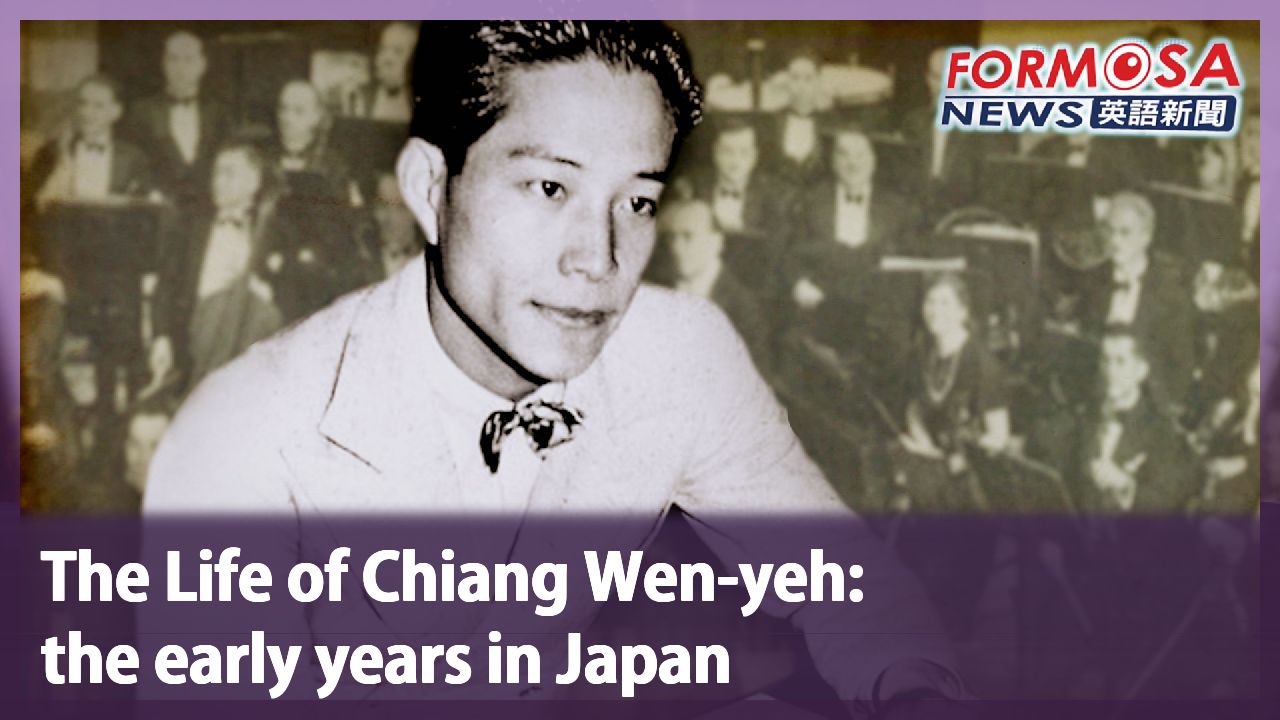
Tonight in our Sunday special report, we begin a three-part series about legendary Taiwanese composer, Chiang Wen-yeh. He was born in Taiwan, educated in Japan, and lived out his later life in China. At the age of 26, he participated in the 1936 Olympic art competition and received an honorable mention in a field populated by many great composers. His life was marked by ups and downs, including a stint in a forced labor camp. In today’s episode, we dive into the life of a musical genius, focusing on his early career in Japan.
The 11th Summer Olympics was held in August 1936 in Berlin, Germany: the first modern Olympics to have an opening ceremony, live TV broadcasts, and a lighting of the torch. The ceremony was newfangled, but the events stuck to tradition. Alongside sport, there were five art competitions: painting, literature, sculpture, architecture and music.
Liu Mei-lien
Biographer of Chiang Wen-yeh
In ancient Greece, the word “Olympics” certainly referred to sport competitions. In the 1912 Olympics in Stockholm, Sweden, they added an art competition for the first time. And the two sections were considered equal: the sport and the art. The art competition was still being held by the time of the 1936 Games in Berlin. Japan sent five competitors to compete in the music event.
Taiwanese composer Chiang Wen-yeh was the standout star, at the age of 26. His work “Formosan Dance” won an Honorable Mention.
Liu Suan-yung
National Taiwan Symphony Orchestra director
When “Formosan Dance” was in competition, and Western composers looked at its structure, its composition may have seemed immature, but the Western judges saw in this work the integration of Asian and Taiwanese elements, incorporated with a certain sophistication. Compared to the other works put forth at that time, which were composed by Chiang’s teachers in a more academic style, when people looked at “Formosan Dance,” which was sent to Berlin, of course they saw a style that was more in line with modernism.
“Formosan Dance” established Chiang’s talent.
He was born Chiang Wen-pin during the Meiji era, on June 11, 1910, which happened to be Dragon Boat Festival. His birthplace was Sanzhi Township in Taipei. He grew up in a wealthy family. His father Chiang Chang-sheng and mother Cheng Kui had three sons, of whom he was the middle child. When he was 6, the family moved to Xiamen, China. At 8, he entered Xuying School for Taiwanese Boys.
Liu Mei-lien
Biographer of Chiang Wen-yeh
Chiang Wen-yeh’s father was a businessman. In those days, all of Taiwan’s businessmen lived in Dadaocheng, Taipei. His father was called Chiang Chang-sheng, and his business was shipping, freight shipping. I think, because he was a businessman, he was probably involved in many different trades. The family was certainly extremely wealthy.
When Chiang was 13, his mother died of ill health. His father was too busy with work for childrearing. Chiang and his older brother were sent to Japan, to study at Ueda High School in Nagano. Chiang was already passionate about music.
Chiang Wen-chung (interviewed in 1995)
Oldest brother of Chiang Wen-pin
As soon as he picked up the harmonica, he wouldn’t put it down. He kept playing until he had the piece perfect. He often played in the school orchestra. The violin, the piano… ever since he was small, he was absolutely captivated by music.
As a music-addicted youth, Chiang loved to sing and had a fine voice. In 1928, he joined the electronics course at Musashi Institute of Technology. But all he could think about was music, and he took extra classes at Tokyo Conservatory of Music. But bad news soon came from Xiamen: Chiang’s father had had a stroke. Money became tight for the family, and Chiang had to take on an evening job.
Wu Ling-yi
Assistant professor of music, NTUA
Their fortunes fell, and there wasn’t much money. So while he was at college, he had to take an evening job. He had studied basic music theory, so he went to Columbia Records to copy music. Lots of musical groups needed extra copies of the violin and cello parts. So his first job was transcribing music. And he learned a lot of general musical knowledge through the transcription job. The school sent him to work in a printing factory, but he didn’t really like that. So he went and auditioned in many places, because he had a lovely voice. So he went and tried out for many choirs.
Liu Mei-lien
Biographer of Chiang Wen-yeh
On the same day he graduated college, he saw Colombia Records wanted to hire singers. So he ran to apply for it, in his college uniform. He got it, and put out a record immediately. In those days, records were called shellacs. It was a 78-rpm shellac.
Liu Mei-lien
Biographer of Chiang Wen-yeh
Why was the record launched so fast? It played into wartime government strategy. It would only work like that for government and military strategy. That’s why Chiang was famous overnight.
His rich voice delighted the company. Chiang Wen-pin decided to adopt a stage name: Chiang Wen-yeh, or “Bunya Koh” in Japanese. In 1932, at the age of 22, he entered Japan’s first National Music Competition. He was nominated for the vocal prize, but the judges didn’t award any grand prize. The next year, the same: He got a vocal nomination and no grand prize was named. After receiving these honors twice in a row, he caught the attention of the Fujiwara Opera, and was hired as a baritone by the group.
Wu Ling-yi
Assistant professor of music, NTUA
At that time, Fujiwara Opera was one of the best opera groups in Tokyo, and he had a great role. So he got quite directly into the Japanese music scene. He also had a genius for composing. In 1932, he got into Fujiwara Opera with his voice, and that November, he declared in an essay for a musical society that he’d become a composer.
Not content with his vocal theory knowledge, Chiang found a teacher and dove into composition.
Liu Mei-lien
Biographer of Chiang Wen-yeh
I think he was extremely diligent. He wasn’t just sincere in training his voice. To study composition, he taught himself but he also went to classes with a teacher. His teacher was Kōsaku Yamada, who was one of Japan’s finest musicians. His nickname was “Japan’s Music Mogul.” So his status was No. 1 among Japan’s musicians. But everyone in Japan’s music scene knew that the two had very different styles, so Chiang didn’t study with him for very long.
Chiang devoted himself to composing. Many of his early works have a profound “Oriental” flavor.
Chen Rueibin
Pianist
All this is “Oriental.” He was always deeply influenced by Japan. This is a simple “Oriental” tune from start to finish.
In 1934, Chiang joined a musical group that toured “the provinces.” They toured Taiwan, and he was deeply touched by seeing the sights and sounds of his homeland, writing his first piece for piano: “Night in the City.”
Liu Suan-yung
National Taiwan Symphony Orchestra director
Of course, performing on the tour in Taiwan was very inspiring for him, seeing the places where he grew up, his homeland. Although he didn’t spend all his youth here, for him, the culture and the lifestyle instilled in him from his mother and father made all this feel very intimate and natural. After he toured Taiwan in 1934, he went back to Japan and wrote a piece. It had a prelude, “Fantasy of the White Egret,” then, “Listening to the Mountain Tribes Speak,” and, “Night in the City.” “Night in the City” was eventually rearranged into “Formosan Dance.”
As he was enjoying exploring composition, Chiang also fell for a woman: Nobu Takizawa. She was a girl from a rich family in the city of Ueda. Chiang was just a poor singer, and a second-class citizen from a colony. The Takizawa family fiercely opposed the match.
Nobu Takizawa (interviewed in 1995)
First wifeof Chiang Wen-yeh
There was nothing for it, in the end. He even said, “Even if you run to the ends of the Earth, I will follow you.” I thought, “Well, he likes me so much, and he’s not a bad guy.” Taiwan was a colony of Japan then, and he was Taiwanese, not Japanese. My family didn’t want me to marry a Taiwanese. So I decided to elope.
In September 1934, Takizawa and Chiang eloped. She took with her some valuable jewelry. After their marriage, he devoted himself to work. But everything was expensive: pens, manuscript paper, record players…Takizawa had to sell her jewelry, and took on sewing work to help make ends meet. Chiang stopped auditioning for singing work. He focused on composing, and quickly won silver for composition in the Third National Music Competition. He was also nominated the following year, then won silver two years in a row.
In early 1936, a snowstorm hit Tokyo, the deepest snow for 50 years. During that snowstorm, Chiang returned to the work called “Night in the City,” inspired by Taiwan. He rearranged it into a symphonic piece, and renamed it “Formosan Dance.” It passed a selection committee in Japan, and, beside works by four other Japanese composers, was sent to the art competition of the 1936 Berlin Olympics. That piece, the first real work by 26-year-old Chiang, produced after less than four years composing, beat Japanese professors and rivals from across the world, to win an Honorable Mention.
Wu Ling-yi
Assistant professor of music, NTUA
He always had lots of melodies in his head. Inspiration came and he just wrote it down. The recognition of those great composers in Germany was what made him the happiest. He had entered lots of contests, big and small, in Japan, but he had never won first prize. It was because he was “from the colony,” so he could never win more than second place.
Chiang could not be truly feted in Japan, even after his great success at the Olympics. Japan’s media gave his win a muted reception. But it was huge news in Taiwan. Frustrated with “second-class citizen” status, Chiang accepted a job from Taiwanese musician Ko Cheng-ho: teaching at Peking Normal University. In fall 1938, he boarded a ship for China, where he would be inspired by classical Chinese music, as well as by another tumultuous love affair.
For more Taiwan news, tune in:
Sun to Fri at 9:30 pm on Channel 152
Tue to Sat at 1 am on Channel 53
2024-10-13