Taiwanese tourist in Japan gets trapped under snowy tree
Taiwanese tourist in Japan gets trapped under snowy tree
2025-02-11
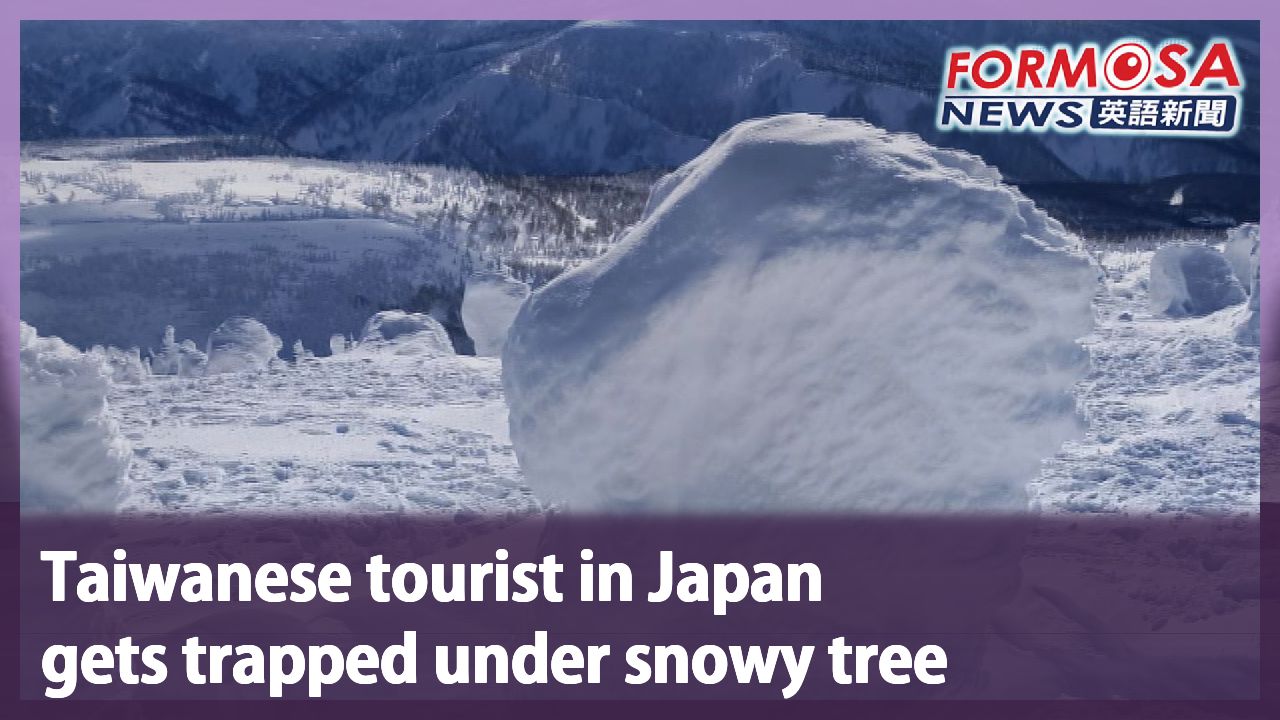
The “snow monsters” in Japan’s Tohoku region attract many tourists every year. It’s a natural phenomenon in the northeast of Japan’s main island, where coniferous trees get a thick dusting of snow from late December to early March. Though it’s a marvelous sight, it can also be dangerous. Many tourists who get a little too close to the trees eventually find themselves trapped deep in snow. FTV got in touch with one such victim to find out more.
Entire trees covered in snow to form these magnificent “snow monsters” in Japan’s Tohoku Region. But do exercise caution if you’re there in person.
Voice of Mr. Chen (voice altered)
Fell into tree well
After I fell down the snow trap, the soft, fluffy snow kept collapsing. I realized what I had under my feet wasn’t solid ground but soft, fluffy snow. It’s like quicksand. The more you struggle, or the more weight you exert from above, the deeper the trap.
This past Saturday, Mr. Chen, a Taiwanese tourist, went to see the snow monsters in the Hakkōda Mountains in Aomori, Japan. The area wasn’t cordoned off, so Chen went up to a snow monster for a picture. Then, he fell into a tree well 1.5m deep. He started to struggle when he fell, but the snow was like quicksand and eventually buried him under.
Voice of Mr. Chen (voice altered)
Fell into tree well
I kept yelling in Japanese, “Help! Help! Help! Can someone please help?” I kept yelling non-stop for so long, kept yelling despite both my legs becoming numb, but no one heard me. I thought, would it be possible that no matter how I kept yelling, no one would hear me? Thinking of that really sent me into despair.
Fortunately, other tourists, also Taiwanese, heard his cries for help and called upon the staff onsite. Mr. Chen was finally lifted out after being trapped for almost an hour.
Avis
Winter tour guide
I advise carrying a whistle. The snow absorbs sound waves, making human voices inaudible. The snow monsters are formed when the tree leaves get covered in snow. There’s a hollow space around the tree trunk, called a tree well. It can be more than 10m deep.
Hsu Che-lang
Travel agency spokesperson
I would recommend recreation parks more likely to have safety warning signage, such as Mount Zao. Try to keep a distance of around 3m to 5m. I think it’s also very important to have someone travel with you and don’t leave the group.
Experts advise tourists to remember the following four steps if they do become trapped in a tree well: hang onto the trunk to avoid falling deeper, find space to breathe, wiggle your body as you move up to escape, and stay away from snow-covered trees in general.
For more Taiwan news, tune in:
Sun to Fri at 9:30 pm on Channel 152
Tue to Sat at 1 am on Channel 53
日本東北"樹冰"藏危機 台灣旅客陷1.5公尺雪境受困
2025-02-11
每年的12月下旬到3月下旬,是日本東北樹冰最棒的觀賞時期。但近日卻接連傳出多起旅客墜樹井意外!我們也獨家訪問到其中一起跌落樹井的台灣旅客,他一度身陷1.5公尺雪坑,嘗試自救卻被滅頂,大聲求救直到1個多小時後,直到旁人來救援才終於脫困!
白雪包覆樹冠,形成一柱柱冰柱,壯觀景象,出現在日本東北。不過這夢幻場景,其實,暗藏危機!
[[聲源:跌落樹井台灣旅客 陳先生(變音)]]
“掉落雪洞的時候,鬆軟的雪其實就一直往下陷落,(意識到)原來我腳底踩的部分,並不是一般的地面,而是鬆軟的雪,它就像流沙一樣,你越想要掙扎,或者是你越在它上面施加重力的話,它就會越陷越深”
台灣旅客陳先生上周六到青森的八甲田山看樹冰,現場沒有拉起封鎖線,旅客想靠近樹冰拍照,卻突然陷落1.5公尺深的雪洞。當下他拼命掙扎,但腳下的鬆雪就像流沙,不斷將他吞噬,直致滅頂。
[[聲源:跌落樹井台灣旅客 陳先生(變音)]]
“大聲地用日文一直喊救命,救命,救命,有沒有人可以救救我,這樣子一直不斷地喊,我喊了好久,喊到我的雙腿都已經麻痺了,但是都沒有人聽到,會不會不管我再怎麼喊,都不會有人聽到,想到這我的心態就開始崩潰了”
好在有其他台灣旅客,聽到呼喚,趕緊找來工作人員救援,結束這場長達1個小時的驚魂記。
[[滑雪旅遊國際領隊 艾維斯]]
“建議隨身攜帶哨子,白雪會吸收聲波,人的呼救聲是聽不到的,樹冰是由樹葉沾滿冰雪而形成,樹幹區則會形成中空的空間,稱為樹井,最深可以有十幾公尺”
[[旅行社發言人 許哲郎]]
“推薦還是一些比較有相關安全警示的,一些遊玩的一些園區,像藏王樹冰這幾個景點,盡量保持大概3到5公尺這個距離,一個同行者,我覺得這個也是非常重要的,避免脫隊”
專家建議,若真的墜落,記住四步驟,抱樹避免下滑、尋找呼吸空間、搖動身體延樹幹逃生、遠離其他樹井。
更多新聞內容,請鎖定:
民視台灣台(152頻道)週日至週五晚上9:30
民視新聞台(53頻道)週二至週六凌晨1:00
Related News