Taiwan government trials new cancer screening scheme
Taiwan government trials new cancer screening scheme
2025-02-19
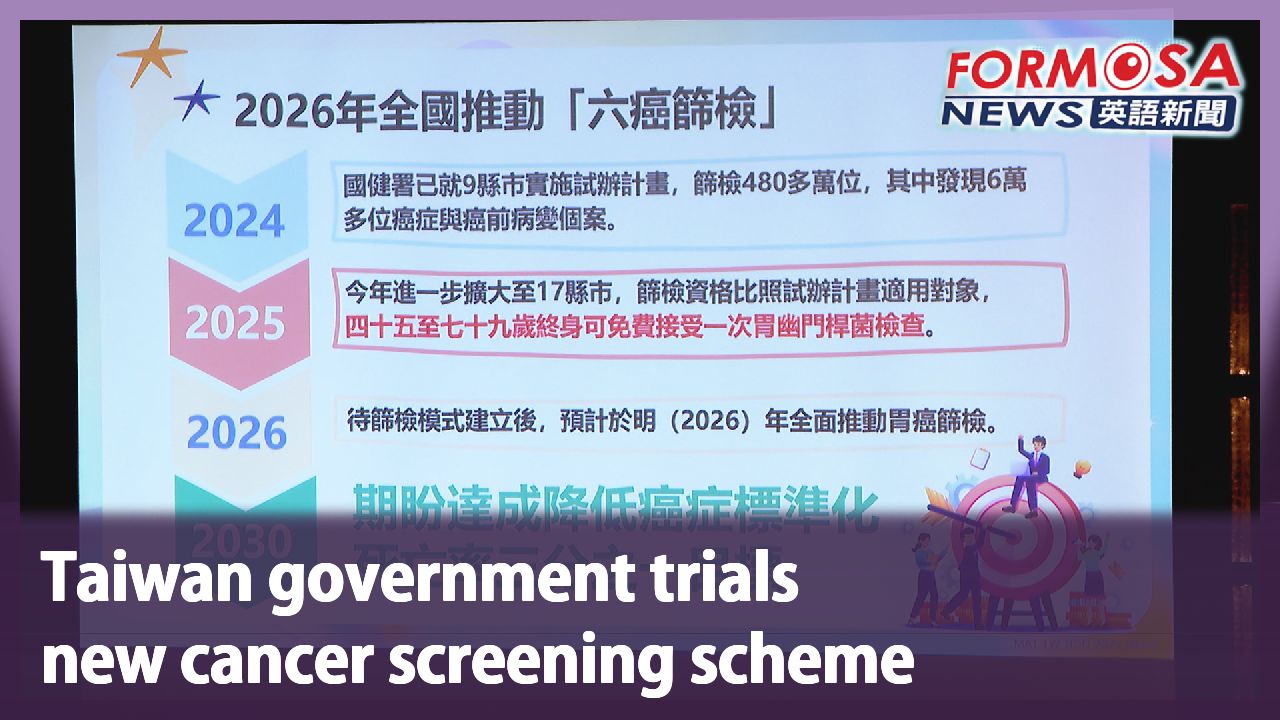
Stomach cancer is one of Taiwan’s Top 10 most common cancers, with one of the highest mortality rates. What’s more concerning is that more than half of new diagnoses were made in the later stages. To promote early diagnosis of stomach cancer, the government is now trialing a new subsidized screening plan in 17 municipalities, which will be expanded to the entire country next year. Let’s find out more.
Taiwan adds around 4,000 new stomach cancer diagnoses every year, 67% of which were already in the later stages. Over the past 20 years, survival rates for patients with stomach cancer only increased 3 percentage points, trailing behind the progress made by Japan and South Korea. As such, early diagnosis is key to treatment.
Chen Jen-shi
Taiwan Oncology Society
The first thing is that we must increase early diagnosis rates. There must not be so many Stage Fours, that’s the first. Second, we must have more targeted drug treatments and supportive therapies, in order to increase the median survival rate of patients. It could be one year, a year and a half, two years… the longer the better. That’s what we wish for. We must not only rely on a single drug, but improve on both prevention and treatment, so we can approach this problem in a more holistic manner.
Under a new government scheme, people aged between 45 and 74 will be eligible for a free Helicobacter pylori stool antigen test. Meanwhile, doctors are also calling for more precise target therapy.
Shan Yan-shen
Taiwan Surgical Society of Gastroenterology
Everyone’s genes are different, and the reason for developing cancer differs. Of course the mutation of oncogenes, the driver oncogene differs. So the most important thing about genetic tests is that they allow us to target the different symptoms and pathogens that induce stomach cancer, so that we can fight and suppress the oncogene that progresses cancer.
With more widespread screening and better treatment, the government aims to reduce the morbidity rate of stomach cancer by a third before 2030.
For more Taiwan news, tune in:
Sun to Fri at 9:30 pm on Channel 152
Tue to Sat at 1 am on Channel 53
胃癌拚精準治療! "基因檢測"找出合適標靶藥
2025-02-19
胃癌是十大癌症之一,更是前三大最低存活率的癌症,為了提升患者存活率,胃癌治療也邁向精準醫療,透過基因檢測,找出適合患者的標靶藥物,量身打造,政府也擴大45-74歲,幽門桿菌糞便抗原檢測,就是希望早期發現。
台灣每年增加4000名胃癌患者,高達6成7,發現時已經是晚期,過去20年的存活率只增加3%,落後日韓。
[[癌症醫學會理事長 陳仁熙]]
“第一個事情就是我們必須,提升早期診斷率,不要讓第四期那麼多,這第一個要素,第二個事情,能使用的藥物治療,支持療法能夠更到位,讓病人的中位存活率更提升,可能一年、一年半、兩年,越高越好,這是我們的期待,必須精進的雙管旗下的,不是單一藥物而已,必須全面來檢視這個問題”
就因為這樣,政府擴大45-74歲,幽門桿菌糞便抗原檢測,除了預防,治療也更精準,可以透過基因檢測,找出患者適合的標靶藥物。
[[台灣消化系外科醫學會理事長 沈延盛]]
“每個人基因不一樣,產生癌症原因不一樣,當然他的致癌基因變化,主導致癌基因就不一樣,所以基因檢測,最重要讓我們針對不同的,產生胃癌的病症、病原,推動癌症的致癌基因,你來打擊它,抑制它”
多管齊下,就是希望2030年,死亡率能減少三分之一,讓"胃"來可期。
更多新聞內容,請鎖定:
民視台灣台(152頻道)週日至週五晚上9:30
民視新聞台(53頻道)週二至週六凌晨1:00
Related News