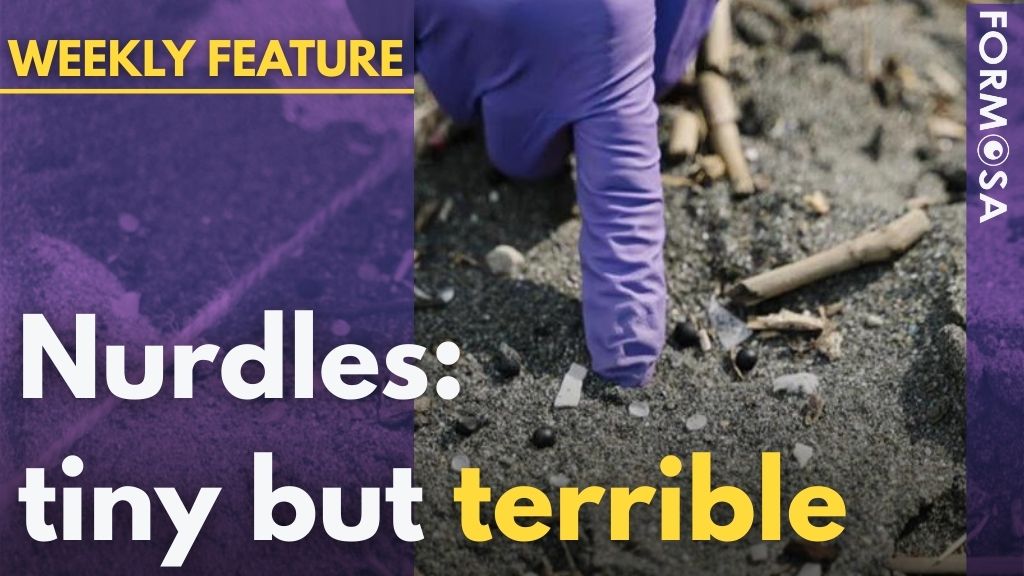
Lentil-sized nurdles cause major pollution problems along Taiwan’s beaches
We all know about the environmental damage caused by discarded plastics such as shopping bags or water bottles. But have you ever heard of nurdles? They are the plastic pellets used to manufacture plastic products. Their small size makes them really prone to leaking into the environment, and extremely difficult to clean. Last year, Greenpeace and two local universities led the first systematic study into nurdle pollution in Taiwan. They found a shockingly high nurdle density of almost 100 pellets per kilogram of sand at a beach near a petrochemical plant in Kaohsiung. Our weekly special report.
Greenpeace’s iconic ship, the Rainbow Warrior set sail from Hong Kong in October 2024 for a five-day journey. Its destination: Kaohsiung. It was the vessel’s first visit to Taiwan in seven years.
The Rainbow Warrior has been involved in activism for pressing environmental issues such as campaigns against whaling and protests against deforestation in the Amazon. One of its tasks in Taiwan was to monitor plastic pollution in marine sediments.
Ship captain
Victoria
Rainbow Warrior, Rainbow Warrior. This is Victoria calling.
We joined a research team from Taiwan at Kaohsiung Port, to take a boat to the Rainbow Warrior out at sea.
Voice of crew member
Rainbow Warrior
So we are waiting until we are out of the traffic separation scheme and then we will launch our boat. I will call you. Copy?
The Rainbow Warrior dispatched a speed boat to pick up the group. It was no easy feat due to strong winds and big waves.
Crew had to pull the speed boat back in over and over again as tall waves and sudden gusts of wind pushed it away.
Crew member
Rainbow Warrior
OK guys. Once we get back. I need everyone to walk on this side. Do not stand up until I tell you. OK?
After a bumpy ride, the research team finally boards the Rainbow Warrior. Chief Mate Ignacio Soaje, familiarly known as Nacho, gave us a tour of the ship of his dreams.
Ignacio Soaje
Rainbow Warrior chief mate
And this is a place to open or to operate with helicopters. And also we have the small boats. They are always ready. And now we have five boats on board.
Ignacio Soaje
Rainbow Warrior chief mate
We also have spaces like the radio room. As you can see, this is where we have all the computers, all the settlers, all the satellite communications is all here.
About a dozen crew members from all over the world live on the ship, which is equipped with everything necessary for daily life and work. There’s a galley, a dining room, a recreation room and even a sick bay.
Ignacio Soaje
Rainbow Warrior chief mate
Everything here for advanced medical care, defibrillator, basic. Yeah.
Wen Yu-ping
FTV reporter
I am currently on the famous Rainbow Warrior, which has sailed all over the world researching the marine environment. We are now heading for the mouth of the Gaoping River to collect a sediment sample.
The Rainbow Warrior halts off the shore of Linyuan Industrial Park. A grab sampler is lowered into the sea to collect sediments from the seabed.
Wu Wen-huai
National Taiwan Ocean University
We let the instrument down. The rope goes slack when it hits the floor. Once it reaches the seabed, the pin and spring system unlocks and the shovels close to collect the sediment.
The samples collected from the seabed are put into metal trays to perform lab tests. The crew is not just researching sediments at the bottom of the sea, but also anything floating in the surface. For that, they have a manta trawl net.
After 15 minutes, the net is pulled up and emptied. A visual assessment confirms the presence of microplastics, including discarded plastic fragments and the key target in the study: plastic pellets, also known as nurdles.
Voice of Wu Wen-huai
National Taiwan Ocean University
They look like the ones we saw on the beach. Yellow pellets.
Nurdles look like lentils and measure less than 5 mm. They are used in the plastics industry, where they are extruded or melted to make all sorts of plastic items. In other words, they are a prime material for factories. Their small size and light weight means they often leak into the environment. Past environmental efforts were mostly concerned about plastic waste after items are discarded. But it turns out pollution can start from the very beginning of the manufacturing process.
We’re now at Zhongmen Beach near Linyuan Industrial Park. In August and September of 2024, Greenpeace, National Taiwan Ocean University and National Sun Yat-sen University joined forces to systematically research nurdle pollution in Taiwan for the first time.
Chang Kai-ting
Greenpeace Plastic Reduction Project
Right here I can already see nine or ten nurdles. You can see more with every step you take on the beach. It’s astonishing.
The team combed four beaches near Linyuan Industrial Park in two different seasons. The highest concentration of nurdles was found on Zhongmen Beach, with 96 plastic pellets for every kilogram of sand.
Shiu Ruei-feng
National Taiwan Ocean University
Controls at the source are very important. There should be regulatory measures in place at the production end. That’s to say, they shouldn’t be released from factories. Once they are in the environment it becomes very difficult to collect them.
Experts say the nurdles may have ended up at the beach due to leaks during transportation or during the manufacturing process. For now in Taiwan, there are no laws to control it. So long as the pellets lost don’t affect operation costs, factories don’t care.
Shiu Ruei-feng
National Taiwan Ocean University
The presence of the nurdles here is clearly tied to the industry in the area. The pellets were brought to the area to be used by plastic factories.
Linyuan Industrial Park is a major hub for the petrochemical sector in Southern Taiwan, located along the coast of Kaohsiung. Every year, it rakes in a combined NT$1.5 trillion, making it a significant contributor to the national economy. Is there really no way to trace back where the pellets originated? What can be done to stop spills?
Lai Ying-ying
Ministry of Environment
If there is a higher concentration of nurdles in a specific area, we can investigate the cause. We can see if there are any firms nearby that could be prone to leaks. The issue can then be further examined by local authorities and environmental protection agencies.
Chang Kai-ting
Greenpeace Plastic Reduction Project
We are also calling on the government of Taiwan to tackle the issue of nurdles. There are a lot of firms producing plastic products in Taiwan. We think it’s important that the companies have measures in place to check for potential leaks throughout the production process.
According to environmental charity Fidra, about 10 trillion nurdles are lost into the natural environment annually. That’s the equivalent of 450,000 tons. Once in the ecosystem they are almost impossible to remove. Plastic pollution is everywhere, on land and at sea, from pellets to products.
News report from July 2, 2015
After five days of failed rescue attempts, a necropsy revealed the whale had swallowed large amounts of plastic bags. The text on them was still readable after a scrub.
News report from March 10, 2018
NCKU’s Marine Biology and Cetacean Research Center performed a necropsy, only to find large garbage liners and plastic bags inside the animal.
Hettie Geenen
Rainbow Warrior captain
My ambition for the ocean... I think it’s not my ambition. What I believe is that everybody needs to do something. And everybody, even if it’s small, even if it’s big.
Hettie Geenen has been part of Greenpeace for 25 years now. It pains her to see the harm caused to the beautiful ocean. She and the crew on the Rainbow Warrior are committed to protecting the marine environment.
Hettie Geenen
Rainbow Warrior captain
Yeah, be aware. Be aware is the big thing. Of what’s happening and how much plastic there is. And how easy we use it: For packing, for quickly do something and then throw it away. And we really need to be aware of this more, I think.
Ignacio Soaje
Rainbow Warrior chief mate
You just stand out here, and you see all the dolphins, jumping, jumping, jumping.
A dolphin leaping from the water called Dave has become the mascot of the Rainbow Warrior. It’s become the figurehead of the ship, leading the vessel across the seas.
Ignacio Soaje
Rainbow Warrior chief mate
I just cut off this rope with buoys that were stuck on the tail of a humpback whale
Nacho narrates how he freed a humpback whale from a net as part of the Rainbow Warrior crew.
The whale sprays water in gratitude, as the crew celebrates the rescue. It is a rare moment of joy while fighting plastic pollution.
Ignacio Soaje
Rainbow Warrior chief mate
I was like this for one week. I had so much emotion so much adrenaline for the “I saved a whale, I touched it.” Yeah.
The sun sinks in the horizon and night sets in as the lights on the Rainbow Warrior sail away. Their glimmer symbolizes a spark of hope in the fight against plastic pollution in our beautiful oceans.
For more Taiwan news, tune in:
Mon to Fri at 9:30 pm on Channel 152
Tue to Sat at 1 am on Channel 53
2025-05-23