When living alone isn’t lonely: how elders stay connected with society
Almost 1 million elders live on their own in Taiwan, with another half a million people living in households made up solely of seniors. Living alone comes with many challenges, but especially on the front of social relations. Fighting loneliness can take on many different looks, from going to social gatherings at a community center, to joining a storyteller troupe and entertaining kids on weekends. This Weekly Feature, we take you to see how elders are staying connected in their golden years.
The pill boxes, medicine bags and the alarm clock on the dining table are all decorated with hand-written reminders. At 101 years old, Liu Chien-ching lives alone in his house in New Taipei’s Banqiao District. He can still take care of himself, so his daughter and caregiver only drop by for visits, meaning Liu is on his own most of the time. For safety reasons, he’s not going out as much in recent years. But loneliness is hard to combat.
On Monday, Wednesday and Friday afternoon, a care companion comes to Liu’s house to do exercise, read the newspaper and more importantly, have a chat.
Her name is Huang Hsin-yi, and her praise gets Liu smiling from ear to ear. The two get along so well that sometimes Liu breaks out into song.
Two years ago, Liu’s daughter decided to hire a daily life companion to prevent her father from being completely cut off from society.
Huang Hsin-yi
Daily life companion
You need to be someone who is not afraid of chatting with older people. Sometimes, they tell you their life story over and over again. They tell you about their condition and their mood. So you have to be able to accept that there are sometimes negative thoughts, or situations that are disconnected from people and issues in the present. You have to be responsive to the information they give you, and the emotions they feel. They need to feel like you care about them, and that you aren’t just doing things perfunctorily.
Lo Yun-ting
Long-term care organization
When we talk about elder care, the conversation usually focuses on nursing and home care. But older adults do not just have physical problems. They need companionship, and someone to help them with their mental wellbeing. So we created this job of “daily life companion.” We hope that these companions can help slow down aging and enrich their lives.
Chang Shu-ching
Federation for the Welfare of Taiwan’s Seniors
For many older people who live alone, being on one’s own for long periods of time and not taking part in social activities can leave them feeling disconnected from society. That can make them feel lonely, and to develop mental health problems, like depression.
Physical and mental wellbeing are both important to leading a happy life in old age. In recent years, cases of elders dying alone have become increasingly common in Taiwan. With fewer family interactions and nobody offering care, some elders end their life all by themselves, be it due to illness, accidents or even, suicide.
About 980,000 older adults live by themselves in Taiwan. And about 520,000 elders live in a household where they are taking care of other elders. Lonely elder deaths seem inevitable as people live alone or with other older adults.
Chang Hung-che
National Taipei University of Nursing and Health Sciences
Elders living alone can feel insecurity, anxiety, and fear about things happening around them. They also become targets for scammers. It’s important to pay attention to their physical and mental safety, and their psychological wellbeing.
But living alone doesn’t necessarily entail loneliness. Lone dwellers can still lead fulfilling lives.
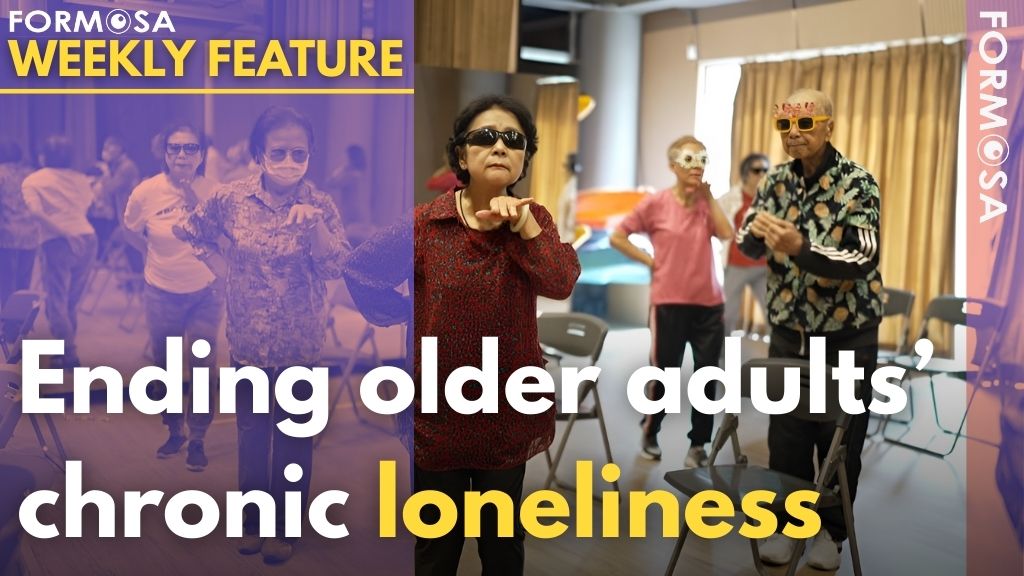
Every Friday morning, Huaxing borough in Taipei’s Wenshan District organizes a sports class for people aged 65 and up. The dress code is funky glasses and colorful shirts, all a must to groove to the beat.
Ms. Tsao
Participant
I love it. Because if you stay at home and you don’t go out, you don’t get to have as many friends. The way our teacher leads the class gets is very exciting and it gets your grey cells moving too. It keeps dementia at bay.
83-year old Mr. Tsao lives with his wife. He has to not just face the challenges of his aging body, but also take care of his other half. His situation, having to care for others in old age, is becoming increasingly common in Taiwan.
Chen Chih-ying
Huaxing Borough warden
When we talk about people living alone we don’t just mean people who live on their own. In our society there is an increasing number of households made up of two elders. Usually it’s couples, where one person in their 70s is taking care of another person in their 80s. Or someone in their 80s taking care of someone in their 90s. We also consider these households as being people who live alone.
Many communities have begun holding elder care courses to strengthen the connections between elders living alone and society. Their goal is to get older people to get out of the house, prevent physical degeneration and delay disability and dementia. But what about people who want nothing to do with these activities?
Chen Chih-ying
Huaxing Borough warden
You can’t just visit them three times and call it a day. We should ask them out, 10, 20 times. Tell them about all the activities there are. If we bring them out and have them joining in once or twice, they’ll see that its fun. They’ll see how nice it is to go out and do exercise, and chat with the classmates next to you. Sometimes the reluctance comes from never having done anything like that before. But once they do get out, the infectious atmosphere will reach them. That’s when we know we’ve achieved our goal of getting older people out and about, engaging with the community, meeting others and interacting with each other.
Coaxing people out of the house and getting them involved in the community allows seniors to make friends and form enriching experiences, while regaining their long-lost self-esteem and enthusiasm. Another way to stay in touch with society and other generations is by volunteering to hang out with children.
It’s just before 10 in the morning and the director and deputy director of the Ugly Duckling Theatre Troupe are busy as can be, as spectators are already filing in for the show.
This public library in Yilan holds storytelling sessions every weekend, led by volunteers from the Ugly Duckling Theater Troupe. The biggest highlight of the events are the performers.
One of them is “Chalk grandma,” as she is known by the kids. Her real identity is Wang Hui-shen, a 77-year-old who lives with her elderly husband. When she’s not taking care of him at home, she’s volunteering at the theater troupe.
Wang Hui-shen
Ugly Duckling Theater Troupe
I used to be awfully shy. After I started volunteering at the theater troupe, my friends thought I’d become a different person. I started liking myself more, too. When I volunteer, I can reach out with my hand and hold many little hands. It fills me with positive energy, with an immense happiness. Going out is very valuable, as it makes every day of my life fresh and new.
These older adults have a potential that goes well beyond their physical limitations.
96-year-old Sun Ju-hsien is also a volunteer at the troupe. Thirty years earlier, she brought her grandson to a storytelling session and ended up becoming a teller herself.
Sun Ju-hsien
Ugly Duckling Theater Troupe
I’m very happy doing this. After I’ve told my story, I immediately ask whose turn it is for the following week. I’m always looking forward to my turn. I used to be a bit afraid. I was afraid I’d say it all wrong, and do a bad job. But the kids are very welcoming. They are happy however you say it. There’s a lot of people. Parents bring their children over, which means they like me. They like what I do, and so I feel that it is all worth it.
Sun has become a popular storyteller among the kids, making a connection across generations. She shows that it’s possible to bust myths and misconceptions about old age and that it’s possible to have a meaningful life in your golden years.
Chiu Chih-han
Ugly Duckling Theater Troupe
The volunteers that join the Ugly Duckling Theater Troup, especially the elderly ones, all have a shared characteristic. They are lively, open-minded and flexible. They can go from being 80 years old to just 12, or even 5 or 3. They use child-like voices when they perform their stories, which is a very valuable skill in our troupe. Being part of this project makes life not be boring or monotonous any more. It’s fantastic for everyone’s physical and mental wellbeing.
These elders are a treasure trove of knowledge. With a positive attitude and an open mindset, they are all finding value and inspiration late in life, keeping loneliness at bay.
#loneliness #lonelinesspandemic #old #oldage #goldenyears
For more Taiwan news, tune in:
Mon to Fri at 9:30 pm on Channel 152
Tue to Sat at 1 am on Channel 53
2025-06-13