Taiwan’s white paper on dementia released
Taiwan’s white paper on dementia released
2025-09-19
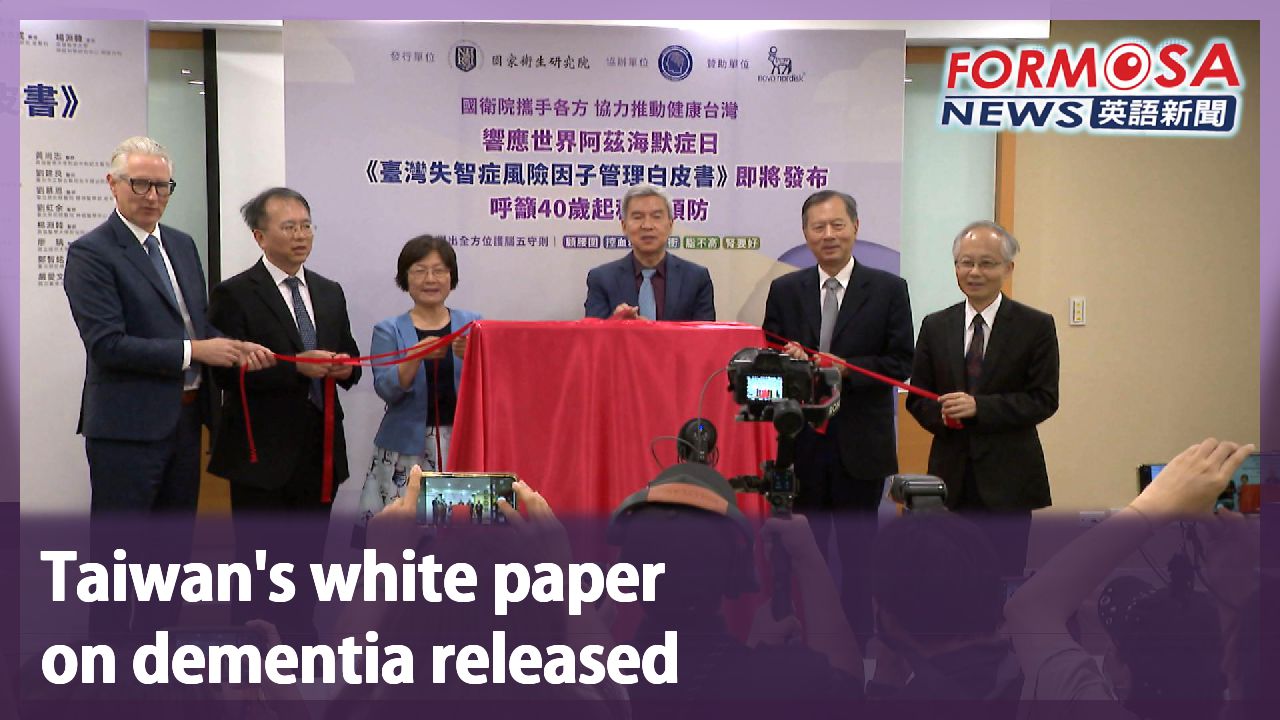
In time for World Alzheimer’s Day, Taiwan’s National Health Research Institutes announced the release of the "White Paper on Managing Risk Factors for Dementia." The initiative urges citizens to begin proactive prevention from age 40, identifying this stage as the “golden period” for intervention. FTV reporter Stephany Yang has the details.
Novo Nordisk, a global leader in the prevention and treatment of diabetes, obesity, and other chronic conditions, signed a Memorandum of Understanding with Taiwan’s National Health Research Institutes and Kaohsiung Medical University. As part of this strategic collaboration, they also jointly released the "White Paper on Managing Risk Factors for Dementia," aiming to encourage early intervention and comprehensive risk management. Through this partnership, they hope to tackle pressing public health challenges, improve chronic disease management, and accelerate research efforts.
Hans Duijf
Novo Nordisk Taiwan General Manager
We started the collaboration last year in 2024. With the same mission in mind, if we are together to address the increasing public health burden of chronic diseases. That includes diabetes, obesity, and dementia, then we simply have to work together. I think that really is the recognition that the thing that can make the biggest difference is really early intervention and prefearbly prevention because that is where we can add the most life to years and years to life.
Sytwu Huey-Kang
NHRI President
Last year, we signed an agreement with Novo Nordisk with the aim of fostering public-private collaboration. The National Health Research Institutes serve as an ideal interface, helping to bridge government policy and resources with Taiwan’s academic institutions, medical centers, domestic industry, and international support.
According to a 2023 survey by the Ministry of Health and Welfare, nearly 8% of Taiwanese aged 65 and older live with dementia. That’s roughly one in every 13 seniors. The white paper outlines 14 modifiable risk factors of dementia, including managing obesity, diabetes, hypertension, and high low-density lipoprotein cholesterol.
Hans Duijf
Novo Nordisk Taiwan general manager
From a risk factor perspective, we as a company is very focused on diabetes and obesity, and recognize that as a rule of thumb for people with diabetes or obesity, the risk of developing dementia is approximately double. So, certainly, when thinking about the best thing to prevent dementia is really to intervene early and work on the prevention of diabetes. One of the underlying causes there is to really think about obesity as a significant contributor and risk to diabetes and to dementia. Leading a healthy lifestyle, but also increasingly thinking about the right medication to deal with obesity is the right way forward.
Chu Chien-fang
Ministry of Health and Welfare, Department of Long-Term Care
Starting Jan. 1 next year, under the Long-Term Care Plan 3.0 initiative, we will expand dementia care services to cover individuals of all ages. This approach comes from the recognition that younger individuals with early-onset dementia often still possess work capabilities and bear significant financial responsibilities for their families. Without proper support following a diagnosis, the burden can overwhelm the entire family. By broadening the scope to include all age groups, Long-Term Care Plan 3.0 aims to identify and assist dementia patients, especially younger ones, as early as possible.
Under the current regulations, eligible recipients of government-subsidized long-term care services in Taiwan include people aged 65 and older, Indigenous people aged 55 and older, individuals with physical or mental disabilities and those aged 50 and older with dementia. Starting Jan. 1, 2026, eligibility will be expanded to include people under 50 with dementia who are also disabled, as well as patients in the post-acute care program.
For more Taiwan news, tune in:
Mon to Fri at 9:30 pm on Channel 152
Tue to Sat at 1 am on Channel 53
#dementia #longtermcare #health #diabetes #WorldAlzheimer’sDay #NationalHealthResearchInstitutes #Ministry of Health and Welfare #earlyprevention
籲及早預防! 國衛院發布首份台灣失智症風險因子管理白皮書
2025-09-19
國家衛生研究院發布首份台灣失智症風險因子管理白皮書,呼籲40歲起及早預防的觀念。
台灣諾和諾德藥品股份有限公司是糖尿病、肥胖和其他慢性疾病防治的全球領導者,最近與國衛院和高雄醫學大學簽署了備忘錄。作為此次策略合作的一部分,也共同發布了《臺灣失智症風險因子管理白皮書》,呼籲40歲起及早預防的觀念。透過此次合作,希望應對緊迫的公共衛生挑戰,改善慢性病管理,並加速研究進程。
[[台灣諾和諾德總經理 杜翰思]]
"我們去年啟動了這項合作,目標是2024年。懷抱著同樣的使命,如果我們要共同應對日益加重的慢性病公共衛生負擔,包括糖尿病、肥胖症和失智症,就必須攜手合作。我認為這實際上意味著我們認識到,能夠帶來最大改變的是早期幹預和預防,因為只有這樣,我們才能最大限度地延長壽命。"
[[國家衛生研究院現任院長 司徒惠康]]
"我們在去年跟Novo Nordisk簽了一個合約,希望可以透過公私協力的方式。國衛院是最好的介面,可把政府的,從政策端、資源端,連結台灣的學員機構,跟醫學中心以及國內的業者跟國際的幫忙。"
根據台灣衛生福利部2023年的調查,台灣65歲以上長者失智症盛行率已達近8%,平均每13名長者就有1人失智。研究指出,45%失智症可透過控制14項可改變因子來預防或延緩。根據白皮書內容,控制 14 項可控風險因子,其中跟慢性疾病相關,包括肥胖、糖尿病、高血壓、低密度脂蛋白膽固醇過高,透過積極落實健康管理,將可有效延緩甚至預防失智的發生。
[[台灣諾和諾德總經理 杜翰思]]
"從風險因素的角度來看,我們公司非常關注糖尿病和肥胖症,並認識到,根據經驗,糖尿病或肥胖症患者患癡呆症的風險大約是一般人群的兩倍。因此,預防癡呆症的最佳方法實際上是及早幹預並努力預防糖尿病。其中一個根本原因是,要真正認識到肥胖是糖尿病和失智症的重要誘因和風險。養成健康的生活方式,並不斷思考如何選擇合適的藥物來應對肥胖症,才是正確的方向。"
[[衛福部長期照顧司長 祝健芳]]
"我們在3.0,明年1月1日,會針對全齡的失智症全部納到我們的長照症的服務體系,有這樣的想法,主要是如果年輕型的失智症,事實上具有工作能力,而且 也承擔了家庭的照顧的經濟重擔,如果一旦是確定是確診了失智沒有一個資源來協助他,可能拖垮了整個家庭。所以在長照3.0就擴大到全齡,希望及早能夠掌握到失智症的患者,尤其是年輕型的。"
根據現行規定,台灣長照服務的受助對象主要包含:65歲以上失能老人、原住民(55歲以上,原住民身分,且符合失能條件)、失能身心障礙者,以及50歲以上失智症者。自2026年1月1日起,長照3.0預計2026年正式上路,包含不分年齡擴大長照服務對象,納入50歲以下年輕型失智症患者,以及符合健保評估為急性後期照顧(PAC)失能者能使用長照服務。
更多新聞內容,請鎖定:
民視台灣台(152頻道)週一至週五晚上9:30
民視新聞台(53頻道)週二至週六凌晨1:00
Related News