Textile company turns pineapple leaves into fabric and leather alternative
Textile company turns pineapple leaves into fabric and leather alternative
2025-10-31
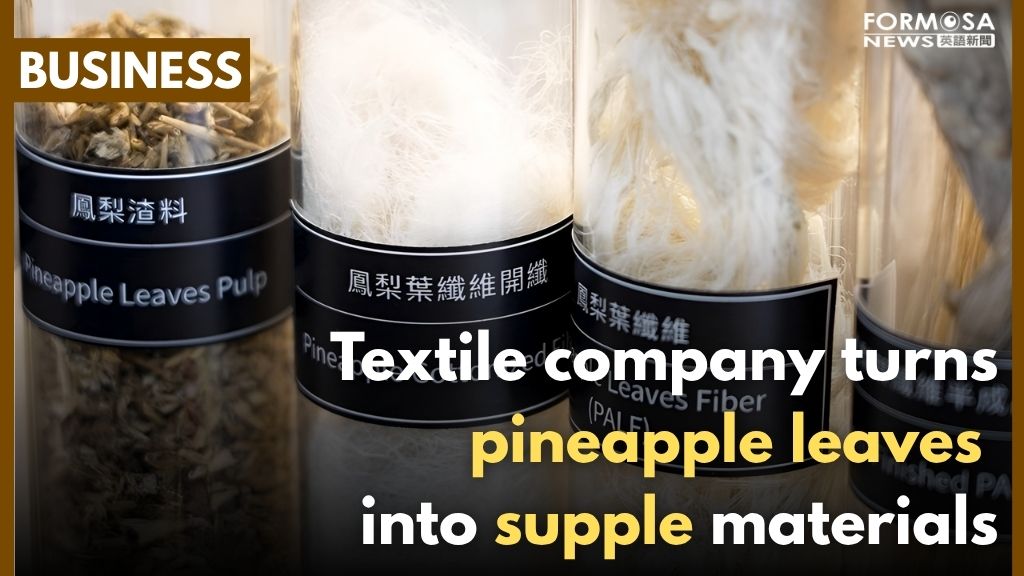
Pineapples are delicious, and now you can wear them too! A textile company has turned pineapple leaves into silky knits and supple leather. Their fabrics are much more environmentally friendly than cotton or linen, let alone their leather compared to conventional plastic alternatives. The company truly has you covered, from head to toe!
Here are some clothing, shoes and hats made out of a leather-like material, which is actually derived from pineapple leaves.
Gary Hsieh
Textile company EVP
The fibers can be turned into leather and made into hats, and even furniture such as couches. It has a wide range of applications.
There’s an average of 1.45 tons of pineapple leaves for every ton of pineapple harvested. The textile company turns these leaves into fibers to produce an eco-friendly leather alternative. Unlike traditional petroleum-based plastics, this plant-based material is less carbon-intensive and uses less water to produce.
Gary Hsieh
Textile company EVP
Last year, our product was certified by the BSI to have a carbon equivalence of 0.784, around one-tenth of linen and half of cotton. Any cash crop with fiber-based by-products can be reused by us.
This is a T-shirt the company designed for a Circular Taiwan Network event, featuring the main visuals. The pineapple fiber material was an apt choice for this souvenir T-shirt.
Gary Hsieh
Textile company EVP
The Ministry of Environment established a great platform, which is the 8+N resource circulation alliance. I think what’s even better is that the platform allows us to learn from other industries regarding how they implement circular economy principles.
As a member of the resource circulation alliance, the company has an opportunity to learn about others with a circular business model. The Ministry of Environment hopes to raise the profile of these green businesses and encourage more companies to get on board with a more sustainable future.
For more Taiwan news, tune in:
Mon to Fri at 9:30 pm on Channel 152
Tue to Sat at 1 am on Channel 53
#sustainability #circulareconomy #recycling #enviromentalism #netzero #fashion
鳳梨葉變永續纖維 環境部8+N聯盟推資源循環
2025-10-31
台灣鳳梨是台灣重要的農產品,不止可以吃,還能拿來製成衣服,有紡織企業以農業廢棄的鳳梨葉,研發創新材料的鳳梨葉纖維,製成的T-shirt,每件可減少約 0.58 公斤二氧化碳排放,是傳統棉花的一半。企業從原料創新,製造減碳,行銷永續,用行動實踐環境部推動的資源循環推動法,也希望能吸引更多業者都能夠創新或綠色轉型,加入循環台灣隊。
衣服,鞋子,甚至是帽子,材質很像柔軟的皮革。但製成這些成品,原料是用不到鳳梨葉。
[[紡織業執行副總 謝煥麒]]
”紗料可以做成皮,我們可以變成皮革,我們可以做成帽子,那個沙發、傢俱,其實它的應用範圍就變的很廣”
每生產一公噸的鳳梨,平均會產生1.45公噸的鳳梨葉,紡織業者拿來循環再造,變成再生的紡織纖維,取代傳統塑化原料,減少碳排放量和用水量。
[[紡織業執行副總謝煥麒]]
“我們去年在BSI的認證之下是0.784的碳當量,大約亞麻的1/10,棉花的一半,所謂的經濟作物,他的材料只要有纖維,我們都可以去做”
紡織業者瞄準天然資源,這件鳳梨葉纖維製成的T-shirt,結合台灣氣溫條碼設計,將永續穿在身上,要大家都看到氣候的危機意識。
[[紡織業執行副總 謝煥麒]]
”環境部建立一個很好的一個平臺(8+N聯盟),我覺得更棒的事情是因為8+N的聯盟的成立,我們可以跨領域去認識到不同的產業,他們如何去做他們的循環經濟”
身為「8+N資源循環聯盟」成員,深刻體會到各產業在循環經濟上的努力。環境部以政策及資金支持,鼓勵數位轉型,期望更多企業加入聯盟,推動資源循環與永續發展。
更多新聞內容,請鎖定:
民視台灣台(152頻道)週一至週五晚上9:30
民視新聞台(53頻道)週二至週六凌晨1:00
Related News