ITRI holds global summit on AI-assisted healthcare
ITRI holds global summit on AI-assisted healthcare
2025-12-08
Last Friday, ITRI held the Global Summit on Transforming Healthcare Through Digital Intelligence with experts from home and abroad, to exchange views on the latest trends in AI-assisted healthcare. Several Taiwanese innovations were presented, showcasing how ITRI has harnesses Taiwan’s industrial and research capabilities.
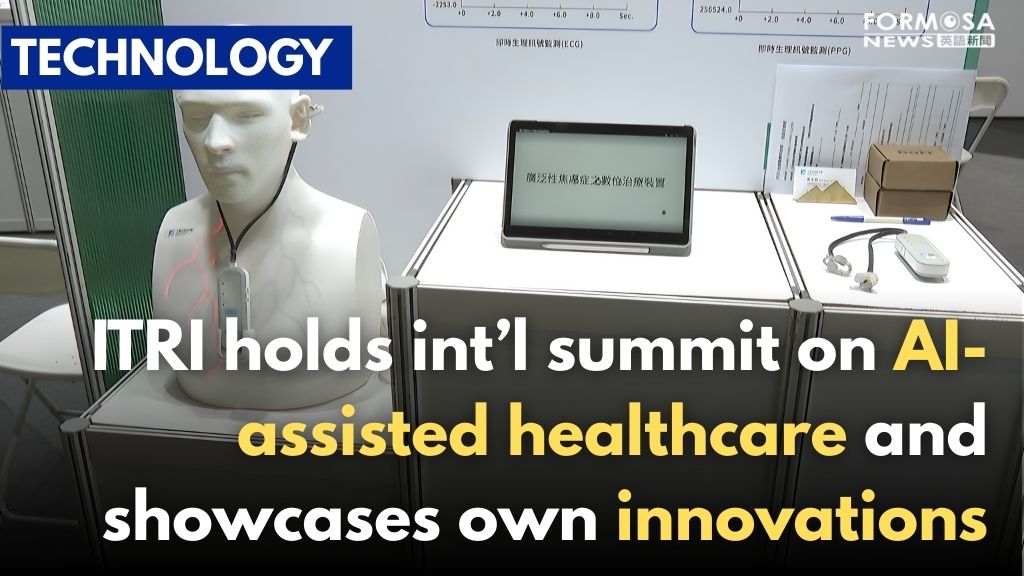
This device is secured with a leg strap and worn against the thigh. It emits electrical signals that stimulate the local nerves, allowing patients with Parkinson’s disease to move more easily. The device also contains sensors for the patient’s muscular electrophysiology, the data of which allows doctors to give more accurate diagnoses and prescriptions.
Like contactless payment, the device beeps when held close to orthopedic implants with chips. This device can monitor tendon tension and tissue recovery after a surgery. The chips used in this smart healthcare device were also made in Taiwan.
Chuang Yao-yu
ITRI biomedical research director
Taiwan holds an advantageous position in semiconductors, the ICT industry and healthcare. We can harness our medical data to improve healthcare outcomes.
Even generalized anxiety disorder is getting an AI-powered solution.
The device is worn like a pair of headphones. It forms an electrode array that stimulates the vagus nerve to relieve anxiety and help the patient feel more relaxed. Under the doctor’s instruction, the device can be used as complementary therapy, which is especially suited to patients with drug allergies or those experiencing excessive side effects. All these innovations showcase how ITRI is harnessing Taiwan’s industrial and research capabilities to promote AI-assisted healthcare.
Stephen Hahn
Former US FDA commissioner
It’s already being done in the agency. There’s very clear information for developers of medical products to actually use AI in them. And as long as you follow the guidance from the FDA, I think the pathway will be relatively smooth.
The former commissioner of the US Food and Drug Administration was one of the many international experts speaking at the summit, contributing to lively exchanges and insights for global AI-assisted healthcare.
For more Taiwan news, tune in:
Mon to Fri at 9:30 pm on Channel 152
Tue to Sat at 1 am on Channel 53
#ITRI #medicine #healthcare #technology #AI
加入台灣晶片助攻 全球智慧醫療創新峰會搭AI革新
2025-12-08
AI引領全球醫療進入全新競爭格局,工研院透過全球智慧醫療創新高峰會,邀請海內外國際領袖,透過論壇,共同探討AI最新趨勢,如何推動全球醫療革新,同時也展示各種加入台灣晶片的智慧醫療方案。
把動作指引裝置,固定在復健帶上,用電刺激帕金森氏症患者行走,不只能增強活動力,還能藉由裝置中的晶片,擷取肌電訊號,幫助醫生加快評估病情及用藥決策。
就像悠遊卡,遙測器一靠近,馬上"嗶"了一聲,傳統骨釘植入感測器,可以監測肌腱張力、觀察組織恢復狀態,小小一塊台灣晶片,大大助攻醫療快速智慧化。
[[工研院生醫與醫材研究所所長 莊曜宇]]
“台灣非常強的半導體,還有我們的資通訊產業,加上我們有非常好的醫療。我們利用這些所謂醫療的數據,來改善我們在醫療上面的一些情形。”
搭上AI趨勢,廣泛性焦慮症,也開發了數位治療新方案。
類似耳機的裝置,運用耳部電極,刺激迷走神經,舒緩焦慮、放鬆情緒,在醫師指示下,可作為輔助治療的工具之一,免去藥物過敏或副作用等疑慮,在經濟部產業技術司支持下,工研院發揮台灣ICT與晶片供應鏈優勢,從研發、臨床到產業鏈,積極佈局更高效、多元的醫療體系。
[[美國食品藥物管理局前局長 Stephen Hahn]]
“醫療產品開發商,實際上已經有很清楚的資訊,可以使用AI人工智慧,只要遵循美國食品藥物管理局(FDA)的指引,我認為整個過程會相對順利。”
從美國跨海來台的食品藥物管理局前局長、美敦力全球人工智慧長等國際領袖,透過創新高風險,與台灣交鋒,在全球醫療革新中,探討更多新可能。
更多新聞內容,請鎖定:
民視台灣台(152頻道)週一至週五晚上9:30
民視新聞台(53頻道)週二至週六凌晨1:00
Related News