Improving pedestrian safety with AI-powered automobile technologies
Can AI absolve Taiwan of its reputation for being a “pedestrian hell?” This summer, the death of a respected surgeon brought the issue to the fore once again. Dr. Chou Chia-cheng was killed by a left-turning bus while crossing a street at the heart of Taipei. His colleagues immediately started calling for all buses to adopt pedestrian crash avoidance mitigation, or PCAM, systems for another layer of protection. But is PCAM ready to be mass deployed? What about other AI-powered automobile technologies? Our special report.
Back in July this year, Dr. Chou Chia-cheng who headed Taoyuan General Hospital’s breast surgery department was killed by a bus while crossing a street in Taipei. Chou almost reached the other side of the zebra crossing while the bus made a left turn and took his life right there and then.
The death of this respected surgeon once again put Taiwan’s road safety under the spotlight.
Now, at the site of the event, the pedestrian countdown has been lengthened to 83 seconds, up from 69, allowing more time to those on foot. Several upgrades were also made, including widening the pedestrian crossing and adding traffic islands.
Unfortunately, this isn’t the only case of too little time for pedestrians to cross a busy, multi-lane road.
Hsu Ching-jou
FTV reporter
This is the intersection between Section 2, Huanzhong Road and Fuke Road in Taichung. There are a total of ten lanes behind me, for a width of 60m, but pedestrians only have 46 seconds to cross.
Pedestrian
It is quite a rush to cross this intersection on Huanzhong Road. Older adults also move slower. Twenty seconds or so simply aren’t enough on a wheelchair. We always start as soon as the countdown begins, and it’s always red light by the time we reach the other side, quite nervously too.
Crossing the road feels like an escape mission, not to mention there are ten lanes. If one cannot cross all ten, they will have to pause on a traffic island.
Y. C. Wu
Vision Zero Taiwan
I think the problem lies in the layout of streets and not pedestrians. What we have in the layout of our streets today, you’ll find that traffic lights for pedestrians and vehicles aren’t separated. There isn’t a complete separation of traffic lights for pedestrians and vehicles in most places, so often, you’ll encounter vehicles turning right or left while pedestrians are still crossing the road. If we change this by having vehicles stop when pedestrians move and vice versa, there won’t be an issue of traffic flow being hindered.
Apart from too little time allocated for pedestrians, in Dr. Chou’s case it was also because the bus driver did not stop and wait for him to cross. But it’s not the first time for something like this to happen.
In 2022, a family of three in Taichung got hit by a left-turning bus at the intersection of Xueshi Road and Yingcai Road. The mother and infant even got caught into the bottom of the bus while it kept going killing them both.
The incident led to a revision to a traffic law, effective since June, 2023. Under the new law, vehicles must yield to all pedestrians on a zebra crossing, with no exceptions. When the new law was first introduced, some even derided it as the “Pedestrian is King Provision.”
Luo Shiaw-shyan
Tamkang University professor
It’s called the “Pedestrian is King Provision,” yes. But it’s not right to say that pedestrians are rude, arrogant or domineering. Instead, pedestrians are the ones with less power. Those who are driving, have a driver’s license or able to maneuver a vehicle must protect these less powerful pedestrians. I think most people in Taiwan still don’t fully put this concept into practice.
To prevent such casualties, in 2013 the Ministry of Transportation and Communication started mandating “pointing and calling” by bus drivers making turns.
Liang Yun-ling
Taipei City Public Transportation Office
Pointing and calling is for making a right turn. You must first check there isn’t anyone on the left, then check on the right, and then you can make the turn. As for left turns, because they’re more complicated, we ask that the driver really thoroughly check the road signs, traffic flow and pedestrians. You must check all of these multiple times before making a left turn.
Pointing and calling is a method in occupational safety originating from Japan. For bus drivers, it requires the coordination of vision, cognition, action and verbalizing to increase focus. However, it’s not thoroughly implemented in Taiwan.
Luo Shiaw-shyan
Tamkang University professor
Our bus drivers lack comprehensive training in this aspect. I do think we need to do more here. In other words, drivers must have risk awareness. Normally people who drive may think checking before turning is enough, that after making the turn you can let the whole vehicle move forward, but that’s incorrect. You must be aware of risks during the whole process.
According to the Ministry of Transportation and Communications, the number of deaths and injuries caused by large vehicles has increased over the past three years, from 12,000+ in 2022 to 13,000+ in 2024. To reduce human errors, local governments had bus service providers install radar sensors and advanced driver-assistance systems, or ADAS on all vehicles. The imaging system allows drivers to see all around the vehicle, especially blind spots.
Liang Yun-ling
Taipei City Public Transportation Office
Our original target was to have all buses install these systems by the end of 2025. But because we really wanted to improve road safety in general, we’ve already reached the target of having all installations done in March this year, There are 3,384 vehicles in total, and all 15 vendors complied.
ADAS mainly alerts drivers of obstacles in a blind spot while turning, and thus preventing pedestrians from harm. After the death of Dr. Chou, physicians in Taiwan called on installing in addition, pedestrian crash avoidance mitigation, or PCAM systems for another layer of protection. So how does PCAM work?
Wang Cheng-chien
Automotive Research & Testing Center
PCAM is a composite of many functions. First, it recognizes pedestrians in the way. The pedestrian could be in front of you and be at risk of getting hit. But it’s not just about recognizing pedestrians. The second step is to calculate how much time and distance there is between the driver and the pedestrian after detection. The system has to decide whether to alert the driver and remind them to brake. If the driver fails to brake, then the system activates the AEB, the autonomous emergency braking system.
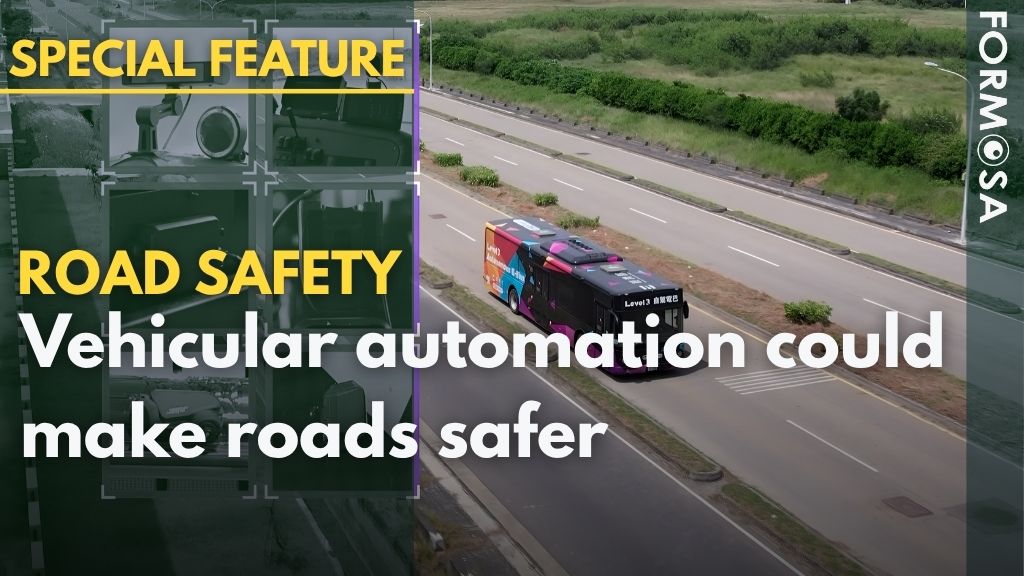
This is Taiwan’s very first international-tier vehicle testing site in Changhua Coastal Industrial Park. With 12 test lanes over an area of 119 hectares, the site is dedicated to product development and regulatory testing of various vehicles. This includes the latest AI-powered self-driving electric buses, which allow drivers to operate hands-free
This Level 3 self-driving electric bus features intelligent driving and driver monitoring systems able to self-navigate, change lanes, avoid obstacles and monitor driver attention. AEB is one feature of an L3 self-driving vehicle.
Hsu Ching-jou
FTV reporter
With an autonomous emergency braking system, accidents can be avoided.
Wang Cheng-chien
Automotive Research & Testing Center
What is an emergency? It’s when there’s only a distance of 10m to 20m from the obstacle. In this case the AEB system will alert the driver to brake. If the driver failed to do so, the system will step in and put on the brakes. The AEB’s brake is more abrupt than a human driver’s. So it’s only activated as a very last resort.
As for PCAM, it encompasses AI-powered imaging sensing technology to recognize objects around the vehicle and triggers autonomous braking when needed.
Wang Cheng-chien
Automotive Research & Testing Center
I must make predictions on this wide strip of area on the sides. A pedestrian might get in the way, so I must predict where they could go. So it’s quite a large area and involves a whole set of systems. This makes it more technically challenging, but it offers better protection. It won’t just consider what’s in front, but also what are on the sides. More importantly, it uses AI when making predictions.
So if PCAM can step in and alert the driver to make an emergency brake and prevent pedestrians from getting hit, why isn’t it deployed in our buses at present?
It’s because there have been cases in which emergency braking on buses was so abrupt that passengers fell and even got bruised.
Liang Yun-ling
Taipei City Public Transportation Office
On Taipei buses, there are many standing passengers. Second, even the seated passengers may not always fasten their seatbelts. In this case, if we apply autonomous brakes which are also quite strong, we’re worried that there’s a risk of making people fall down and get injured. So after consideration we decided not to introduce this just yet.
The AES is so powerful that it could put passengers at risk. Even a specialized seat belt must be used to test one out. That’s why there’s no plan to deploy it yet. But the Automotive Testing & Research Center says it’s still developing an AES that doesn’t risk making passengers fall.
Wang Cheng-chien
Automotive Research & Testing Center
When it comes to vehicles, there are many stages between movement and stillness. You can release the accelerator to slow down and check if there’s really someone coming toward you. If that’s the case, then you can put on the brakes.
There’s more that technology can do, including using AI image recognition to monitor the driver’s line of vision and head movements to determine whether the driver could be fatigued or unwell, and notify the operations control center if that’s the case.
Self-driving electric buses are still at the testing stage. To ensure safety, they can only be deployed once relevant laws are introduced.
A researcher believes that technology will always remain auxiliary to humans.
Luo Shiaw-shyan
Tamkang University professor
Technology has always come from human nature. So it’s ultimately one’s attitude that matters. So when it comes to operating a vehicle, we must take into account the risks involved and deal with risks properly, and drove with care. I think attitude comes before auxiliary tools. Is traffic human-centered or vehicle-centered in Taiwan? I’d say neither. It’s me-centered. Everyone puts themselves first. But the examples of road design I gave earlier all start with protecting the vulnerable. All of us could be in a vulnerable position on the streets, because we’re not always behind the wheels.
In the end, it’s all about putting yourself in others’ shoes. You might be behind the wheel one day, but someday, you might be an older adult anxiously crossing the street. Only with consideration for others will road safety truly improve.
For more Taiwan news, tune in:
Mon to Fri at 9:30 pm on Channel 152
Tue to Sat at 1 am on Channel 53
#EV #electricvehicles #roadsafety #traffic #AI #selfdriving
2025-12-12