Improving pedestrian safety with AI-powered automobile technologies
Improving pedestrian safety with AI-powered automobile technologies
2025-12-12
Can AI absolve Taiwan of its reputation for being a “pedestrian hell?” This summer, the death of a respected surgeon brought the issue to the fore once again. Dr. Chou Chia-cheng was killed by a left-turning bus while crossing a street at the heart of Taipei. His colleagues immediately started calling for all buses to adopt pedestrian crash avoidance mitigation, or PCAM, systems for another layer of protection. But is PCAM ready to be mass deployed? What about other AI-powered automobile technologies? Our special report.
Back in July this year, Dr. Chou Chia-cheng who headed Taoyuan General Hospital’s breast surgery department was killed by a bus while crossing a street in Taipei. Chou almost reached the other side of the zebra crossing while the bus made a left turn and took his life right there and then.
The death of this respected surgeon once again put Taiwan’s road safety under the spotlight.
Now, at the site of the event, the pedestrian countdown has been lengthened to 83 seconds, up from 69, allowing more time to those on foot. Several upgrades were also made, including widening the pedestrian crossing and adding traffic islands.
Unfortunately, this isn’t the only case of too little time for pedestrians to cross a busy, multi-lane road.
Hsu Ching-jou
FTV reporter
This is the intersection between Section 2, Huanzhong Road and Fuke Road in Taichung. There are a total of ten lanes behind me, for a width of 60m, but pedestrians only have 46 seconds to cross.
Pedestrian
It is quite a rush to cross this intersection on Huanzhong Road. Older adults also move slower. Twenty seconds or so simply aren’t enough on a wheelchair. We always start as soon as the countdown begins, and it’s always red light by the time we reach the other side, quite nervously too.
Crossing the road feels like an escape mission, not to mention there are ten lanes. If one cannot cross all ten, they will have to pause on a traffic island.
Y. C. Wu
Vision Zero Taiwan
I think the problem lies in the layout of streets and not pedestrians. What we have in the layout of our streets today, you’ll find that traffic lights for pedestrians and vehicles aren’t separated. There isn’t a complete separation of traffic lights for pedestrians and vehicles in most places, so often, you’ll encounter vehicles turning right or left while pedestrians are still crossing the road. If we change this by having vehicles stop when pedestrians move and vice versa, there won’t be an issue of traffic flow being hindered.
Apart from too little time allocated for pedestrians, in Dr. Chou’s case it was also because the bus driver did not stop and wait for him to cross. But it’s not the first time for something like this to happen.
In 2022, a family of three in Taichung got hit by a left-turning bus at the intersection of Xueshi Road and Yingcai Road. The mother and infant even got caught into the bottom of the bus while it kept going killing them both.
The incident led to a revision to a traffic law, effective since June, 2023. Under the new law, vehicles must yield to all pedestrians on a zebra crossing, with no exceptions. When the new law was first introduced, some even derided it as the “Pedestrian is King Provision.”
Luo Shiaw-shyan
Tamkang University professor
It’s called the “Pedestrian is King Provision,” yes. But it’s not right to say that pedestrians are rude, arrogant or domineering. Instead, pedestrians are the ones with less power. Those who are driving, have a driver’s license or able to maneuver a vehicle must protect these less powerful pedestrians. I think most people in Taiwan still don’t fully put this concept into practice.
To prevent such casualties, in 2013 the Ministry of Transportation and Communication started mandating “pointing and calling” by bus drivers making turns.
Liang Yun-ling
Taipei City Public Transportation Office
Pointing and calling is for making a right turn. You must first check there isn’t anyone on the left, then check on the right, and then you can make the turn. As for left turns, because they’re more complicated, we ask that the driver really thoroughly check the road signs, traffic flow and pedestrians. You must check all of these multiple times before making a left turn.
Pointing and calling is a method in occupational safety originating from Japan. For bus drivers, it requires the coordination of vision, cognition, action and verbalizing to increase focus. However, it’s not thoroughly implemented in Taiwan.
Luo Shiaw-shyan
Tamkang University professor
Our bus drivers lack comprehensive training in this aspect. I do think we need to do more here. In other words, drivers must have risk awareness. Normally people who drive may think checking before turning is enough, that after making the turn you can let the whole vehicle move forward, but that’s incorrect. You must be aware of risks during the whole process.
According to the Ministry of Transportation and Communications, the number of deaths and injuries caused by large vehicles has increased over the past three years, from 12,000+ in 2022 to 13,000+ in 2024. To reduce human errors, local governments had bus service providers install radar sensors and advanced driver-assistance systems, or ADAS on all vehicles. The imaging system allows drivers to see all around the vehicle, especially blind spots.
Liang Yun-ling
Taipei City Public Transportation Office
Our original target was to have all buses install these systems by the end of 2025. But because we really wanted to improve road safety in general, we’ve already reached the target of having all installations done in March this year, There are 3,384 vehicles in total, and all 15 vendors complied.
ADAS mainly alerts drivers of obstacles in a blind spot while turning, and thus preventing pedestrians from harm. After the death of Dr. Chou, physicians in Taiwan called on installing in addition, pedestrian crash avoidance mitigation, or PCAM systems for another layer of protection. So how does PCAM work?
Wang Cheng-chien
Automotive Research & Testing Center
PCAM is a composite of many functions. First, it recognizes pedestrians in the way. The pedestrian could be in front of you and be at risk of getting hit. But it’s not just about recognizing pedestrians. The second step is to calculate how much time and distance there is between the driver and the pedestrian after detection. The system has to decide whether to alert the driver and remind them to brake. If the driver fails to brake, then the system activates the AEB, the autonomous emergency braking system.
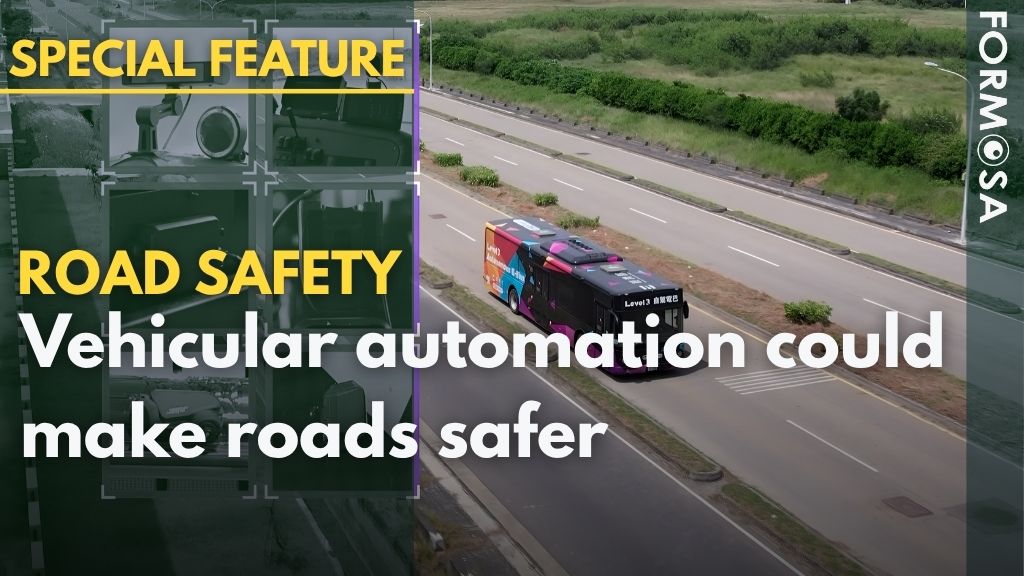
This is Taiwan’s very first international-tier vehicle testing site in Changhua Coastal Industrial Park. With 12 test lanes over an area of 119 hectares, the site is dedicated to product development and regulatory testing of various vehicles. This includes the latest AI-powered self-driving electric buses, which allow drivers to operate hands-free
This Level 3 self-driving electric bus features intelligent driving and driver monitoring systems able to self-navigate, change lanes, avoid obstacles and monitor driver attention. AEB is one feature of an L3 self-driving vehicle.
Hsu Ching-jou
FTV reporter
With an autonomous emergency braking system, accidents can be avoided.
Wang Cheng-chien
Automotive Research & Testing Center
What is an emergency? It’s when there’s only a distance of 10m to 20m from the obstacle. In this case the AEB system will alert the driver to brake. If the driver failed to do so, the system will step in and put on the brakes. The AEB’s brake is more abrupt than a human driver’s. So it’s only activated as a very last resort.
As for PCAM, it encompasses AI-powered imaging sensing technology to recognize objects around the vehicle and triggers autonomous braking when needed.
Wang Cheng-chien
Automotive Research & Testing Center
I must make predictions on this wide strip of area on the sides. A pedestrian might get in the way, so I must predict where they could go. So it’s quite a large area and involves a whole set of systems. This makes it more technically challenging, but it offers better protection. It won’t just consider what’s in front, but also what are on the sides. More importantly, it uses AI when making predictions.
So if PCAM can step in and alert the driver to make an emergency brake and prevent pedestrians from getting hit, why isn’t it deployed in our buses at present?
It’s because there have been cases in which emergency braking on buses was so abrupt that passengers fell and even got bruised.
Liang Yun-ling
Taipei City Public Transportation Office
On Taipei buses, there are many standing passengers. Second, even the seated passengers may not always fasten their seatbelts. In this case, if we apply autonomous brakes which are also quite strong, we’re worried that there’s a risk of making people fall down and get injured. So after consideration we decided not to introduce this just yet.
The AES is so powerful that it could put passengers at risk. Even a specialized seat belt must be used to test one out. That’s why there’s no plan to deploy it yet. But the Automotive Testing & Research Center says it’s still developing an AES that doesn’t risk making passengers fall.
Wang Cheng-chien
Automotive Research & Testing Center
When it comes to vehicles, there are many stages between movement and stillness. You can release the accelerator to slow down and check if there’s really someone coming toward you. If that’s the case, then you can put on the brakes.
There’s more that technology can do, including using AI image recognition to monitor the driver’s line of vision and head movements to determine whether the driver could be fatigued or unwell, and notify the operations control center if that’s the case.
Self-driving electric buses are still at the testing stage. To ensure safety, they can only be deployed once relevant laws are introduced.
A researcher believes that technology will always remain auxiliary to humans.
Luo Shiaw-shyan
Tamkang University professor
Technology has always come from human nature. So it’s ultimately one’s attitude that matters. So when it comes to operating a vehicle, we must take into account the risks involved and deal with risks properly, and drove with care. I think attitude comes before auxiliary tools. Is traffic human-centered or vehicle-centered in Taiwan? I’d say neither. It’s me-centered. Everyone puts themselves first. But the examples of road design I gave earlier all start with protecting the vulnerable. All of us could be in a vulnerable position on the streets, because we’re not always behind the wheels.
In the end, it’s all about putting yourself in others’ shoes. You might be behind the wheel one day, but someday, you might be an older adult anxiously crossing the street. Only with consideration for others will road safety truly improve.
For more Taiwan news, tune in:
Mon to Fri at 9:30 pm on Channel 152
Tue to Sat at 1 am on Channel 53
#EV #electricvehicles #roadsafety #traffic #AI #selfdriving
AI自駕電動巴士問世 能否加強應變 讓行人安全過馬路?
2025-12-12
台灣真的是行人地獄嗎?乳癌名醫周佳正醫師先前在總統府官邸附近過馬路時,不幸遭左轉公車撞死,台北市政府事發後,已在該路口加裝庇護島,也延長了行人綠燈秒數,但全台仍有許多路口存在類似的狀況。實際走訪一些危險路段進行測試,並前往全台首座封閉測試場,深入了解AI自駕電動巴士的最新發展,希望能找出提升駕駛應變能力,保障行人穿越馬路安全的新解方!
今年7月,衛福部桃園醫院周佳正醫師小跑步過馬路,同時一輛公車準備左轉,沒想到公車沒有停讓,直接撞上他,送醫不治。
事發後,行人地獄問題再度浮上檯面。
重回事故現場,行人綠燈秒數從69秒增加到83秒,就怕民眾一次走不完,現場也進行改善工程,將行穿線往內縮,增加庇護島。
其實,行人綠燈秒數過短的狀況,不僅出現在台北市,其他縣市也有。
[[民視記者 許敬柔]]
“這裡是台中環中路二段和福科路口,在我背後的馬路,總共有十個車道,寬度60公尺,但行人綠燈只有46秒。”
[[民眾]]
“我們走環中路這個路口的的秒數確實有點趕,因為我們長輩走路有點慢,推輪椅20幾秒根本過不了,我們就是倒數秒數0開始,走到對面剛好紅燈了,而且很緊張。”
行人過馬路 走得心驚膽跳,要一口氣走完十個車道,萬一走不完,只能先靠在庇護島暫停。
[[還路於民行人路權促進會理事長 吳宜蒨]]
“我覺得是道路規劃的問題,而不是行人的問題,因為今天道路規劃,燈號沒有分流,現在很多地方並沒有很完整的人車燈號分流,所以很多時候,會遇到車輛要右轉或左轉,行人還在過馬路,所以這個問題如果把它改成行人走就是車輛停,車輛走就是行人停,就不會有阻礙車流效率的問題。”
除了行人綠燈秒數過短問題,7月撞死周佳正醫師的肇事公車,疑似左轉時在行穿線沒有停讓 釀成悲劇,而這已不是第一次。
2022年台中學士路、英才路口,一家三口走在斑馬線,遭左轉的客運撞到,媽媽跟嬰兒被捲到車底拖行,送醫不治。
後來促成修法,2023年6月上路,汽機車行經行人穿越道時,必須無條件禮讓行人的規定,當時還被戲稱為「行人帝王條款」。
[[淡江大學運輸管理學系教授 羅孝賢]]
“為什麼叫它「天王條款」?並不是說行人是無禮、傲慢、霸道,不是的,它是告訴你行人是弱勢,我們今天開車的人,我是有駕照的,可以去操作車輛的人,對於這些弱勢是要給予保護的,所以這種觀念,我覺得在我們台灣並不是那麼落實。”
為了防止公車事故釀成死傷,交通部自2023年起,推動公車轉彎須「指差確認」。
[[台北市公運處業務稽查科科長 梁筠翎]]
“右轉是指差確認,他要先確定左邊沒有人、右邊沒有人,他再進行轉彎。左轉的話,因為他的複雜度稍微比較高,我們是要求再三確認,再三確認包含號誌、車流的狀況、行人的狀況,你在左轉的時候,都必須要再三去做確認。”
「指差確認」是仿效日本的安全動作,讓駕駛結合視覺、大腦、動作與口述,提高注意力,只是在台灣不夠落實。
[[淡江大學運輸管理學系教授 羅孝賢]]
“因為我們司機缺乏這種比較完整的訓練,我覺得這塊也是要加油的,就是說,你今天要有風險意識,我們開車的人常常就覺得頭過身就過,我閃一下就過,過就我的,不行,你絕對要有風險意識。”
根據交通部統計,近三年大型車造成的死傷人數,從2022年一萬兩千多人,2024年來到一萬三千多人。為了將人為疏失降到最低,地方政府要求公車業者,安裝轉彎雷達,與行車視野輔助設備,又稱ADAS設備,透過加裝攝影機和螢幕,讓司機看見車輛周圍的影像,尤其是盲點區域。
[[台北市公運處業務稽查科科長 梁筠翎]]
“我們原本是目標在民國114年能夠全面裝設完成,但因為我們希望能夠提升整體的行車安全,所以我們已經提前在今年的三月份已經全面裝設完成,總共的車輛數是3384輛。我們15家業者都有去裝設。”
「行車視野輔助系統」主要透過警示功能提醒駕駛,目的在於避免轉彎死角,造成用路人傷亡。在周醫師事件之後,醫界進一步呼籲大型車輛,應該加裝「行人辨識防護系統」,避免行人死傷憾事一再發生。究竟什麼是行人辨識防護系統呢?
[[財團法人車輛研究測試中心董事長 王正健]]
“行人辨識防護系統是組合權,它有好多個功能加在一起,第一個就是要辨識行人,行人在你的前面,你可能會撞到他。可是辨識行人這個動作,就沒有那麼簡單,第二個就是你辨識到行人之後,必須計算一下,還剩多少時間跟距離,要不要提醒這個駕駛員,提醒駕駛員踩煞車,駕駛員可以自己去踩,如果駕駛員沒有注意又沒有踩,就會啟動AEB(自動緊急煞車系統)。”
來到位在彰濱工業區,國內首座國際級試車場,占地面積119公頃,具備12條測試道,專門用來執行各式車輛的產品研發及法規測試。其中,包括最新的AI自駕電動巴士,駕駛把雙手鬆開都沒問題。
這輛L3自駕電動巴士,最新亮點,在於智慧駕駛與監控駕駛系統,包括自駕巡航、變換車道、閃避障礙物以及偵測駕駛狀態,其中緊急剎車系統AEB便是一環。
[[民視記者 許敬柔]]
“背後的原理就在於系統介入主動煞車,就能避免意外的發生。”
[[財團法人車輛研究測試中心董事長 王正健]]
“什麼是緊急?就是非常靠近的時候,可能只剩下10公尺 20公尺,一般AEB會警告駕駛員,如果駕駛員再不踩煞車的話,AI就會幫你用力地踩下去,所以AEB都會比較用力,到最後關頭的時候,你用力地踩才叫緊急煞車系統。”
至於「行人辨識防護系統」的概念更廣泛,是一種利用影像感測和AI技術,協助車輛偵測四周,並在必要時主動煞車。
[[財團法人車輛研究測試中心董事長 王正健]]
“我要預測看到旁邊比較寬的範圍,這個行人有可能走到你前面,所以我要預測他的方向,所以它的範圍是比較大的,它是一個整套的系統。技術上會比較困難,不過是防護性更高,不會只看前面,連旁邊左右都會看,而且最重要是要用AI來預測。”
既然行人辨識防護能主動介入幫駕駛緊急煞車,預防撞到行人,為何現行公車還沒有這項裝置?
原來,日前曾發生過不少次案例,公車為了閃躲前方危險路況,司機緊急煞車,卻因為太大力,釀成車上乘客摔倒受傷,還有的人身體多處瘀青。
[[台北市公運處業務稽查科科長 梁筠翎]]
“考量到說因為台北市的公車,第一個我們有很多立位的乘客,第二個就算是座位的乘客,他也不會緊繫安全帶,這樣子條件之下,如果說遇到一些狀況,車輛被自動緊急又很強力的煞車,我們擔心會有跌傷或撞傷的風險,所以我們在檢討之後,暫時沒有把這個設備納入規劃。”
正因為自動緊急煞車的力道極為強勁,車上乘客恐有摔傷風險,就連車輛測試,都要使用專門的安全帶,因此暫無納入規劃。但車測中心說,這些困難並非無法克服,行人辨識系統要做到讓車上乘客不跌倒,目前都在研發測試階段。
[[財團法人車輛研究測試中心董事長 王正健]]
“所以對汽車來講,它有好幾個動作 不是0跟1,它可以先放油門,減慢速度,觀察一下是不是真的有人過來,最後真的跑過來 趕快緊急煞車。”
除此之外,科技能做的還很多,包括利用AI影像,偵測駕駛的眼睛視線,頭部擺動角度,判斷是否精神疲勞或身體不舒服,及時回報行控中心。
目前國內自駕電動巴士,仍處於測試階段,為了保障安全,得等國內修法才能上路。
學者認為,科技始終是配角與輔助,人才是開車的主體。
[[淡江大學運輸管理學系教授 羅孝賢]]
“科技始於人性,現在重點還是人心。今天去用這個交通工具,我理解它的風險,去妥善的對待這個風險,我很善用、很慎用交通工具,我覺得心態建立,這些輔助才有用。我們台灣到底是人本還是車本?我說都不是,台灣是我本,每一個人都是很自我本位的。我剛剛前面提到道路的一些設計,其實它是從保護弱勢的角度開始出發的,你都有機會變成弱勢,因為我們不會一直騎在輪子上。”
過馬路究竟誰該讓誰,人人都有可能是駕駛,更有可能是行人,若能角色互換,多點同理心,尤其面對高齡社會的挑戰,給速度慢的人多點時間,或許就能少一點交通憾事發生。
更多新聞內容,請鎖定:
民視台灣台(152頻道)週一至週五晚上9:30
民視新聞台(53頻道)週二至週六凌晨1:00
Related News