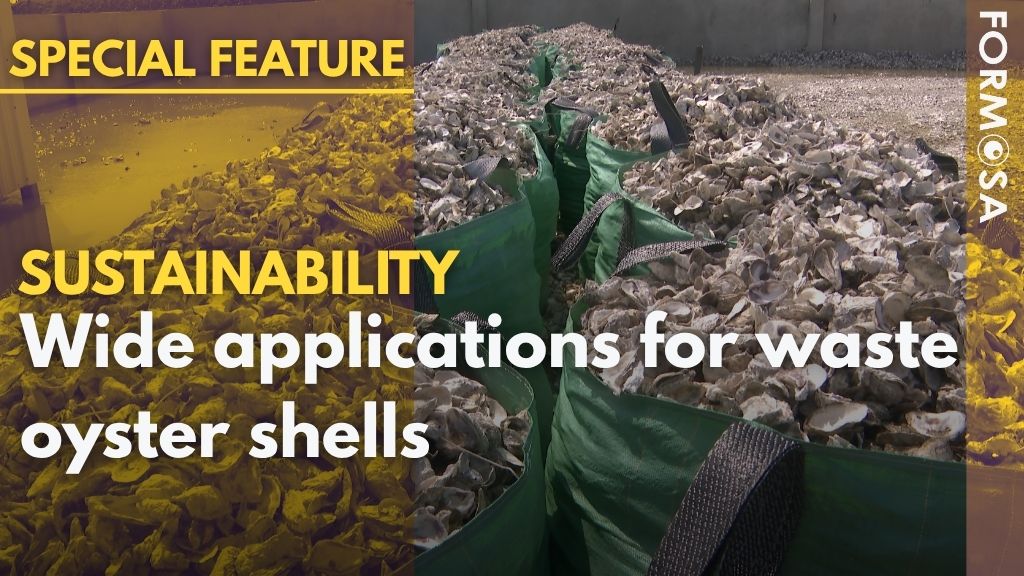
Discarded oyster shells recycled for a wide range of applications
Have you ever paused to think about where oyster shells end up when you’re enjoying a nice plate of oysters? Compared to the delicious flesh, the shells take up much more space. Instead of being left discarded and continuing to take up space, they could be used for so much more! Find out now, in our special report.
Every day, oyster farmer Chen Cheng-I pulls up his oysters from the pond to get sunlight. This makes it easier to remove algae from the shells and also allows him to check for flatworms.
Chen Cheng-i
Oyster farmer
This is a flatworm. It preys on oysters. Sunlight kills it. The sun also dries out and kills the algae growing on the shells. We don’t want flatworms to eat up the oysters.
Chen is a second-generation oyster farmer. Unlike previous generations farming oysters with racks installed on sea, Chen is experiment with oyster farming with aquaculture ponds. Although this method gives him a smaller yield, the quality ends up much better.
Chen Cheng-i
Oyster farmer
There’s nothing you can do about flatworms at sea, where there are plenty. If you farm oysters on sea, there’s no way for you to spread them out under the sun. But it’s much easier to do these things with ponds. Although the yield is smaller, the quality is relatively better.
Penghu’s oysters are best harvested between Dragon Boat Festival and Mid-Autumn Festival. Over this period, visitors flock here to enjoy fresh oysters delivered daily. Oyster farmers also pick up waste oyster shells when shipping their goods.
This large, white mound is entirely comprised of oyster shells. This Penghu’s westernmost Xiyu Township. Around 100 tons of waste oyster shells are piled up here every year.
Hsu Kuai-le
Xiyu Township cleaning team
You can’t dispose of oyster shells immediately. They need some washing from the rain and sun-drying. That way, you can get rid of the odor and germs.
The shells need to be exposed to the elements for at least half a year to get cleaned and have the organic matters fully composted. Only then can they be disposed of.
Xiyu isn’t the only place with an oyster shell storage site in Pengu. They’re also in Magong City and Baisha Township. Around 2,000 tons of waste oyster shells are generated in Penghu every year.
The shells actually have more uses than their humble appearance may suggest. They mainly made up of calcium carbonate, which has a wide array of applications in buildings, textiles and packaging. It can also be used as pharmaceutical filler. All these uses are already being applied on Taiwan proper, and Penghu does in fact export clean waste shells to the main island. But there will always be waste shells. Therefore, in 2024, the Penghu Fishery Research Center started running a small-scale processing site.
The shells are fed into a storage tank, then ground up, dried, and packaged by grit size. This NT$3.7 million site in Xiyu can process 30% of all the waste oyster shells in the county, or around 700 tons. The resulting product can then be applied locally.
Hernyi Hsieh
Penghu Fishery Research Center
Over in Taiwan, they use it to improve soil quality or in fertilizers, or in other higher-end applications. There’s already a supply chain around it there, but not in Penghu. So we’re trying to figure out how to turn this material into something useful. It’s not trash. It’s just not given the treatment it deserves.
Here at Lintou Beach, this entire wall looks like it’s made of coral stones, but it’s not. The coral-shaped building blocks are made with molded oyster shell powder. The Penghu Fishery Research Center replicated the look of Penghu’s traditional building material and reduced waste at the same time.
Lu I-lin
Penghu Fishery Research Center
Take this 10kg piece. Around 60% or more of it is oyster shell.
The composition of oyster shells makes them a substitute for cement, reducing the environmental impact of mining. Using them in construction also helps use up a great amount of the shells. However, oyster shells contain chloride, which is corrosive. To use them in construction, the shells must be left in the open for at least half a year. Otherwise, the chloride could eventually compromise the building structure.
Lu I-lin
Penghu Fishery Research Center
Its physical properties are not necessarily weaker than cement, so we’re thinking about using it as a building material. However, a new building material will have to comply with safety codes, which requires the introduction of relevant laws. So it’s going to be a long way because it also has to do with legislation.
Even though oyster shells are not yet approved as a main construction material, some are already making plaster with them.
Tsai Shan
Local rejuvenation project manager
This is our rejuvenation site. It’s called “GO Nan’ao.” We demonstrate the applications of oyster shell powder here.
The plaster is made of shell powder is mixed with water and a binder. Just spread it over the wall like you would with paint. The material can quickly absorb and release excess moisture, preventing water damage to walls.
Kuo Wen-yih
CEO of materials company
They have diatomaceous earth, or DE in Japan. The material made with the calcium carbonate from oyster shells can become Taiwan’s very own DE.
Nan’ao Township in Yilan has a humid climate. Most residential buildings here, especially older ones, often suffer leakage problems.
Tsai Shan
Local rejuvenation project manager
There’s a lot of leakage here. And this spot is also starting to crack. It’s already bulging. It gives off a different sound, a bit broken. This is how oyster shell powder works: you can see that the color’s darker here, which means there’s leakage. But there’s no bulging. After we turn on the AC or have ventilation, the color will lighten, meaning the moisture’s released.
Nine years ago, Tsai Shan returned to his hometown to film the renovation process of the old family home. His videos went viral and he gained a clientele. That’s how he got started as a rejuvenation project leader.
This row of houses near the train tracks are all over 50 years old. They used to be Taiwan Railway’s dorms for employees, but now they’re a demonstration site for Tsai’s project. He began using his oyster shell plaster on the fourth unit.
Tsai Shan
Local rejuvenation project manager
It’s like soil. Oyster shell powder can regulate moisture, just like soil. If you apply this plaster onto spots that have leakage in your old building, the moisture will be released if you have the AC or dehumidifier on. Then you won’t get cracks on your walls. I think that’s what makes this material so wonderful.
The plaster also helps regulate indoor temperature on a hot summer day, when it could easily be over 30 degrees outdoors.
Tsai Shan
Local rejuvenation project manager
When the sun is directly on top of the roof, heat will begin to be released. In the case of a cement building, you’ll need to use reflective paint at the top. We didn’t use reflective paint on any of these houses. This one here is less prone to overheating, because the plaster helps regulate the temperature. It also allows the temperature to cool down faster after turning on the AC.
The oyster shell plaster has wonderful properties, doesn’t contain formaldehyde and is environmentally friendly. But it’s a lot fussier than conventional paint, which can be applied straight from the can by one single person. This plaster has to be prepared before the paint job and requires many pairs of hands to use up. It takes a lot more time and effort than conventional paint.
Tsai Shan
Local rejuvenation project manager
It’s faster to use paint, and time is very important for our project. We have a strict deadline. With this plaster, we need 25 people and so many tools to use it all up and complete the paint job in a single day. It’s applied by spraying, and there are hard-to-reach spots. For these spots we must apply it manually.
A group of visitors from Taichung are trying out a DIY project, for which they pour an oyster shell mix into a mold to make a decorative item.
Hsiao Po-wen
Artisan
I knew that this material is used to improve soil quality or in fertilizers, but that’s not very profitable. So I thought I’d come up with an application to develop products that everyone would like. And so it got a creative use.
Hsiao Po-wen’s oyster shell crafting material, which he uses to make water-absorbent and heat-resistant place mats, became so successful, it’s not only loved by tourist, but also the National Palace Museum. He was commissioned to develop museum gift products for a special exhibition.
Hsiao Po-wen
Artisan
This is the place mat made for the National Palace Museum. The exhibition was on Tongan ships, so we incorporated the design and made a very special and exquisite product. It also has a lot of added value.
The exterior of Hsiao’s seaside home also uses oyster shell plaster, making it stand out from all the other houses in the area.
Kuo Wen-yih
CEO of materials company
If we apply it to the exterior, then it becomes characteristic of Penghu. It’s like how things were in the past, when people would build with locally available materials. But our materials are more durable. We’re all promoting sustainability today, and this is one way to go about it.
Now you know where the shells could go, instead of straight to the landfill. The shells are showing us a way to make better use of what nature has to offer.
For more Taiwan news, tune in:
Mon to Fri at 9:30 pm on Channel 152
Tue to Sat at 1 am on Channel 53
#circulareconomy #oysters #freshoysters #shells #seashells #seafood #sustainability
2026-03-05