Discarded oyster shells recycled for a wide range of applications
Discarded oyster shells recycled for a wide range of applications
2026-03-05
Have you ever paused to think about where oyster shells end up when you’re enjoying a nice plate of oysters? Compared to the delicious flesh, the shells take up much more space. Instead of being left discarded and continuing to take up space, they could be used for so much more! Find out now, in our special report.
Every day, oyster farmer Chen Cheng-I pulls up his oysters from the pond to get sunlight. This makes it easier to remove algae from the shells and also allows him to check for flatworms.
Chen Cheng-i
Oyster farmer
This is a flatworm. It preys on oysters. Sunlight kills it. The sun also dries out and kills the algae growing on the shells. We don’t want flatworms to eat up the oysters.
Chen is a second-generation oyster farmer. Unlike previous generations farming oysters with racks installed on sea, Chen is experiment with oyster farming with aquaculture ponds. Although this method gives him a smaller yield, the quality ends up much better.
Chen Cheng-i
Oyster farmer
There’s nothing you can do about flatworms at sea, where there are plenty. If you farm oysters on sea, there’s no way for you to spread them out under the sun. But it’s much easier to do these things with ponds. Although the yield is smaller, the quality is relatively better.
Penghu’s oysters are best harvested between Dragon Boat Festival and Mid-Autumn Festival. Over this period, visitors flock here to enjoy fresh oysters delivered daily. Oyster farmers also pick up waste oyster shells when shipping their goods.
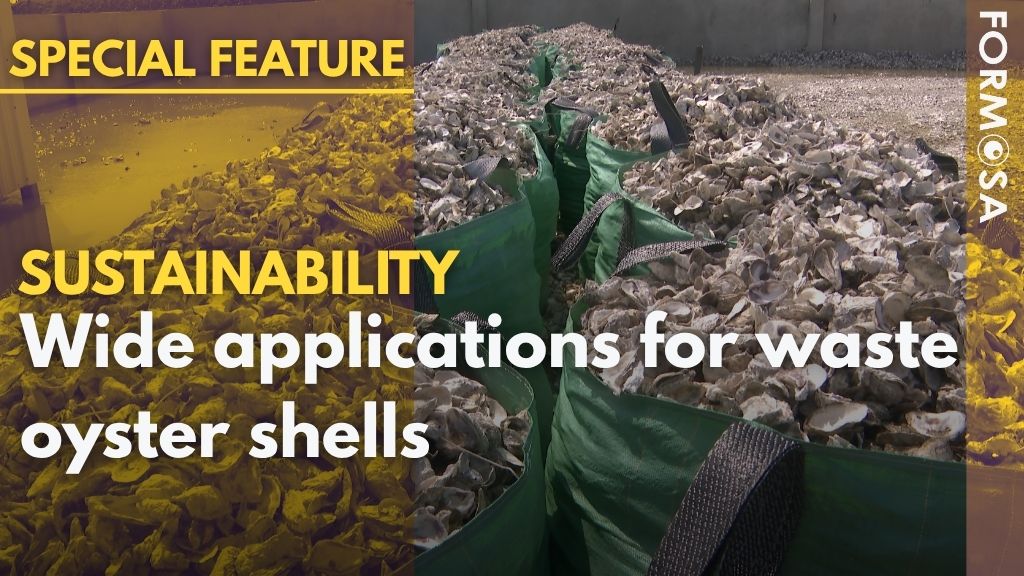
This large, white mound is entirely comprised of oyster shells. This Penghu’s westernmost Xiyu Township. Around 100 tons of waste oyster shells are piled up here every year.
Hsu Kuai-le
Xiyu Township cleaning team
You can’t dispose of oyster shells immediately. They need some washing from the rain and sun-drying. That way, you can get rid of the odor and germs.
The shells need to be exposed to the elements for at least half a year to get cleaned and have the organic matters fully composted. Only then can they be disposed of.
Xiyu isn’t the only place with an oyster shell storage site in Pengu. They’re also in Magong City and Baisha Township. Around 2,000 tons of waste oyster shells are generated in Penghu every year.
The shells actually have more uses than their humble appearance may suggest. They mainly made up of calcium carbonate, which has a wide array of applications in buildings, textiles and packaging. It can also be used as pharmaceutical filler. All these uses are already being applied on Taiwan proper, and Penghu does in fact export clean waste shells to the main island. But there will always be waste shells. Therefore, in 2024, the Penghu Fishery Research Center started running a small-scale processing site.
The shells are fed into a storage tank, then ground up, dried, and packaged by grit size. This NT$3.7 million site in Xiyu can process 30% of all the waste oyster shells in the county, or around 700 tons. The resulting product can then be applied locally.
Hernyi Hsieh
Penghu Fishery Research Center
Over in Taiwan, they use it to improve soil quality or in fertilizers, or in other higher-end applications. There’s already a supply chain around it there, but not in Penghu. So we’re trying to figure out how to turn this material into something useful. It’s not trash. It’s just not given the treatment it deserves.
Here at Lintou Beach, this entire wall looks like it’s made of coral stones, but it’s not. The coral-shaped building blocks are made with molded oyster shell powder. The Penghu Fishery Research Center replicated the look of Penghu’s traditional building material and reduced waste at the same time.
Lu I-lin
Penghu Fishery Research Center
Take this 10kg piece. Around 60% or more of it is oyster shell.
The composition of oyster shells makes them a substitute for cement, reducing the environmental impact of mining. Using them in construction also helps use up a great amount of the shells. However, oyster shells contain chloride, which is corrosive. To use them in construction, the shells must be left in the open for at least half a year. Otherwise, the chloride could eventually compromise the building structure.
Lu I-lin
Penghu Fishery Research Center
Its physical properties are not necessarily weaker than cement, so we’re thinking about using it as a building material. However, a new building material will have to comply with safety codes, which requires the introduction of relevant laws. So it’s going to be a long way because it also has to do with legislation.
Even though oyster shells are not yet approved as a main construction material, some are already making plaster with them.
Tsai Shan
Local rejuvenation project manager
This is our rejuvenation site. It’s called “GO Nan’ao.” We demonstrate the applications of oyster shell powder here.
The plaster is made of shell powder is mixed with water and a binder. Just spread it over the wall like you would with paint. The material can quickly absorb and release excess moisture, preventing water damage to walls.
Kuo Wen-yih
CEO of materials company
They have diatomaceous earth, or DE in Japan. The material made with the calcium carbonate from oyster shells can become Taiwan’s very own DE.
Nan’ao Township in Yilan has a humid climate. Most residential buildings here, especially older ones, often suffer leakage problems.
Tsai Shan
Local rejuvenation project manager
There’s a lot of leakage here. And this spot is also starting to crack. It’s already bulging. It gives off a different sound, a bit broken. This is how oyster shell powder works: you can see that the color’s darker here, which means there’s leakage. But there’s no bulging. After we turn on the AC or have ventilation, the color will lighten, meaning the moisture’s released.
Nine years ago, Tsai Shan returned to his hometown to film the renovation process of the old family home. His videos went viral and he gained a clientele. That’s how he got started as a rejuvenation project leader.
This row of houses near the train tracks are all over 50 years old. They used to be Taiwan Railway’s dorms for employees, but now they’re a demonstration site for Tsai’s project. He began using his oyster shell plaster on the fourth unit.
Tsai Shan
Local rejuvenation project manager
It’s like soil. Oyster shell powder can regulate moisture, just like soil. If you apply this plaster onto spots that have leakage in your old building, the moisture will be released if you have the AC or dehumidifier on. Then you won’t get cracks on your walls. I think that’s what makes this material so wonderful.
The plaster also helps regulate indoor temperature on a hot summer day, when it could easily be over 30 degrees outdoors.
Tsai Shan
Local rejuvenation project manager
When the sun is directly on top of the roof, heat will begin to be released. In the case of a cement building, you’ll need to use reflective paint at the top. We didn’t use reflective paint on any of these houses. This one here is less prone to overheating, because the plaster helps regulate the temperature. It also allows the temperature to cool down faster after turning on the AC.
The oyster shell plaster has wonderful properties, doesn’t contain formaldehyde and is environmentally friendly. But it’s a lot fussier than conventional paint, which can be applied straight from the can by one single person. This plaster has to be prepared before the paint job and requires many pairs of hands to use up. It takes a lot more time and effort than conventional paint.
Tsai Shan
Local rejuvenation project manager
It’s faster to use paint, and time is very important for our project. We have a strict deadline. With this plaster, we need 25 people and so many tools to use it all up and complete the paint job in a single day. It’s applied by spraying, and there are hard-to-reach spots. For these spots we must apply it manually.
A group of visitors from Taichung are trying out a DIY project, for which they pour an oyster shell mix into a mold to make a decorative item.
Hsiao Po-wen
Artisan
I knew that this material is used to improve soil quality or in fertilizers, but that’s not very profitable. So I thought I’d come up with an application to develop products that everyone would like. And so it got a creative use.
Hsiao Po-wen’s oyster shell crafting material, which he uses to make water-absorbent and heat-resistant place mats, became so successful, it’s not only loved by tourist, but also the National Palace Museum. He was commissioned to develop museum gift products for a special exhibition.
Hsiao Po-wen
Artisan
This is the place mat made for the National Palace Museum. The exhibition was on Tongan ships, so we incorporated the design and made a very special and exquisite product. It also has a lot of added value.
The exterior of Hsiao’s seaside home also uses oyster shell plaster, making it stand out from all the other houses in the area.
Kuo Wen-yih
CEO of materials company
If we apply it to the exterior, then it becomes characteristic of Penghu. It’s like how things were in the past, when people would build with locally available materials. But our materials are more durable. We’re all promoting sustainability today, and this is one way to go about it.
Now you know where the shells could go, instead of straight to the landfill. The shells are showing us a way to make better use of what nature has to offer.
For more Taiwan news, tune in:
Mon to Fri at 9:30 pm on Channel 152
Tue to Sat at 1 am on Channel 53
#circulareconomy #oysters #freshoysters #shells #seashells #seafood #sustainability
廢棄蚵殼堆積成山 化身建材和藝術品 開啟循環重生路
2026-03-05
您可曾想過,每一顆鮮甜蚵仔的背後,是一個又大又重的牡蠣殼,它們的去向如何?在澎湖,這些蚵殼被大量堆置,形成一座座白色山丘,不僅佔地,也帶來環境問題,但其實,這些牡蠣殼是由碳酸鈣組成,可做成飼料、服飾以及建材,價值不容小覷。去年農業部澎湖水試所在西嶼鄉建製小型的去化工場,去化量可達六成,帶您來看看。
蚵農陳正一每天都像這樣,把牡蠣從水裡拉起來曬太陽,一方面可以清除長在牡蠣上的水藻,另一方面也可以看看,有沒有牡蠣的天敵出現。
[[牡蠣農 陳正一]]
“這就是蚵仔的天敵-扁蟲,就把牠曬死,把牠上面一些雜草,曬死曬乾,蚵蛭怕牠把蚵仔吃光。”
陳正一是蚵農第二代,他有別於家族傳統,外海棚架式的養殖法,大膽嘗試在比較小的魚塭裡養殖,雖然產量少,但品質顧得到。
[[牡蠣農 陳正一]]
“扁蟲他是無解,因為外海牠養殖量比較大,你也不可能說,全部讓牠拿起來曬,可是你在漁塭裡面,比較方便作業,雖然量比較小,可是牠的品質會相對比較好。”
每年端午節到中秋節前夕,正值澎湖牡蠣最肥美的季節,吸引大批遊客嚐鮮,蚵農每天新鮮直送,也將饕客吃剩的蚵殼載去回收。
眼前這座白色山丘,都是牡蠣殼堆積的。這裡是澎湖最西邊的西嶼鄉,每年大約有100噸的廢棄牡蠣殼,被堆置於此。
[[澎湖西嶼鄉公所清潔隊隊長 許快樂]]
“蚵殼進來不能馬上處裡掉,要讓雨水沖刷跟曝曬,把一些味道還有上面的微生菌給清除乾淨。”
被堆置的牡蠣殼要放至少半年,讓太陽跟雨水,把殘肉或是其他有機質分解掉,才可以進行清運。
除了西嶼鄉,馬公市與白沙鄉,也都有蚵殼暫置場。在澎湖,每年約有2000噸的廢棄蚵殼。
然而,這些看似無用的廢棄蚵殼,其實是個寶,由於牡蠣殼是天然碳酸鈣,不僅可用於建築、紡織、包材等產業,也可當作藥錠的賦形劑,應用範圍廣,在台灣已廣泛利用。但在澎湖,一直以來都是整批銷往台灣,給廠商做後續利用,但送走了一批,還是會持續堆積,因此2024年農業部澎湖水試所,就開始做小規模的去化。
白色蚵殼進入收集槽,經粉碎、烘乾,最後製成不同顆粒的粉末包裝,這裡是水試所編列370萬元,在西嶼鄉建置的小型去化場,每年可處理全縣三成,大約是700噸的廢棄蚵殼,讓澎湖的牡蠣殼做在地應用。
[[水試所澎湖研究中心研究員 謝恆毅]]
“因為台灣他們後段的利用,把它做成土質改良、肥料,或是一些其他的高端用途,已經有很明顯的產業鏈在操作了,澎湖一直沒有,所以我們就在思考,如何讓這些有用的資材,它不是垃圾,它是被時間跟空間,不當棄置的資材。”
來到林投沙灘,眼前的這一面牆,是珊瑚造型的磚牆,其實它們並非真的珊瑚,而是以牡蠣殼粉重塑而成,水試所仿造澎湖早期咾咕石的建築風貌,保留在地文化。
[[水試所澎湖漁業生物研究中心聘用技師 呂逸林]]
“假設這是10公斤好了,它可以用掉的牡蠣殼,大概有60%左右,甚至可以更高。”
事實上,牡蠣殼可以取代水泥中的碳酸鈣,不僅能減少挖礦帶來的碳排,蚵殼的去化量也很可觀,不過牡蠣殼來自海中,本身含有氯離子,若要應用在建材上,必須要經過至少半年的曝曬,讓陽光跟雨水帶走殼中的氯離子,否則若直接灌漿,恐會像「海砂屋」一樣出現結構剝落受損的情形。
[[水試所澎湖漁業生物研究中心聘用技師 呂逸林]]
“它的一些物理表現,其實某些特質不見得會比水泥差,所以我們就想把它拿來當作建材上的運用。問題是,如果我們用到一些結構性建材的時候,它會涉及到安全結構的一些審核,所以它需要有一些法規的同意,基本上它是一個比較漫長的路,因為它會涉及到修法。”
雖然法規目前還不能讓牡蠣殼做為建築主材料,但還是有人把牡蠣殼做為取代油漆的塗料。
[[地方創生青年 蔡山]]
“這邊是我們創生聚落,現在叫「南澳出花」的基地,我們這間就是使用到「蚵灰」材料的示範的場所。
將蚵灰加入黏著劑跟水調和,就可以塗在牆壁上,跟油漆一樣粉刷牆面,專家就是看中蚵灰具有吸濕排水的功能,可以防壁癌。
[[材料公司執行長 郭文毅]]
“我們都聽過日本有硅藻土,台灣的這些蚵殼碳酸鈣的材料,我們也可以把它當作是台灣的硅藻土來做使用。”
來到宜蘭南澳,這裡氣候潮濕,所以這裡的房子,特別是老屋 容易有漏水的狀況。
[[地方創生青年 蔡山]]
“像這邊也是很常漏水,所以你看這邊已經岌岌可危了,開始凸起來,摸的聲音就不一樣,就是摸就會破破的。蚵灰上在用的時候,你可以看到,這個顏色雖然它是深的,代表說這邊會漏水,可是它不會凸起來,等到我們開冷氣,或是有通風的時候,顏色就會再降回淺色,代表它的水又排掉。”
蔡山九年前從外地返鄉,原本拍片,想記錄自己修繕老屋的經過,沒想到影片爆紅,許多人找他修老屋,也因為修繕老屋,意外讓他成為地方創生青年。
這一排鄰近鐵軌的平房,屋齡都超過50年,原本是台鐵宿舍,如今已搖身一變,成為地方創生的聚落,推手就是蔡山。當初整修時,第四間房屋就是使用蚵殼粉,也就是「蚵灰」做塗料。
[[地方創生青年 蔡山]]
“它就類似土壤,加上蚵殼,所以它是像土一樣會吸濕、排濕,所以就算你的老屋有漏水,它也會在漏水的地方,如果你有開冷氣或除濕,它會自己排掉,它就不會有爆開的問題,其實也是一種,我們覺得這個材料很神奇的地方。”
夏日炎熱的午後,高溫動輒三十幾度,蚵灰塗料還能降溫。
[[地方創生青年 蔡山]]
“當太陽落在屋頂的時候,它會開始放熱,水泥建築來說,除非你塗反光塗料在屋頂,我們每間都沒有塗,但是就只有這間,它相對來說耐熱,因為它的溫度下來之後,會先被這個土壤先吸收,所以會相對會比較耐熱,還有冷氣開了之後效率會更好。”
蚵灰塗料能防止漏水造成的壁癌,也免去頻繁粉刷的困擾,又不會釋放甲醛,雖是友善環境的綠建材,但相較於一般調配好的油漆,僅需一人就能完成,蚵灰則需要自行調配,便利性不夠,也必須仰賴多人一起施作,人力與技術都較一般油漆費工。
[[地方創生青年 蔡山]]
“有些是油漆會比較快,因為我們在改造的時候,是有時效性,需要在幾月之前做完,但是這個材料相對來說,你看我們要25個人一天,要一堆道具、塗料,然後全部都準備好,才有辦法一天全部噴完,後續有些地方噴不到的,還是得用手去抹,相對來說需要大量的人力。”
來自台中的遊客們,正在體驗DIY活動,他們倒在量杯裡的,正是蚵殼粉末,經混入膠合溶劑,再倒入模具塑型,一件實用的藝術品就完成了。
[[蚵殼藝術家 蕭博文]]
“當初我知道的,它只能夠應用在土壤改質,還有做成肥料或者飼料,這個經濟價值不高。我先來試看看,怎麼樣變成每個人都喜歡,或者是說可以應用在,各個方面的產品,我就把它做成文創。”
為了提高牡蠣殼的經濟價值,住在澎湖的蕭博文,以文創品為發想,沒想到受到遊客喜愛,特別是吸水隔熱墊,吸引故宮下單,並要求依據當時特展做客製化商品。
[[蚵殼藝術家 蕭博文]]
“故宮的隔熱墊,也是因為這一次展出同安船的元素,我們把它做成一個很細緻的設計,變成一個很有特色,然後也很精緻的產品,它的價值的空間也比較高。”
鄰海僅百公尺的蕭博文住家,內外牆也使用蚵灰塗料,外觀與其他房子相比明顯不同。
[[材料公司執行長 郭文毅]]
“我們用於它的外觀的話,當然就是說,它會形成澎湖在地的特色,其實有點回到過去,就地取材的建築方式,但是我們讓這些材料能夠更耐久,我們現在在談永續之島,是比較能夠接近理想的方向。”
當我們享受美味鮮蚵時,那一顆顆被剝落的牡蠣殼最終何去何從?蚵殼堆起的不只是白色山丘,更是人類與環境的反思,大自然給的每一份資源,並非一次性的消耗,而是循環再生的可能。
更多新聞內容,請鎖定:
民視台灣台(152頻道)週一至週五晚上9:30
民視新聞台(53頻道)週二至週六凌晨1:00
Related News