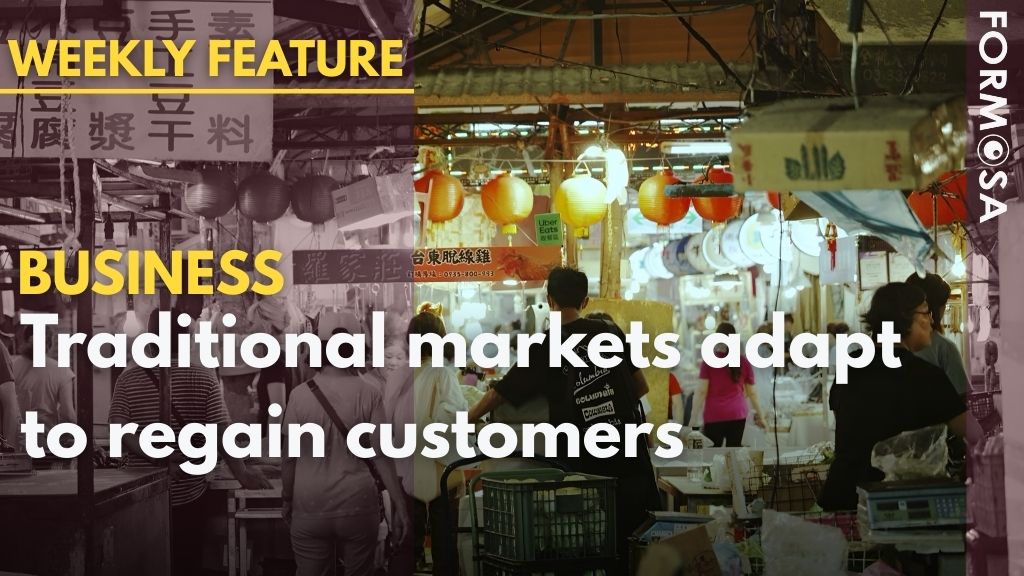
Traditional markets get modern revamp to attract customers
Due to unruly human behavior in its open-air structure, traditional markets are gradually losing customers to supermarket chains. According to the Ministry of Economic Affairs, more than 100 traditional markets closed in just two years, from 2021 to 2023. To reattract customers, governments are stepping in to revamp the facilities and vendors are also finding clever ways to gain new customers. Our weekly special report.
Pulling a trolley and fritting from one stall to another: this is A-ming, a retail-level fruit and vegetable vendor. Every morning, he goes to Sanchong Fruit and Vegetable Market to bulk buy what he’s planning to sell.
He stacks boxes upon boxes of produce onto the trolley, then takes them over to his truck in the parking lot. It usually takes several trips back-and-forth to get everything he needs.
Loading his truck under the hot summer weather is quite some serious workout. Some vendors couldn’t bear to see him having to work so hard, so they try to make things easier by pre-packaging the goods. Others even help A-ming transport the boxes over with their own scooters. That saves him a number of trips.
Many people enjoy shopping at traditional markets for the social aspect. However, traditional markets all over Taiwan are in decline, losing customers and even forced to close in some cases.
According to the Ministry of Economic Affairs, from 2021 to 2023, the number of government-owned markets fell from 486 to 438. The decline is even steeper with privately-owned markets, from 215 to 153. In total, more than 100 markets have shut down in just two years.
It’s likely some shoppers are put off by those inconsiderate people, and coupled with the rise of supermarket chains and hypermarkets, many customers would rather opt for those instead. Is modernizing traditional markets, and thereby improving the shopping experience, the solution?
As soon as one walks in, they’re greeted by the cool AC. This is Wugu Market in New Taipei, where A-ming runs his fruit and vegetable stall. It’s not only well-lit and comfortable. The vendors also try to provide a better experience themselves. A-ming and his wife Elsa clearly put a lot of thought into product display.
Elsa
Fruit and vegetable vendor
We have different layers as opposed to having everything on one flat surface before. We noticed that people may be overwhelmed when everything’s placed together, so we categorized our products in different layers to make it easier for them.
Established in 2022, Wugu Market is the first modernized, government-run traditional market in New Taipei. Stalls here are placed in designated areas for fresh produce, meats and prepared foods. Scooters are also not allowed inside, making for a comfortable and safe shopping experience.
A-ming
Fruit and vegetable vendor
The clearest difference is the AC. In traditional markets, when the weather’s hot, it really feels like a sauna. It’s really hot. Also drainage. We have well-designed drains with covers, whereas in traditional markets it’s the usual type that have many gaping holes, and residue like vegetable waste and other stuff will get inside, and cause blockage. When it’s really hot, the odor becomes worse.
Wugu Market’s modern facilities allow it to be free of the shortcomings plaguing traditional markets, but foot traffic there still can’t compare to markets past.
Ya-wen
Pork vendor
I can’t manage to sell the day’s inventory. Sometimes I make sausage from those pork, and also cured meat. For the shoulder, we turn that into sliced meat for hotpots. And pork belly can be made into bacon.
Ya-wen has run a pork stall for over 20 years. She applied for a spot at Wugu Market when it opened because rent was cheap. But she didn’t expect the decline in shoppers after the initial opening period. Many vendors have already left.
Ya-wen
Pork vendor
In the beginning there were more than 100 vendors. But after the number of customers fell, vendors left too.
At the time of filming, we noticed that the signboards from those previous vendors remained, but their spots were taken over as storage or made into dining areas. And with less vendors, the number of customers also dropped.
Customer
Some people enjoy shopping at markets because they like to look around for things to buy, but there aren’t as many vendors or products available here anymore.
Why is it so hard to attract customers even though the facilities are much better?
Wu Yi-shin
National Sun Yat-sen University assistant professor
Most people seem to redesign markets on the premise that consumer habits have changed when that’s not the case.
Dr. Wu Yi-shin believes instead that consumer habits are hard to change. For example, modernized markets with AC may be more pleasant for pedestrians, but because scooters aren’t allowed inside, a great proportion of customers and older adults are left out. That greatly shrinks vendors’ customer base.
Wu Yi-shin
National Sun Yat-sen University assistant professor
I think they can start with allowing scooters inside, but with rules in place. I believe that would be a good start. It’s less abrupt than banning them altogether. Begin by putting a speed limit on scooters and make scooter riders build a new scooter etiquette, then move on to the next stage. People with scooters will be better behaved and that makes it easier to implement traffic control.
Because of its proximity to industrial zones and a redevelopment zone, the local population is still quite small. To attract customers, the vendors’ association often hands out vouchers on weekends or organizes family activities to create incentives to locals to drive over to shop. Additionally, being close to highway exits also brought them customers through partnerships with tour groups, and turn the market into a rest stop of sorts.
Chen Wen-sun
Wugu Market vendors’ association head
Wugu’s tourism is mainly centered on our Guanyinshan National Scenic Area. Many visitors come from Central and Southern Taiwan and stop here to rest. They can have meals, do some shopping and rest a bit before going back on the road.
While the vendors’ association launches campaigns to attract customers, individual stalls try to get them to make a purchase.
Ya-wen noticed that her customers are usually small families in the nearby redevelopment zones. They buy little and don’t cook very often. So she began offering sausages and vacuum-packed ingredients that suit those customers better, and has since gained a steady clientele.
Ya-wen
Pork vendor
I’ve been here for almost three years now. I have a steady customer base and also my own Line open chat group. My customers order from there and we also try to offer products, such as vacuum-sealed meat that they can order straight from the chat.
Meanwhile, A-ming approached many eateries outside when he’s not taking care of the stand. He now has several long-term contracts, and clients like working with him because he has machinery that can quickly prepare chopped green onions, ginger and chili. A diverse clientele improved his business.
A-ming
Fruit and vegetable vendor
Sometimes there are really so few customers. In this situation you must come up with solutions. So I approach restaurants and we also do deliveries and group-buying. I deliver to the nearby Zhouziyang redevelopment zone, and also Sanchong and Xinchuang, because I live in Sanchong and I can do deliveries on my way home. So there are ways to get more customers.
Vendors at Wugu Market have to do more than traditional retail-level outdoor markets, and even reaching customers beyond the market building. But A-ming has no complaints. He says he believes it’s only a matter of time for vendors to have to adapt to new business practices. He also says he observes local markets on holidays to Japan and South Korea.
A-ming
Fruit and vegetable vendor
The markets there are now all renovated, have AC and are all pretty clean, which is closer to what we have here. But they try to keep a retro vibe, meaning they combine the old and the new, while prioritizing cleanliness and tidiness. But our modernized markets may still feel off for older generations or people who are used to traditional markets. But I also think it’s a matter of habit. If you visit certain sellers often, you’ll eventually develop a cordial relationship with them. You just have to take the first step inside here.
Newer markets may no longer look like they used to, but it’s all for a better customer experience. They also offer a more social experience even when chain stores are gradually taking over.
For more Taiwan news, tune in:
Mon to Fri at 9:30 pm on Channel 152
Tue to Sat at 1 am on Channel 53
#shopping #markets #consumertrends #taoyuan #nanmenmarket
2026-03-10