Social isolation suggested as common, crucial risk factor of mass violence
Social isolation suggested as common, crucial risk factor of mass violence
2026-06-11
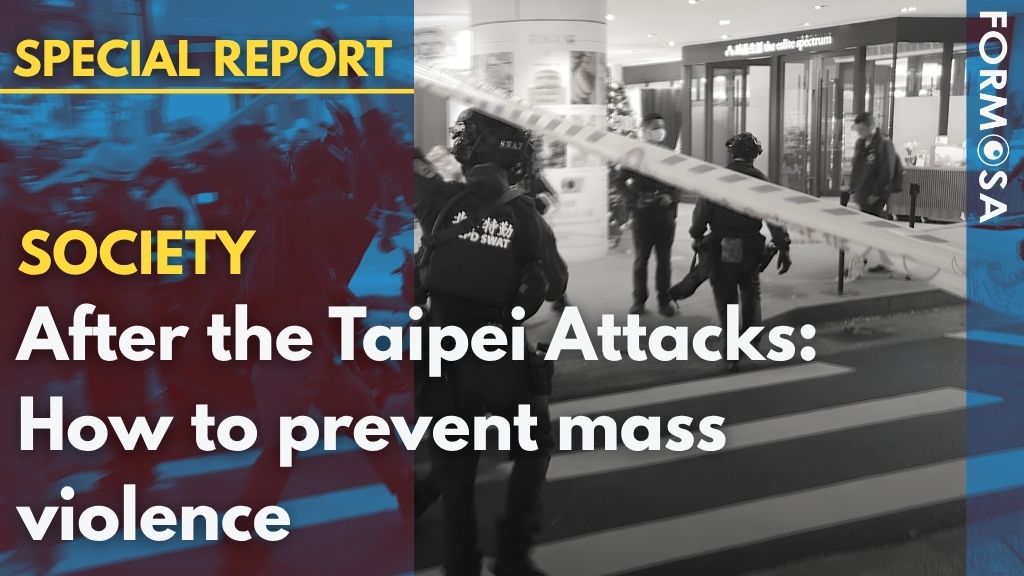
During rush hour on Friday Dec. 19, 2025, a man conducted a mass killing spree at Taipei Main Station exit and at a department store next to MRT Zhongshan Station. He killed three and injured 11. The attacker died immediately after jumping off the building. Cases of mass violence may be relatively rare in Taiwan, but they’re worrying all the same. More so, because they indicate larger societal and structural risk factors that played a part in driving the attackers to violence. So what exactly is the socio-psychological root of mass violence? Let’s find out now in our Special Report.
In 2021, on the night of Halloween, screams erupted on a Keiō Railway train in Tokyo, Japan. A man dressed up as a clown conducted mass stabbing of fellow passengers, and arson. A total of 18 were injured.
Earlier, in 2014, another stabbing spree took place outside a subway station in Chiba Prefecture. The perpetrator attacked four passers-by, leaving one injured and another dead.
Since the 1990s when Japan began formally documenting statistics of mass killing events, at least one would occur every year. There were 14 such cases in 2008 alone.
The most chilling of all was the 2008 Akihabara massacre. The perpetrator drove a mini-truck and rammed through the pedestrian area. Then he exited the vehicle and began stabbing. Within five minutes, he killed seven and injured 10.
Witness
2008 Akihabara massacre
The mini-truck ran over three people. It didn’t look like an accident. It ran over about three people in high speed.
The perpetrator of the 2008 Akihabara massacre was a 25-year-old contract worker. His dissatisfaction with employment and personal life drove him to violence.
Tai Shen-feng
Professor of Criminology, CCU
The perpetrator in this case was unhappy that full-time employees had their own desks and lounge, while contractors like him had to squat in a corner or gather in a separate space to eat their bentos. It’s this feeling of differential treatment that made him feel marginalized very deeply. The last thing that happened to him was when he couldn’t find his work gear. Someone left it in the restroom. That’s a rather extreme example of social rejection, which aggravated him. He likely thought, “since society doesn’t care about me, what’s wrong with me annihilating others?”
In Taiwan, such cases of indiscriminate killing, in which victims were targeted at random, gained widespread attention in 2012, following a brutal case of child murder at a game arcade.
Tai Shen-feng
Professor of Criminology, CCU
“Indiscriminate” here is a direct Japanese loan word. Of course it differs from our concept. It’s not really indiscriminate. Someone will have to get close enough to get killed. Taiwan has very strict gun control, so it’s not possible to do this from a distance. Rather, it’s a form of mass murder in a very short period, causing a great number of casualties in a very short period.
Call it indiscriminate killing, random killing or more accurately, mass murder, this form of homicide are all characterized by a stranger relationship between the perpetrator and victims. Anyone in a public space could be randomly attacked.
Hsu Fu-sheng
Central Police University dean
Think about it. You happen to be walking down the street only to get stabbed and killed by a complete stranger. That sense of fear. I believe anyone would be frightened. That’s why random killings or indiscriminate killings cause such great terror.
On the afternoon of May 21, 2014, a stabbing spree erupted on the Taipei MRT’s Blue Line. The attacker was quickly captured at Jiangzicui Station by the police and members of the public, but he still caused four deaths and 24 injured. Shock and fear quickly rippled through society at the wake of the incident.
Little by little, people in Taipei dropped their guards. But exactly ten years later, on the same day in 2024, a similar knife attack took place on the Taichung MRT.
Fortunately, no one lost their lives this time, thanks to brave passengers. But very soon, on Dec. 19 the following year, Taipei MRT was again the site of violent crime.
Tai Shen-feng
Professor of Criminology, CCU
The way the crime was carried out this time around at the Taipei MRT was even more sophisticated. He had exhibitive props, such as the addition of smoke bombs, which he used in an attempt to create terror. He killed those who stood in the way of his criminal plan, those who he perceived as obstructions. We can reasonably deduce that the perpetrator thought those he killed were those who obstructed him from taking the next steps. For example, sometime stopped him from lighting up the Molokov cocktail, or maybe someone caused him the trouble of having to go through traffic before he could enter the store. His killings were done to eliminate those obstructions.
This time around, the perpetrator killed three pedestrians and injured 11 within three hours. He also died after jumping off a building during a police chase. All three instances of mass attacks on the metro were astoundingly similar in execution.
Hsu Fu-sheng
Central Police University dean
The commonalities, I guess, are that all of them chose public spaces, targeted complete strangers and instilled widespread fear and panic. The perpetrators often choose highly visible public places, train station and the metro are typical examples. The action must be shocking, and it was especially so this time around. The key is to instill fear in everyone.
Sadness, fear and rage were in everyone’s heart after the tragedy, but also questions. Why did all three attackers target strangers without any regard?
Hsu Fu-shen
Central Police University dean
Speaking of the perpetrator Cheng, he did well in high school, at Banqiao Senior High. He later attended the National Defense University but got expelled, and then he transferred to Tunghai University, and became interested in killing others. It’s worth noting these shifts. It’s the same with Chang in the recent incident. He also did well in high school and university, but he experienced a major setback when he was dismissed from the military after being caught drunk-driving. And he only stayed on his next job as a security guard for a year. In the year or so afterwards, he started planning the mass murder. What was the impetus? At which point was he completely abandoned by our society and its systems and institutions, which in turn motivated him to commit this form of lone actor terror?
Only the perpetrators themselves can fully explain their motivation. But Cheng of the 2014 attacks was executed in 2016, while Chang of 2025 plunged to death immediately. Only the Taichung MRT attacker, sentenced to nine years and nine months in prison, could serve as a research subject.
Tai Shen-feng
Professor of Criminology, CCU
In the Taichung MRT incident, the attacker survives. After analyzing lots of data, we discovered that the attacker had trouble adapting in new stages of life. He experienced difficulties at home and in school. He felt bullied in school. The attack was his way of avenging, which he saw as an exercise of justice. He sought justice, alright, but the method wasn’t ideal.
Chuang Yueh-hsiang
Flying Youth mentor
We’d describe this as the safety net in their heart fraying bit by bit. Once they lose their family, friends, colleagues, work, their support system would come undone little by little. Imagine that every individual is a web within a larger system. If every link snaps, the individual’s life is no longer supported. When someone becomes isolated to a certain extent, they become negative. When these negative thoughts accumulate, they’re expressed in harmful action, whether to the self or to others.
Researchers believe that instigators of mass murder at home were similarly motivated as those in Europe or Japan. They’ve all experienced, or rather perceived, great social rejection.
Tai Shen-feng
Professor of Criminology, CCU
What’s perceived social rejection? It’s when an individual believes that people around them are marginalizing them, despite otherwise. It’s a form of cognitive distortion. The individual may perceive others as targeting them in some way. That perception would aggravate feelings of hostility, and the intensification of such feelings could motivate the individual toward aggression.
In all three cases, the perpetrators were in their twenties, transitioning from campus life to the job market. It’s easy to perceive setbacks negatively during this critical period. Difficulties in life could lead to cognitive distortion, in which the individual believes they’re marginalized. From what the police gathered in Chang’s phone, it appeared that he was almost completely cut off from others.
Hsu Fu-sheng
Central Police University dean
In Chang’s case, I’d say it’s due to his personal dissatisfaction with life trajectories. I believe there are more and more people of this sort. Chang was dismissed from the military, he got another job, but he only stayed on it for a year. Little by little, he became isolated from society. Someone who’s dissatisfied with their life course may turn to random killing to assert their individual existence.
In all three cases, the perpetrators acted upon feelings of extreme social rejection. Experts believe these events hinted at a higher probability for similar incidents in the future.
Tai Shen-feng
Professor of Criminology, CCU
Now that we have three such cases, our society has to face a certain reality. It’s happened repeatedly, meaning there could be many more out there with similar fantasies, but dare not act them out yet. Or perhaps they might not have entertained such acts of violence before, but now they are. Could these people be emboldened to entertain, and even act out their violent fantasies? We certainly don’t want this to be true.
How can we prevent these negative feelings from being internalized, and in turn become the catalyst for violence? With increased evidence from research, the government has worked on bolstering the social safety net.
Hsu Fu-sheng
Central Police University dean
A Japanese study was conducted on random killing. It analyzed 52 cases. The researchers concluded that they’re all related to social isolation.
Chuang Yueh-hsiang
Flying Youth mentor
Now that we’re able to identify the cause, we can perhaps reflect on those around us. Someone may start acting strangely. They may speak less. Once these symptoms appear, we should think about how to intervene through care and action so that tragedies can be avoided.
It’s not enough to strengthen connections with one’s social circle. A long-time mentor for high-risk youth, reminded us not to incite hatred.
Chuang Yueh-hsiang
Flying Youth mentor
After a young person commits a crime, they may see comments on YouTube attacking them, calling them scum or trash, or wanting them to just die. But just think here: the law protects these youths and they could be released or rejoin society to work. If they do not develop self-awareness, or if they do not reflect on themselves, and internalize all the criticisms at them, they would take that as, “Yes, I am no good. I’m violent. I want to attack you. To those that once made me suffer, I’ll make you all suffer too!” All that hatred and fear only breed more fear.
The three lives lost on that fateful day in 2025, and many more before them, are scars in our collective memory. But even more than that, they forced us to open our eyes to interpersonal, societal and structural risk factors that catalyzed violence in the very first place. The perpetrators’ individual traits notwithstanding, we can also play a part in healing our communities and prevent another similar tragedy.
For more Taiwan news, tune in:
Mon to Fri at 9:30 pm on Channel 152
Tue to Sat at 1 am on Channel 53
#crime #criminology #psychology #sociology #highriskyouth
社會排斥感 心態扭曲隨機殺人 如何阻止悲劇發生
2026-06-11
2025年12月19日週末前夕下班時間,一名張姓嫌犯在台北車站出口,和中山站附近的誠品商場隨機殺人,造成3名無辜路人死亡,11人受傷,而張嫌也在逃逸過程中,墜樓身亡。相較於歐美和日本,這樣的犯罪類型在台灣發生比例更低,但有專家擔心,相似的手法,之後很有可能再出現。這也令人好奇,這些犯罪者為何會走上成「魔」路?而且可以對完全不認識的陌生人痛下殺手?除了台灣的案例,鄰近日本的情形又是如何?
2021年10月萬聖節當晚,日本京王線電車傳來乘客倉皇逃離的尖叫聲,一名裝扮成小丑模樣的男子,持刀無差別攻擊乘客,並且縱火,造成18人受傷。
時間再往前,2014年,日本千葉縣地鐵站前,發生男子持刀行搶,十分鐘內砍殺4名路人,造成一死一傷。
從1990年代有統計數字以來,日本每年都會發生這樣無差別殺傷的案件,尤其2008年就高達14件。
其中最引發討論的,就是「秋葉原殺人事件」,兇手開著小貨車衝撞秋葉原行人步區,下車後持刀犯案,在短短五分鐘造成7死10傷的慘劇。
[[秋葉原殺人事件目擊者]]
“小貨車壓過三個人,看起來不像是交通事故,在高速的狀態下輾過大約三個人。”
犯下「秋葉原殺人事件」的兇手,當時25歲,是一名派遣員工,因對工作和生活不滿,鑄下大錯。
[[中正大學犯罪防治所教授 戴伸峰]]
“為什麼你們(正職)都有自己的辦公桌、休息區,我們這些派遣就只能蹲在旁邊,或者只能集合在某一個空間裡面一起吃便當,這種差別的感受,讓他深刻的感覺到被排擠,直到最後他發生了一件事情,就是他自己的工作服不見了,被別人丟在廁所裡面,這個是非常社會拒絕的樣態,所以激發了他,既然社會已經不忠於我於前,我何妨毀滅你。”
而在台灣社會從2012年的湯姆熊殺童案開始,此種型態的犯罪,也日漸受到重視。
[[中正大學犯罪防治所教授 戴伸峰]]
“無差別這個名詞是日文借來,當然跟我們概念上也有一點點不太一樣,畢竟它不是真的無差別,它是接近才殺得到。台灣因為槍枝管制非常的嚴格,所以它沒有辦法用遠距的方法來做,應該叫做短期間內的,大規模殺人行為,短期間內的大量死傷事件。”
不論稱之為無差別殺人、隨機殺人,還是學者口中的,短期間內大規模殺人事件,這類犯罪型態,最大的特徵就是犯罪者和被害人之間,並不認識,人們走在路上,或在任何的公共空間,都可能遭到莫名攻擊。
[[中央警察大學行政警察學系系主任 許福生]]
“你想想看,我們走在路上,被一個完全不認識的人,被殺、被砍,那種恐懼感,我想任何人一定是很驚嚇的。所以這就是為什麼,隨機殺人或無差別殺人,會引起這麼大的恐慌。”
2014年5月21日下午,台北捷運板南線驚傳持刀隨機攻擊事件,雖然兇手在江子翠站,便被員警和民眾成功制伏,但悲劇已然發生,事件造成4死24傷,帶給台灣社會極大的恐懼和震撼。
隨時間流逝,台北民眾漸漸放下緊張,但就在北捷遭攻擊的十周年當天,2024年5月21日,台中捷運也發生了一起持刀隨機傷人案。
所幸在英勇乘客的阻止下,無人喪生,然而隔年12月19日,台北捷運再度被盯上。
[[中正大學犯罪防治所教授 戴伸峰]]
“北捷這一次的案件,犯罪的成熟度更高了,他使用了一個我們叫做「演出性道具」,增加了比方說煙霧彈,他意圖造成恐慌,他殺的都是阻礙他犯罪計畫執行的,在他眼中認定的阻礙者。我們合理推測,會不會是因為張姓嫌疑人,他覺得你擋了我要執行下一步,也許比方說,你害我沒有點燃汽油彈,你害我還要跨過車陣才能夠進去商場,類似這樣的行為阻礙,所引起的排除型的殺機。”
這一次 凶嫌的冷血行動在三個小時內,導致3名路人死亡、11人受傷,凶嫌也在逃亡過程中墜樓身亡。這三起隨機殺傷事件,發生在不同的時空、地點,但犯案手法卻有相似之處。
[[中央警察大學行政警察學系系主任 許福生]]
“共通性,我想,就是他選擇公共場所,針對陌生人,製造社會的恐慌。凶嫌選擇的場域常常是在公開,可見度高的公共場所,像這種車站、捷運,就是很典型的,這個行為它既有這種震撼性,尤其這次,這種產生大家的恐懼感,這個才是它很重要的核心。”
悲劇發生後,民眾的心裡除了哀傷、恐懼、憤怒,也有許多疑問。為何這三人都不惜對陌生人痛下殺手?
[[中央警察大學行政警察學系系主任 許福生]]
“就以鄭姓兇手來講,他在高中時候,讀板中還OK,去讀國防大學,被退學到東海,後來開始對殺人產生興趣,這樣機轉到底是什麼,值得我們去關注。包括這件,張嫌也是一樣,他讀的高中大學都還不錯,從他在當志願役酒駕之後被汰除,到只有短短一年的保全任職,之後這一年多,他就開始有計畫,要去殺人,這個機轉是什麼,到底哪一關被我們整個社會的系統體制拋棄,才會引伸他想要變成孤狼式的象徵性暴力。”
面對犯下罪刑的鄭姓兇手與張嫌,專家學者還有無數的問號,但鄭姓兇手已在2016年伏法,張嫌也在追捕過程中當場死亡。被判處9年9個月有期徒刑的中捷案兇手,因而成為學者研究的對象。
[[中正大學犯罪防治所教授 戴伸峰]]
“在中捷案件,因為當事人是存活的,我們在經過非常多的資料判讀以後,發現中捷當事人本身的背景,在成長過程中,在學校適應上面,以及校園的一些相關事務上,他感受到自己被霸凌,所以他希望伸冤,這叫做正義感的伸張,我伸張我自己的正義感,只是他用錯了方法。”
[[乘風少年學園導師 莊越翔]]
“我們稱這個叫做心裡面的網一根一根斷掉,家人沒有、朋友沒有、同事沒有、工作沒有的時候,他的支持系統一根一根瓦解,你想像人是一張網,他每一條線斷掉以後,可能就沒辦法支撐起這個人的生命。當一個人孤獨到一定程度的時候,就會比較容易往負面的思考去想,這些負面思考累積久了,就會成為很多不好的行動,不論是傷害自己或傷害別人。”
學者認為就如同歐洲、日本,在台灣多數犯下隨機傷人案件的兇手,也都曾經歷主觀的社會排斥感受。
[[中正大學犯罪防治所教授 戴伸峰]]
“什麼叫做主觀社會排斥感受呢?就是旁邊的人沒有排擠他,他自己覺得別人在排擠我這種樣態,其實是比較扭曲的認知樣態,當事人會這麼覺得你針對我、故意對我怎麼樣,這種主觀社會排斥現象,出現的時候呢,敵意就容易上升,所帶來後續敵意攻擊的動機就會越疊越高。”
此外不論是十年前的鄭姓犯罪人,還是2024年,犯下中捷案的洪姓犯罪人,以及2025年底北捷案的張姓凶嫌,三人行動時,都正值20多歲的年紀,剛從校園進入社會,若瞬間發展不順、適應不良,很容易出現認知扭曲,認為自己被社會排擠,而根據警方在張嫌手機裡發現的證據,也指出他幾乎與外界斷聯。
[[中央警察大學行政警察學系系主任 許福生]]
“張嫌這件,我比較定義說,應該是屬於對於自身境遇不滿的,我想這種人可能現在還是愈來愈多,他認為它從被汰除,後來他找工作,他也做了一年就(沒做),然後慢慢的這樣子,跟社會斷絕了關係,像這一種對自身境遇不滿的人,他可能就藉由隨機殺人,來表示他還是一個存在的個體。”
然而 這些對社會的不滿與敵意,化為短時間內大規模的殺傷事件,從十多年前 北捷的鄭姓兇手,到中捷洪姓兇手,再到這次的張嫌,專家擔心,這樣的犯罪型態恐怕已在台灣生根。
[[中正大學犯罪防治所教授 戴伸峰]]
這樣三個案件的累積,已經讓我們社會不得不去面對一件事情,這樣的重複性,的確會有可能在某一些心裡頭也許有這種想法 ,但是不敢執行,或者說以前不敢想,現在發現可以想的,這些人心中的這個種子,會不會因此而埋下去,如果這個種子埋下去,未來萌芽的可能性,就大幅度的增加,這是我們最不願意見到的。
「惡」的種子已被種下,我們如何阻止它發芽、生根。面對兒少保護、家暴防治、精神健康及弱勢家庭,政府逐年將社會安全網愈織愈密,但研究顯示,成魔的犯罪者,未必來自於傳統概念上的高風險家庭。
[[中央警察大學行政警察學系系主任 許福生]]
之前日本也有做過隨機殺人研究,追了52個案子,結果他們當初得出來的結論,就是「孤立」
[[乘風少年學園導師 莊越翔]]
“當我們可以釐清原因的時候,我們在看身邊的人,他好像也有點開始怪怪的,開始不講話了。有一些徵兆出現以後,我們可以做哪些介入、可以做哪些關懷、行動,減少憾事的發生。”
除了多關懷身邊親友,降低社會孤立感,長期接觸輔導高風險少年的莊越翔,也特別提醒,不要繼續「餵養恨意」。
[[乘風少年學園導師 莊越翔]]
“很多的少年他犯案了,他在YouTube上看他被留言什麼,那些留言都把他罵成社會敗類、底層廢物,這個人為什麼不去死一死,但想像一下18歲前(犯案),法律會保障這些人,有可能會再出來,或者是重回社會工作,當他如果沒有自我覺察、沒有自省,他吞下來所有社會的攻擊,他會認知,對,我就是爛,就是暴力,我就是要攻擊你,我就要讓那些曾經讓我不好的人,我要讓你們不好,這些仇恨跟恐懼只會再複製恐懼。”
2025年底 3條無辜的人命,加上之前案件的死傷者,都是台灣社會的傷痕,但只有深入探究,這些犯罪者萌生恨意的原因,我們才有機會根絕隨機殺人案件,避免悲劇再次發生。
更多新聞內容,請鎖定:
民視台灣台(152頻道)週一至週五晚上9:30
民視新聞台(53頻道)週二至週六凌晨1:00
Related News